
Free Safe Operating Procedure (Stud Tensioning) Template
Download our free Safe Operating Procedure for stud tensioning to document safe work methods.
Free Safe Operating Procedure (Stud Tensioning) Template
DOCX • 126 KB + PDF
Updated Oct 2026
No signup required
Purpose of the Free Safe Operating Procedure (Stud Tensioning) Template
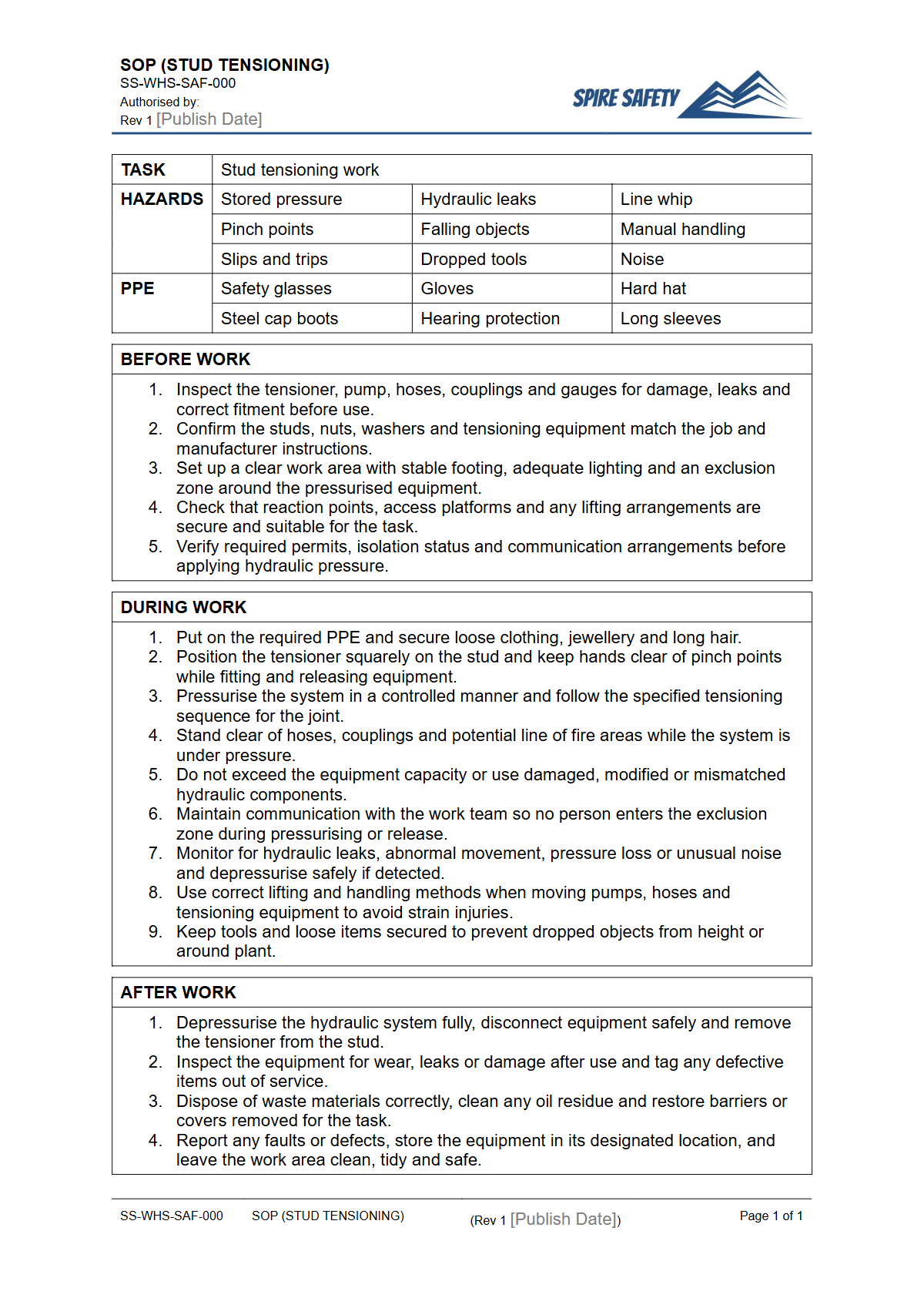
This Free Safe Operating Procedure (Stud Tensioning) Template provides a structured starting point for documenting the safety requirements for bolt and stud tensioning tasks. Stud tensioning is a high-risk activity that uses high-pressure hydraulic equipment to apply a precise, controlled axial load to fasteners.
A formal SOP is crucial for managing the significant hazards involved, including hydraulic fluid injection, uncontrolled release of stored energy, and equipment failure. Using a standardised procedure helps ensure that all personnel follow a consistent, safe method of work, reducing the likelihood of injuries and ensuring the integrity of bolted connections.
A well-defined SOP forms a critical part of a broader safety framework. It serves as a key tool for operator training, competency assessments, and task supervision.
Integrating this procedure into a robust WHS management system helps demonstrate your organisation's commitment to proactively managing workplace risks associated with high-pressure equipment.
Key Hazards in Stud Tensioning
The process of stud tensioning introduces several serious hazards that must be controlled. Your SOP should explicitly address:
- High-Pressure Hydraulics: Hydraulic systems for tensioning operate at extreme pressures, often exceeding 10,000 psi. A pinhole leak in a hose or fitting can eject fluid at a velocity high enough to penetrate skin and cause severe injection injuries, which are medical emergencies.
- Stored Energy: Both the hydraulic system and the stretched stud contain significant amounts of stored energy. Uncontrolled release due to component failure or improper procedure can result in projectiles, violent whipping of hoses, or catastrophic failure of the connection.
- Dropped Objects: Tensioning often occurs at height or in awkward positions. Heavy equipment like tensioner load cells, pumps, and hoses can become dropped object hazards if not properly secured.
- Ergonomic Strain: Manual handling of heavy hydraulic pumps, tensioning heads, and hoses can lead to musculoskeletal injuries.
Documenting controls for these hazards is essential. For other high-risk industrial tasks, you may find our guidelines for Oxy-Acetylene use a useful reference for structuring similar safety documents.
Video walkthrough
How to use the Free Safe Operating Procedure (Stud Tensioning) Template
This template is available for download in both DOCX and PDF formats. The DOCX version is fully editable, allowing you to tailor the content to your specific operational needs.
To effectively use this document, you should gather information on the specific stud tensioning equipment in use, the types of flanges or structures being worked on, and the environment where the work occurs. Populate the template with step-by-step instructions, pre-start checks, required PPE, and emergency procedures relevant to your site.
Important: This document is a template and is not a complete or ready-to-use Safe Operating Procedure. It is essential that you customise this SOP in consultation with the workers who perform the task, their supervisors, and any relevant safety professionals.
We are not responsible for the outcomes of any work performed using a procedure based on this template. Your final document should accurately reflect the unique risks and control measures of your specific workplace.
Once implemented, the effectiveness of your procedure should be regularly reviewed. You can verify its practical application and worker adherence through workplace inspections and WHS compliance audits.
When to use a Safe Operating Procedure for Stud Tensioning
A specific SOP for stud tensioning should be used whenever this task is performed. It is not limited to a single industry and is critical in any setting involving the assembly of high-integrity bolted joints. Common applications include:
- Assembly and maintenance of pipeline flanges in the oil, gas, and water industries.
- Work on pressure vessels, heat exchangers, and reactors in processing plants.
- Erection of structural steel for buildings, bridges, and other large structures.
- Assembly and maintenance of wind turbines.
- Heavy equipment maintenance and repair, particularly on large engines and earthmoving machinery.
On large construction or maintenance sites, the movement of tensioning equipment may require mechanical aid. Incorporating safe lifting practices by using our Telehandler SOP template for associated tasks can help manage these related risks.
Who should use it
This SOP is designed for use by various personnel within an organisation to ensure a shared understanding of safe work practices. Key users include:
- Operators and Technicians: As a direct, step-by-step guide for performing the stud tensioning task safely and correctly.
- Supervisors and Team Leaders: For conducting pre-task briefings (toolbox talks), verifying operator competency, and monitoring work to ensure the procedure is followed.
- WHS Advisors and Managers: As a foundational document for risk assessments, training programs, and incident investigations related to stud tensioning activities.
- Maintenance Planners and Engineers: To ensure safety requirements are built into maintenance and project work packs from the planning stage.
The safe operation of all plant on site is critical. For other common equipment, consider adapting documents like our free Air Compressor SOP to build a comprehensive library of procedures.
By providing a clear and detailed procedure, this template helps ensure that everyone involved in stud tensioning operations has the information they need to work safely. Feel free to explore our complete free WHS resources library for more templates to support your safety management system.
Common mistakes
Common mistakes to avoid
- Using incorrect pressure settings or exceeding the equipment's maximum operating pressure.
- Failing to conduct a thorough pre-start inspection of all hoses, couplings, and seals for wear or damage.
- Standing directly in line with the stud (the 'line of fire') during pressurisation and de-pressurisation.
- Not fully releasing stored pressure from the system before attempting to disconnect hydraulic couplings.
Legal references
Legal considerations
The following legal requirements may be relevant to this type of work.
- Work Health and Safety Act (Harmonised) — Provides the primary duties for protecting workers and other people from work health and safety risks.
- Work Health and Safety Regulations (Harmonised) — Sets out requirements supporting the management of workplace hazards and risks.
The following codes may be relevant to this type of work.
- Managing WHS Risks Code of Practice — Provides practical guidance on identifying hazards, assessing risks and applying effective controls.
- Work Health and Safety Consultation, Cooperation and Coordination Code of Practice — Provides practical guidance on consulting workers and coordinating with other duty holders.
- Managing the Work Environment and Facilities Code of Practice — Provides practical guidance on safe work environments, workplace facilities and related controls.
Did you know
Extreme Pressure
A leak from a high-pressure hydraulic line can inject fluid into the skin at speeds exceeding the muzzle velocity of a rifle, causing severe and often irreversible injuries that require immediate specialist medical attention.
Incredible Force
Hydraulic stud tensioners can generate forces over 4,500 kilonewtons—equivalent to the weight of three semi-trailers—to stretch a single large-diameter stud before the nut is secured.
FAQ
Frequently asked questions
01What are the main hazards of hydraulic stud tensioning?
02Is a Safe Work Method Statement (SWMS) required for stud tensioning?
03What training is needed to operate stud tensioning equipment?
04How often should stud tensioning equipment be inspected?
Share this resource
Free Safe Operating Procedure (Stud Tensioning) Template
Browse Categories
How To Use It
- 1Download and open in Word or PDF.
- 2Replace the placeholders with your business details.
- 3Get it reviewed by a WHS specialist before rollout.
Need it customised?
Our WHS consultants can adapt this template to your site, run a gap analysis, or audit what you already have in place.
Book a Free Consultation WHS consulting servicesor call 1300 156 382
Related templates
- Free Safe Operating Procedure (Stud Welder) Template
- Free Safe Operating Procedure (Stump Grinder Operation) Template
- Free Safe Operating Procedure (Stump Pulling) Template
- Free Safe Operating Procedure (Submersible Pump) Template
- Free Safe Operating Procedure (Substation Access) Template
- Free Safe Operating Procedure (Substation Cleaning) Template