
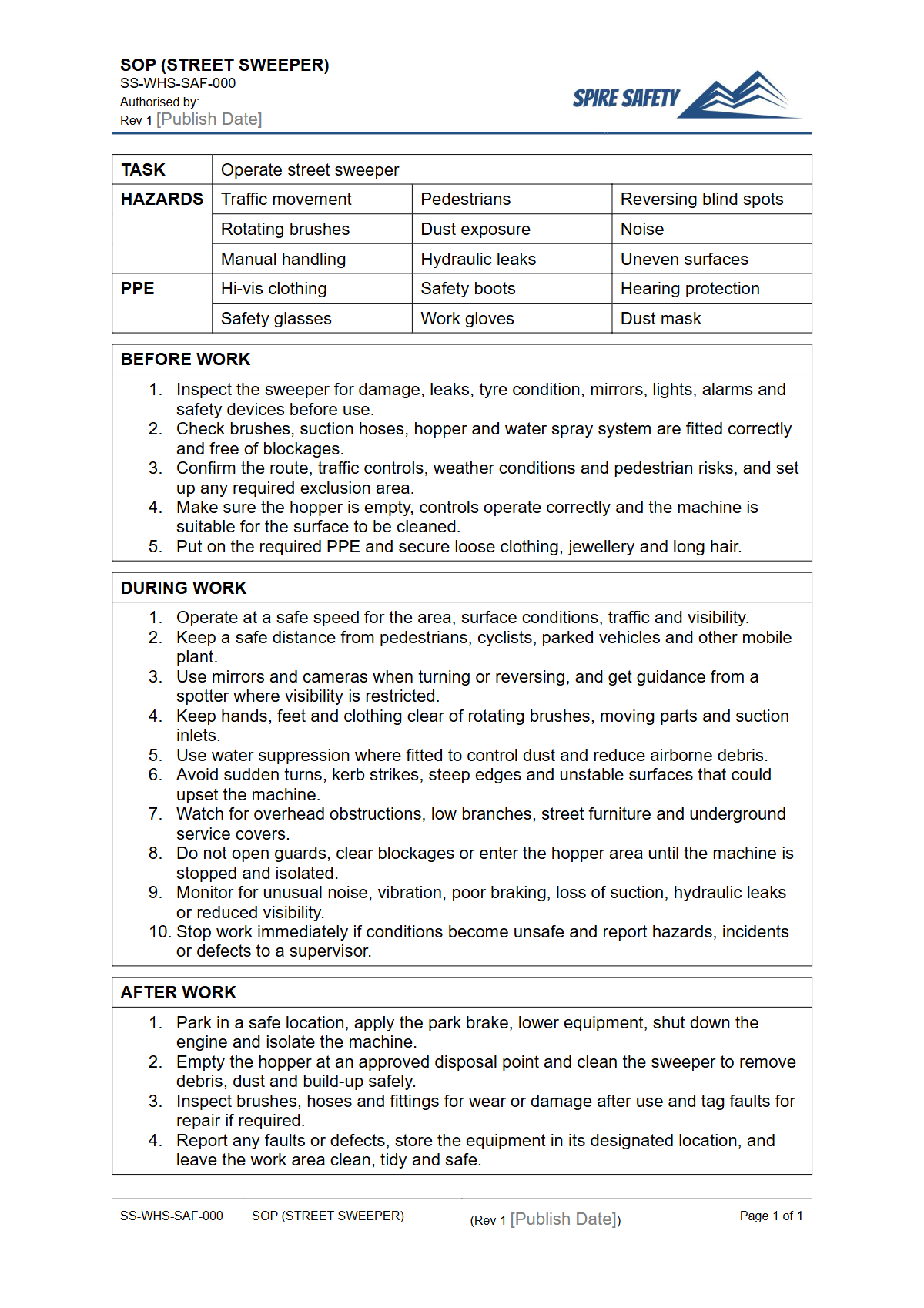
Free Safe Operating Procedure (Street Sweeper) Template
Operating a street sweeper involves specific risks that require clear instructions. Download our free Street Sweeper Safe Operating Procedure template.
Free Safe Operating Procedure (Street Sweeper) Template
DOCX • 126 KB + PDF
Updated Oct 2026
No signup required
Purpose of the Free Safe Operating Procedure (Street Sweeper) Template
Operating a street sweeper, like any mobile plant, exposes workers and the public to significant risks if not managed correctly. This Free Safe Operating Procedure (Street Sweeper) Template provides a structured foundation for documenting the safest way to perform tasks associated with street sweeper operations.
A comprehensive SOP is a key administrative control that helps organisations meet their duty of care under Australian WHS laws. It formalises pre-operational checks, safe operational steps, and shutdown procedures to minimise risks such as collisions with vehicles or pedestrians, exposure to hazardous dust (like silica), ergonomic injuries, and mechanical failures.
By clearly defining expectations and procedures, this SOP helps ensure that all operators perform tasks consistently and safely. It serves as a critical training tool for new employees and a reference for experienced operators.
Implementing a robust SOP is a fundamental component of effective WHS management systems, demonstrating a proactive approach to risk management. For complex sites or operations with unique hazards, you may need to seek professional advice from WHS consulting services to ensure all risks are adequately controlled.
Video walkthrough
How to use the Free Safe Operating Procedure (Street Sweeper) Template
This document is a template, not a finished product. To make it effective, you must customise it to reflect the specific circumstances of your workplace.
This involves a collaborative process of consultation with the people who actually operate the equipment. Your customisation should detail the specific make and model of the street sweeper, the unique site conditions (e.g., public roads, construction sites, car parks), and the specific traffic management plans in place.
Important Note: We have provided this template as a starting point. It is essential that you adapt it by consulting with your workers and incorporating your specific site hazards, machine controls, and risk control measures.
Generic procedures are insufficient; your final SOP must be a practical, site-specific document that your team understands and follows.
When adapting this SOP, consider the hierarchy of controls. Can you eliminate or substitute certain hazards?
For example, using wet sweeping methods to suppress dust is an engineering control that is more effective than relying solely on Personal Protective Equipment (PPE). Reviewing SOPs for other mobile plant, such as our Scraper SOP template, can provide additional context on structuring procedures for heavy machinery.
When to use a Safe Operating Procedure
A Safe Operating Procedure for a street sweeper should be a living document, integrated into your daily operations. It should be used in several key situations:
- Operator Training: It forms the basis of training for new and existing operators, ensuring they are competent before using the machinery.
- Pre-Start Checks: Operators should reference the SOP daily before commencing work to complete all required safety and maintenance checks.
- Risk Assessments: The SOP is a vital input when conducting or reviewing a plant and equipment risk assessment for street sweeping tasks.
- Incident Investigations: Following an incident or near-miss, the SOP should be reviewed to identify if the procedure was followed and if it needs revision.
- Audits and Reviews: Procedures should be reviewed periodically (e.g., annually) or whenever there is a change in equipment, environment, or legislation. This is often a key activity during WHS compliance audits.
Who should use this Safe Operating Procedure
This template is designed for use by various personnel within an organisation to promote a safe system of work. Key users include:
- Persons Conducting a Business or Undertaking (PCBUs): To help fulfil their primary duty of care to ensure the health and safety of workers.
- Managers and Supervisors: To train, supervise, and monitor operators, ensuring they adhere to the established safe procedures.
- WHS/HSE Professionals: To develop, implement, and review safety documentation as part of the overall WHS management system.
- Operators: As a direct guide for performing their work safely and for conducting necessary pre-operational checks and maintenance.
Ensuring all relevant personnel are trained on and have easy access to the finalised SOP is crucial for its effectiveness. You can find more templates and tools to support your safety framework in our complete free WHS resources library.
Common mistakes
Common mistakes to avoid
- Using the generic template without customising it for the specific sweeper model and site conditions.
- Failing to consult with and properly train operators on the finalised, site-specific SOP.
- Operators skipping the documented pre-start checks, leading to mechanical failures or safety system faults.
- Neglecting to integrate the SOP with broader traffic management plans, increasing the risk of collisions.
Legal references
Legal considerations
The following legal requirements may be relevant to this type of work.
- Work Health and Safety Act (Harmonised) — Provides the primary duties for protecting workers and other people from work health and safety risks.
- Work Health and Safety Regulations (Harmonised) — Sets out requirements supporting the management of workplace hazards and risks.
The following codes may be relevant to this type of work.
- Managing WHS Risks Code of Practice — Provides practical guidance on identifying hazards, assessing risks and applying effective controls.
- Work Health and Safety Consultation, Cooperation and Coordination Code of Practice — Provides practical guidance on consulting workers and coordinating with other duty holders.
- Managing the Work Environment and Facilities Code of Practice — Provides practical guidance on safe work environments, workplace facilities and related controls.
Did you know
Invisible Danger
Street sweeping can generate significant amounts of respirable crystalline silica (RCS) from concrete and road dust. Prolonged inhalation is a serious health hazard, making dust suppression controls (like water sprays) a critical part of the SOP.
Noise Exposure
Operators of street sweepers can be exposed to noise levels exceeding the Australian exposure standard of 85 dB(A). An SOP should specify hearing protection and other controls to manage the risk of noise-induced hearing loss.
FAQ
Frequently asked questions
01What key information should be included in a Street Sweeper SOP?
02Is a Safe Operating Procedure a legal requirement for street sweepers in Australia?
03How often should a Street Sweeper SOP be reviewed?
04Who is responsible for writing and approving a Street Sweeper SOP?
Share this resource
Free Safe Operating Procedure (Street Sweeper) Template
Browse Categories
How To Use It
- 1Download and open in Word or PDF.
- 2Replace the placeholders with your business details.
- 3Get it reviewed by a WHS specialist before rollout.
Need it customised?
Our WHS consultants can adapt this template to your site, run a gap analysis, or audit what you already have in place.
Book a Free Consultation WHS consulting servicesor call 1300 156 382
Related templates
- Free Safe Operating Procedure (Stud Tensioning) Template
- Free Safe Operating Procedure (Stud Welder) Template
- Free Safe Operating Procedure (Stump Grinder Operation) Template
- Free Safe Operating Procedure (Stump Pulling) Template
- Free Safe Operating Procedure (Submersible Pump) Template
- Free Safe Operating Procedure (Substation Access) Template