
Free Safe Operating Procedure (Street Garden Care) Template
Manage risks associated with public gardening and landscaping tasks. Download our free Safe Operating Procedure for Street Garden Care to get started.
Free Safe Operating Procedure (Street Garden Care) Template
DOCX • 126 KB + PDF
Updated Oct 2026
No signup required
Purpose of the Free Safe Operating Procedure (Street Garden Care) Template
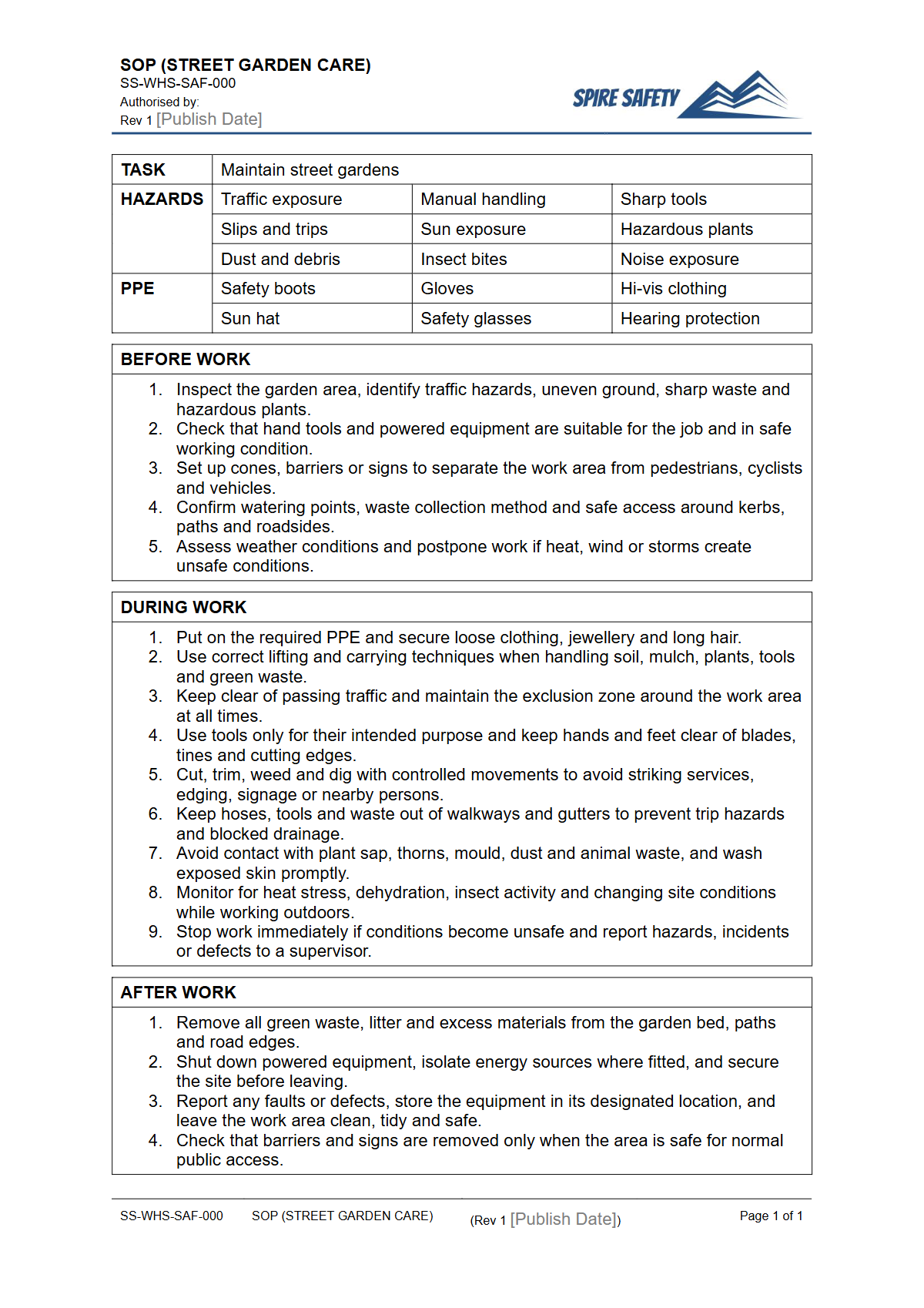
This Free Safe Operating Procedure (Street Garden Care) Template provides a structured framework for documenting the risks and control measures associated with maintaining public green spaces, community gardens, or verge plantings. A Safe Operating Procedure (SOP) is a critical document that outlines a step-by-step process for performing a task safely, helping to ensure all workers, including volunteers, understand their obligations.
By standardising procedures, organisations can significantly reduce the risk of injury from hazards like manual tasks, tool use, and public interaction. Implementing robust SOPs is a cornerstone of effective WHS management systems, demonstrating a commitment to health and safety.
Video walkthrough
How to use the Free Safe Operating Procedure (Street Garden Care) Template
Our Safe Operating Procedure template for Street Garden Care is available for immediate download in both DOCX and PDF formats. The DOCX version is fully editable, allowing you to tailor the content to your specific site, tools, and team.
It is essential that you customise this document to reflect the unique environment and tasks of your project. We've included common hazards and controls as a starting point, but your own risk assessment process must inform the final version.
For tasks involving specific equipment, you may also need separate procedures, such as our FREE Circular Saw SOP (Safe Operating Procedure) Template for when constructing garden beds or planters.
A note on customisation
This document is a template and not a complete Safe Operating Procedure. It is your responsibility to ensure it is adapted to your specific workplace, equipment, and environment.
A generic SOP that doesn't account for site-specific risks offers little protection. We are not liable for any incidents that may occur from the use of this document.
When to use it
An SOP for street garden care should be developed and implemented before any work begins on a new project. It serves as a key training and induction tool for new staff or volunteers and a reference point for established team members.
The procedure should be readily accessible on-site during all work activities. It is particularly important when multiple people are involved, tasks are complex, or the work occurs in an area with public access, high traffic, or other external hazards.
If you are unsure how to integrate this document into your broader safety framework, engaging with a WHS consulting service can provide clarity and direction.
Who should use it
This template is designed for use by any Person Conducting a Business or Undertaking (PCBU) responsible for street gardening activities. This includes local councils, community organisations, non-profits, and body corporates. The final, customised SOP should be used by:
- Managers and Supervisors: To train workers and volunteers, induct new team members, and supervise work to ensure it complies with the established procedure.
- Workers and Volunteers: To understand the safe way to perform tasks, recognise hazards, and implement control measures correctly.
- WHS Representatives: To assist in the development, review, and communication of the procedure.
Key Hazards in Street Garden Care
Your risk assessment should identify site-specific hazards. Common risks to consider for street gardening include:
- Manual Tasks: Lifting heavy bags of soil, digging, bending, and repetitive motions can lead to musculoskeletal injuries.
- Tools and Equipment: Lacerations from saws, secateurs, and shovels; noise exposure from mowers or trimmers; and risks from powered equipment.
- Slips, Trips, and Falls: Caused by uneven ground, hoses, discarded tools, or wet surfaces.
- Environmental Factors: Sun exposure (UV radiation), heat stress, insect bites, and contact with poisonous plants.
- Chemicals: Exposure to herbicides, pesticides, or fertilisers through inhalation, ingestion, or skin contact. Using equipment like spreaders requires its own set of controls, as detailed in documents like our FREE Spreader SOP Template.
- Public Interaction: Hazards from pedestrians, cyclists, and vehicle traffic near the work area.
- Underground Services: Risk of striking gas lines, water pipes, or electrical cables when digging.
Essential Control Measures
Your SOP must detail the control measures to eliminate or minimise identified risks. These often include:
- Personal Protective Equipment (PPE): Mandating gloves, safety glasses, sun hats, high-visibility clothing, and enclosed footwear.
- Safe Work Practices: Proper lifting techniques, regular breaks, tool maintenance schedules, and clear communication protocols.
- Site Management: Using barriers or signage to delineate the work area, ensuring clear pathways, and managing traffic.
- Emergency Procedures: Clearly defining steps for first aid, incident reporting, and emergency contacts. Regular reviews of your procedures through a WHS compliance auditing process can ensure they remain effective and relevant.
Common mistakes
Common mistakes to avoid
- Using the template 'as is' without customising it for specific site hazards and tools.
- Failing to adequately train volunteers and workers on the finalised SOP.
- Not making the SOP easily accessible to workers at the location where the task is performed.
- Forgetting to review and update the SOP after a near-miss, incident, or change in work practice.
Legal references
Legal considerations
The following legal requirements may be relevant to this type of work.
- Work Health and Safety Act (Harmonised) — Provides the primary duties for protecting workers and other people from work health and safety risks.
- Work Health and Safety Regulations (Harmonised) — Sets out requirements supporting the management of workplace hazards and risks.
The following codes may be relevant to this type of work.
- Managing WHS Risks Code of Practice — Provides practical guidance on identifying hazards, assessing risks and applying effective controls.
- Work Health and Safety Consultation, Cooperation and Coordination Code of Practice — Provides practical guidance on consulting workers and coordinating with other duty holders.
- Managing the Work Environment and Facilities Code of Practice — Provides practical guidance on safe work environments, workplace facilities and related controls.
Did you know
Manual Handling Risk
Serious claims for musculoskeletal disorders resulting from manual handling account for a significant portion of all worker's compensation claims in Australia, highlighting a key risk in any gardening or landscaping task.
Dial Before You Dig
Before any excavation, including simple gardening tasks on a public verge, it is a critical safety step in Australia to contact 'Dial Before You Dig' to obtain plans for underground utilities like gas, water, and electricity.
FAQ
Frequently asked questions
01What should be included in a Street Garden Care SOP?
02Is a Safe Operating Procedure legally required for volunteer gardening groups?
03How often should an SOP for street gardening be reviewed?
04Can this template be used for commercial landscaping businesses?
Share this resource
Free Safe Operating Procedure (Street Garden Care) Template
Browse Categories
How To Use It
- 1Download and open in Word or PDF.
- 2Replace the placeholders with your business details.
- 3Get it reviewed by a WHS specialist before rollout.
Need it customised?
Our WHS consultants can adapt this template to your site, run a gap analysis, or audit what you already have in place.
Book a Free Consultation WHS consulting servicesor call 1300 156 382
Related templates
- Free Safe Operating Procedure (Street Litter Patrol) Template
- Free Safe Operating Procedure (Street Sign Cleaning) Template
- Free Safe Operating Procedure (Street Sweeper) Template
- Free Safe Operating Procedure (Stud Tensioning) Template
- Free Safe Operating Procedure (Stud Welder) Template
- Free Safe Operating Procedure (Stump Grinder Operation) Template