
Free Safe Operating Procedure (Street Litter Patrol) Template
Manage public space cleaning tasks safely and efficiently. Download our free Street Litter Patrol Safe Operating Procedure template to get started today.
Free Safe Operating Procedure (Street Litter Patrol) Template
DOCX • 126 KB + PDF
Updated Oct 2026
No signup required
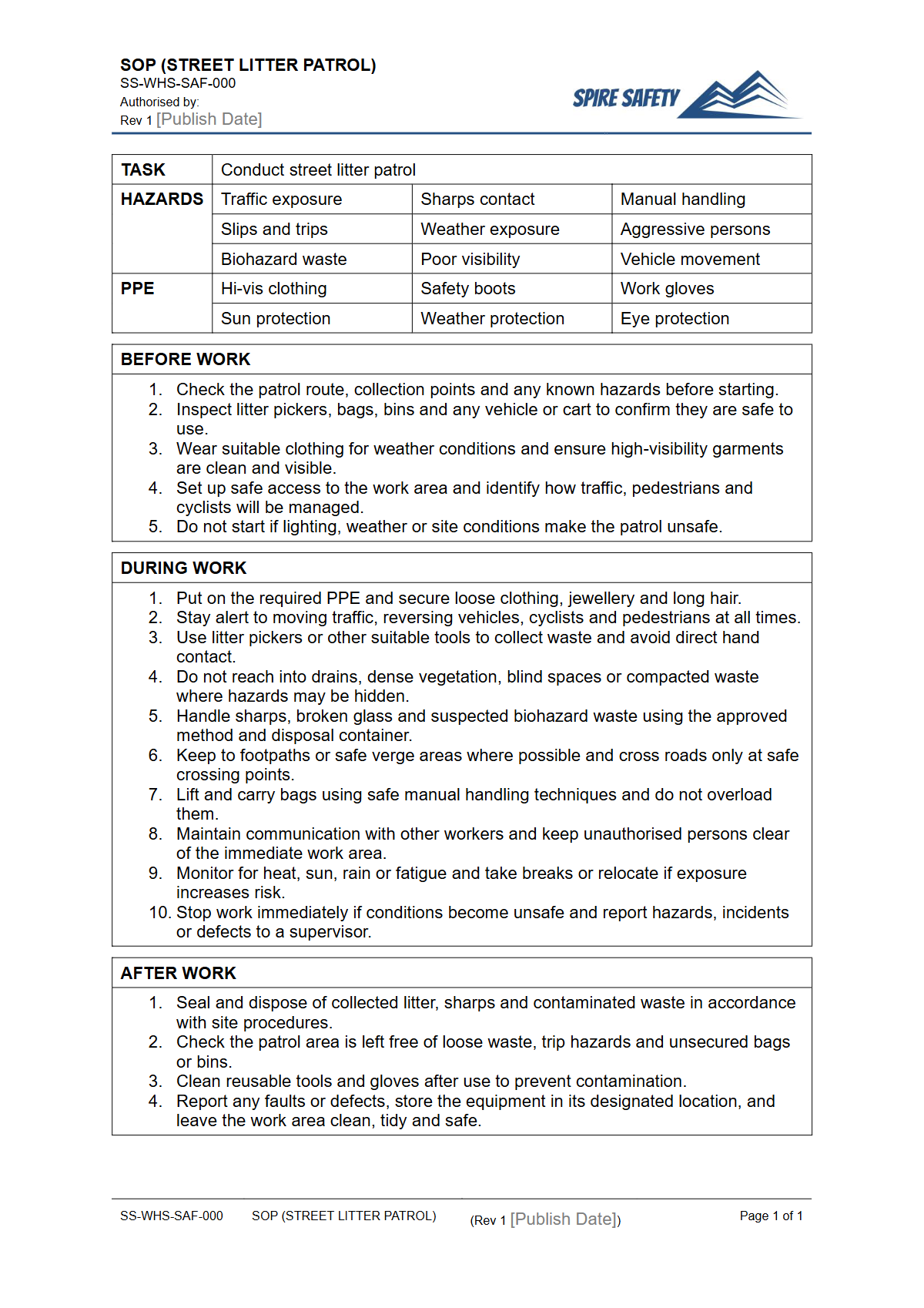
Purpose of the Free Safe Operating Procedure (Street Litter Patrol) Template
This Free Safe Operating Procedure (Street Litter Patrol) Template provides a structured framework for businesses and organisations to document the safety requirements for collecting litter from public spaces like streets, parks, and car parks. Its purpose is to clearly outline the step-by-step process, associated hazards, and essential control measures to ensure worker safety.
By implementing a formal SOP, you can minimise risks such as manual handling injuries, exposure to hazardous materials, and incidents involving traffic or the public. This document is a key component in demonstrating proactive safety management and forms an essential part of your overall WHS management systems, helping to standardise tasks and promote a consistent safety culture.
Video walkthrough
How to use the Free Safe Operating Procedure (Street Litter Patrol) Template
Our free template is provided in both DOCX and PDF formats for your convenience. The DOCX file is fully editable, allowing you to tailor the content to the unique conditions of your workplace.
It is crucial to adapt this document to reflect your specific operational environment, equipment, and local hazards. Generic procedures are insufficient; a site-specific risk assessment must inform the final SOP.
Important Note: This is a template only. We provide it as a starting point.
You MUST customise this document to suit the specific hazards, routes, equipment, and personnel at your workplace. You must consult with your workers during this process.
After customisation, the procedure should be reviewed and approved by a competent person before being used to train your team. Regular reviews of this procedure should also form part of your internal WHS compliance auditing schedule to ensure it remains current and effective.
Key Hazards in Street Litter Patrol
When customising your SOP, pay close attention to the common hazards associated with litter collection. Your control measures should directly address:
- Manual Handling: Lifting heavy bags, repetitive bending, and carrying equipment can lead to musculoskeletal injuries. Specify safe lifting techniques and weight limits.
- Sharps and Biohazards: Discarded needles, broken glass, and biological waste pose a significant risk of injury and infection. The SOP must include procedures for identifying and safely handling or reporting such items.
- Traffic Management: Workers operating near roadsides are exposed to live traffic. Detail requirements for high-visibility clothing, designated work zones, and safe crossing procedures.
- Public Interaction: Unpredictable behaviour from the public can create hazards. Include guidance on de-escalation and communication.
- Environmental Factors: Exposure to sun, heat, rain, and cold can lead to illness. Your SOP should specify controls like mandatory hydration breaks, sunscreen, and appropriate wet or cold weather gear.
- Waste Disposal: The final disposal of collected waste can involve different processes. At a larger facility, this might involve machinery governed by its own procedures, such as a FREE Conveyer System SOP.
When to use this Safe Operating Procedure
A Safe Operating Procedure for street litter patrol should be used consistently as part of your daily operations. It is not a document to be filed away and forgotten. Specifically, it should be used for:
- Worker Training and Induction: All new employees or contractors assigned to litter patrol duties must be trained on the contents of the SOP before starting work.
- Refresher Training: Use the SOP as the basis for periodic refresher training to reinforce safe work habits.
- Task Planning: Supervisors should reference the SOP when planning daily routes and assigning tasks.
- Incident Investigation: If an incident or near-miss occurs, the SOP should be reviewed as part of the investigation to identify any gaps or deficiencies.
Developing clear procedures for all routine but potentially hazardous tasks is a cornerstone of good WHS practice. Just as a workshop requires a documented process for equipment, so does outdoor work.
For instance, a maintenance depot might also use a Free Air Compressor SOP to manage risks associated with that specific task.
Who should use it
This Safe Operating Procedure template is designed for a range of users within an organisation responsible for public area maintenance and cleaning. This includes:
- WHS Managers and Safety Officers: To develop, implement, and review safety documentation as part of the broader safety system.
- Supervisors and Team Leaders: To train workers, conduct pre-start briefings, and monitor adherence to safe work practices on-site.
- Workers and Contractors: As a practical guide and reference for performing their duties safely and correctly.
Effectively integrating this SOP requires clear communication and robust training programs. For organisations looking for assistance in developing and rolling out comprehensive safety documentation across various roles, our WHS consulting services can provide expert guidance.
You can also explore our complete free WHS resources library for other templates and guides to support your safety management efforts.
Common mistakes
Common mistakes to avoid
- Failing to customise the template for specific routes or locations.
- Not consulting with the workers who actually perform the patrol.
- Treating the SOP as a 'tick-and-flick' document instead of a live training tool.
- Forgetting to include procedures for unusual but foreseeable events (e.g., finding hazardous waste or interacting with aggressive members of the public).
Legal references
Legal considerations
The following legal requirements may be relevant to this type of work.
- Work Health and Safety Act (Harmonised) — Provides the primary duties for protecting workers and other people from work health and safety risks.
- Work Health and Safety Regulations (Harmonised) — Sets out requirements supporting the management of workplace hazards and risks.
The following codes may be relevant to this type of work.
- Managing WHS Risks Code of Practice — Provides practical guidance on identifying hazards, assessing risks and applying effective controls.
- Work Health and Safety Consultation, Cooperation and Coordination Code of Practice — Provides practical guidance on consulting workers and coordinating with other duty holders.
- Managing the Work Environment and Facilities Code of Practice — Provides practical guidance on safe work environments, workplace facilities and related controls.
Did you know
Administrative Controls
Safe Operating Procedures (SOPs) are considered an 'administrative control' in the hierarchy of risk controls. They are a formal method of providing information and instruction to workers to reduce risk.
Litter Costs
According to Keep Australia Beautiful, managing litter costs Australian governments and communities hundreds of millions of dollars each year, highlighting the importance of efficient and safe collection operations.
FAQ
Frequently asked questions
01What should be included in a Street Litter Patrol SOP?
02How often should a Safe Operating Procedure be reviewed?
03Who is responsible for writing a Safe Operating Procedure?
04Is this template enough to be compliant with WHS laws?
Share this resource
Free Safe Operating Procedure (Street Litter Patrol) Template
Browse Categories
How To Use It
- 1Download and open in Word or PDF.
- 2Replace the placeholders with your business details.
- 3Get it reviewed by a WHS specialist before rollout.
Need it customised?
Our WHS consultants can adapt this template to your site, run a gap analysis, or audit what you already have in place.
Book a Free Consultation WHS consulting servicesor call 1300 156 382
Related templates
- Free Safe Operating Procedure (Street Sign Cleaning) Template
- Free Safe Operating Procedure (Street Sweeper) Template
- Free Safe Operating Procedure (Stud Tensioning) Template
- Free Safe Operating Procedure (Stud Welder) Template
- Free Safe Operating Procedure (Stump Grinder Operation) Template
- Free Safe Operating Procedure (Stump Pulling) Template