
Free Safe Operating Procedure (Straddle Carrier) Template
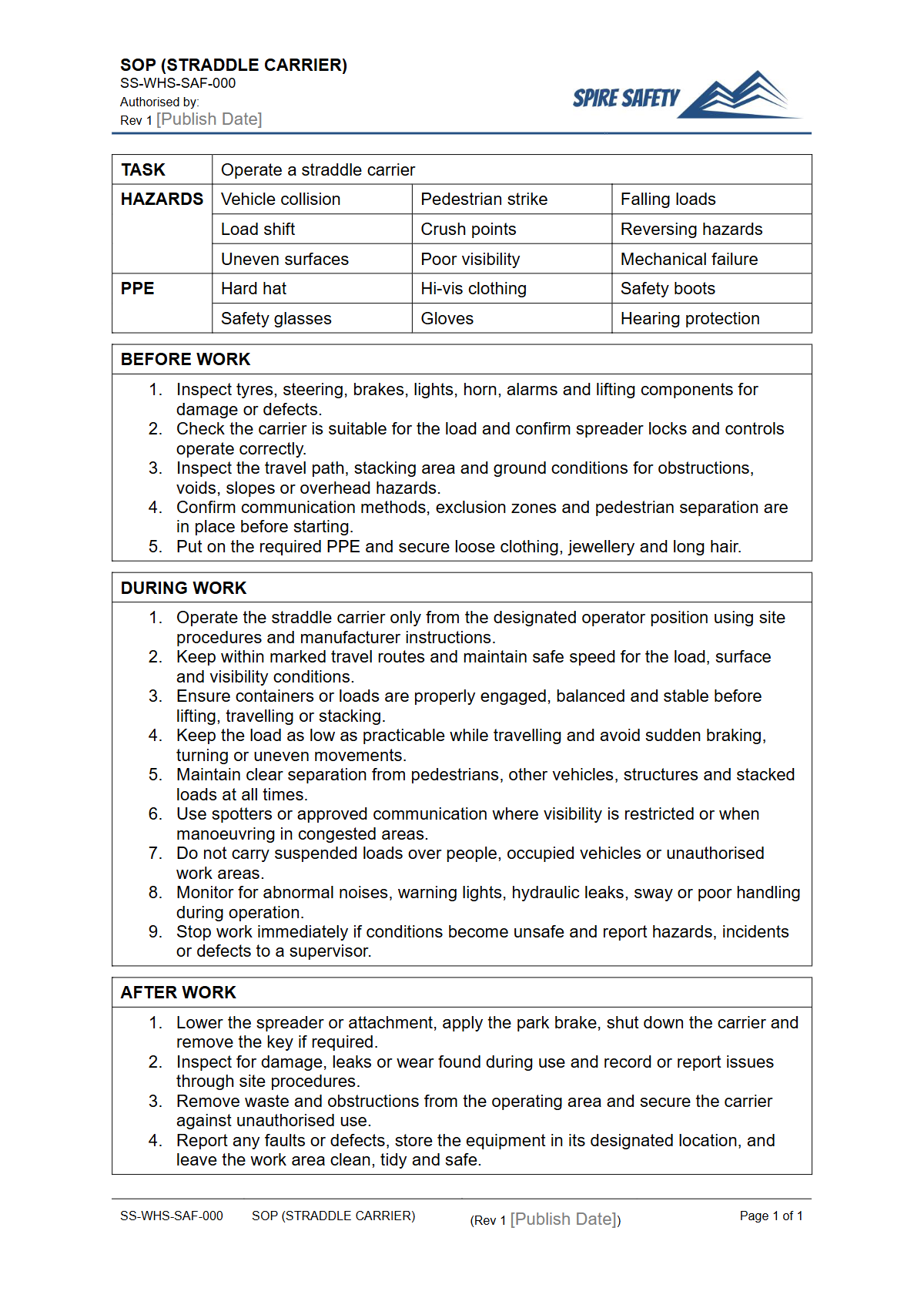
Effectively manage hazards associated with straddle carriers in your workplace. Download our free Safe Operating Procedure (Straddle Carrier) template today.
Free Safe Operating Procedure (Straddle Carrier) Template
DOCX • 126 KB + PDF
Updated Oct 2026
No signup required
Purpose of the Free Safe Operating Procedure (Straddle Carrier) Template
A Safe Operating Procedure (SOP) is a critical document that provides step-by-step instructions to help workers perform tasks safely and consistently. This Free Safe Operating Procedure (Straddle Carrier) Template is designed to help your organisation establish and document safe work methods for the operation of straddle carriers.
Using this template helps to identify potential hazards, outline control measures, and ensure all operators are aware of the required safety protocols, personal protective equipment (PPE), and emergency procedures. Properly implemented, an SOP is a key tool in minimising risks such as collisions, dropped loads, and pedestrian interaction.
This document provides a structured starting point aligned with Australian WHS principles, helping you meet your duty of care obligations. It forms a crucial part of a broader safety framework, similar to procedures for other heavy equipment. For example, if your site also uses telescopic handlers, you may find value in documenting procedures with resources like our free Telehandler SOP template.
Video walkthrough
How to use the Free Safe Operating Procedure (Straddle Carrier) Template
This template is provided in both DOCX and PDF formats for your convenience. The DOCX file is fully editable, allowing you to tailor the content to the specific models of straddle carriers used at your site, your unique operating environment, and your existing safety management system.
It is crucial that you customise this document to reflect your workplace's specific risks and control measures.
Important: We have provided a comprehensive framework, but for this document to be effective, you must consult with your workers and other relevant stakeholders. You need to conduct a site-specific risk assessment and incorporate its findings directly into the procedure.
This is not a one-size-fits-all solution; its effectiveness depends on your thorough customisation and implementation.
When to use a Straddle Carrier SOP
A Straddle Carrier SOP should be developed and implemented before any worker is permitted to operate the equipment. It should be used as a primary reference document during operator training and for ongoing competency verification.
The SOP should also be reviewed and updated whenever there is a change in equipment, processes, or workplace conditions. Following an incident or near-miss involving a straddle carrier, the SOP must be reviewed to determine if any updates are needed to prevent recurrence.
A robust SOP supports developing comprehensive WHS management systems that are proactive, not just reactive.
Straddle carriers are often used in environments with other complex machinery, like logistics hubs or manufacturing plants. It's good practice to have clear procedures for all major equipment; for instance, you might also require a Conveyer System SOP template to manage risks in the same area.
Who should use this Safe Operating Procedure
This Safe Operating Procedure should be used by several key groups within an organisation:
- Operators: To learn and follow the safe steps for operating the straddle carrier.
- Supervisors and Managers: To train workers, enforce safety standards, and conduct workplace inspections.
- WHS Professionals and Safety Committees: To develop, review, and update workplace safety documentation as part of the overall safety management system.
- Training Coordinators: As a foundational document for developing training programs and assessing operator competency.
Effectively managing documentation is a core part of safety governance. The processes outlined in this SOP can be evaluated through regular WHS compliance auditing to ensure they are being followed correctly and remain effective.
This template is just one of many procedures your site may need. If your operations involve earthmoving or construction tasks, you may also need documents like our FREE Trencher SOP Template to cover other types of mobile plant.
You can explore our complete collection in our free WHS resources library for more templates and guides.
Common mistakes
Common mistakes to avoid
- Failing to customise the template with site-specific details and risks.
- Neglecting to consult with operators and supervisors during the drafting process.
- Not providing adequate training on the finalised SOP to all relevant personnel.
- Failing to review and update the SOP after an incident or change in workplace conditions.
Legal references
Legal considerations
The following legal requirements may be relevant to this type of work.
- Work Health and Safety Act (Harmonised) — Provides the primary duties for protecting workers and other people from work health and safety risks.
- Work Health and Safety Regulations (Harmonised) — Sets out requirements supporting the management of workplace hazards and risks.
The following codes may be relevant to this type of work.
- Managing WHS Risks Code of Practice — Provides practical guidance on identifying hazards, assessing risks and applying effective controls.
- Work Health and Safety Consultation, Cooperation and Coordination Code of Practice — Provides practical guidance on consulting workers and coordinating with other duty holders.
- Managing the Work Environment and Facilities Code of Practice — Provides practical guidance on safe work environments, workplace facilities and related controls.
Did you know
Container Handling Giants
Modern straddle carriers used in port terminals can lift and stack containers weighing over 60 tonnes up to four containers high, making them essential but high-risk pieces of equipment in global logistics.
FAQ
Frequently asked questions
01What hazards should a Straddle Carrier SOP address?
02Is this template sufficient for WHS compliance?
03Who is responsible for writing a Safe Operating Procedure?
04How often should a Straddle Carrier SOP be reviewed?
Share this resource
Free Safe Operating Procedure (Straddle Carrier) Template
Browse Categories
How To Use It
- 1Download and open in Word or PDF.
- 2Replace the placeholders with your business details.
- 3Get it reviewed by a WHS specialist before rollout.
Need it customised?
Our WHS consultants can adapt this template to your site, run a gap analysis, or audit what you already have in place.
Book a Free Consultation WHS consulting servicesor call 1300 156 382
Related templates
- Free Safe Operating Procedure (Strapping Machine) Template
- Free Safe Operating Procedure (Street Garden Care) Template
- Free Safe Operating Procedure (Street Litter Patrol) Template
- Free Safe Operating Procedure (Street Sign Cleaning) Template
- Free Safe Operating Procedure (Street Sweeper) Template
- Free Safe Operating Procedure (Stud Tensioning) Template