
Free Safe Operating Procedure (Strapping Machine) Template
Download our free Safe Operating Procedure template for strapping machines, designed for Australian workplaces.
Free Safe Operating Procedure (Strapping Machine) Template
DOCX • 126 KB + PDF
Updated Oct 2026
No signup required
Purpose of the Free Safe Operating Procedure (Strapping Machine) Template
Effectively managing the risks associated with plant and equipment is a cornerstone of workplace safety. Our free Safe Operating Procedure (Strapping Machine) template provides a structured starting point for documenting the hazards and control measures specific to using semi-automatic and automatic strapping machines.
These machines are common in manufacturing, warehousing, and logistics, and while they improve efficiency, they also introduce risks such as entanglement, crushing, and cuts if not managed correctly. This SOP helps you formalise procedures to ensure workers understand how to operate the equipment safely, minimising the chance of injury.
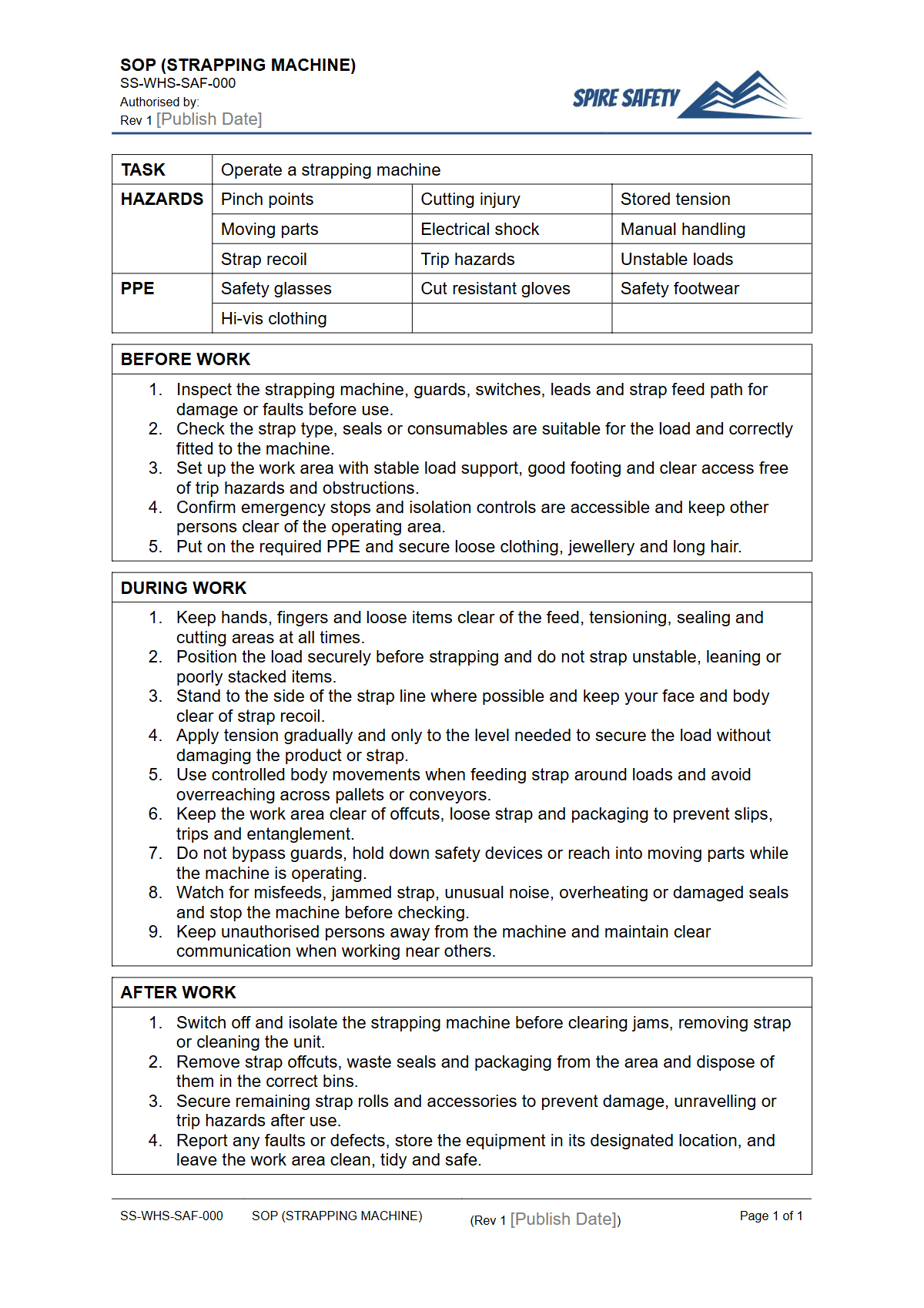
This document is designed as a clear, step-by-step guide that outlines pre-operational checks, operational steps, and post-operational tasks. It also prompts the inclusion of required Personal Protective Equipment (PPE) and emergency procedures.
By using this template, you can create a practical tool that helps meet your WHS obligations for providing safe systems of work. A well-developed SOP is a critical component of worker training and induction, particularly for machinery that is often integrated with other equipment like a conveyer system Safe Operating Procedure would cover.
Video walkthrough
How to use the Free Safe Operating Procedure (Strapping Machine) Template
This resource is available for download as a DOCX file for easy editing and a PDF for quick reference. It is not a complete, off-the-shelf solution but a comprehensive framework that you must adapt to your specific circumstances.
Different models of strapping machines have unique features, controls, and hazards.
To use the template effectively:
- Conduct a thorough risk assessment on the specific strapping machine in your workplace. Identify all potential hazards through its entire lifecycle of use.
- Consult with the machine operators, supervisors, and any health and safety representatives. Their direct experience is invaluable for creating a practical and effective procedure.
- Modify the document to include details specific to your machine, such as manufacturer, model, location, and unique safety features like interlocks or emergency stops.
- Clearly state the type of strapping material (e.g., polypropylene, polyester, steel) and the required PPE, such as safety glasses and gloves.
- Once customised, use the final document as a key part of your training program. Ensure all operators read, understand, and sign off on the SOP before they are authorised to use the machine.
Important: This template provides a base structure aligned with Australian WHS principles. To be effective, we strongly recommend that you customise this document by incorporating the specific details of your machinery, site-specific hazards, and internal procedures you have developed.
When to use a Strapping Machine SOP
A Safe Operating Procedure for a strapping machine should be a living document, used consistently throughout your operations. It is not a file to be completed once and forgotten.
It should be directly referenced during worker inductions for new employees and as a core part of task-specific training for anyone assigned to operate the equipment. It also serves as a crucial refresher tool during periodic safety training or toolbox talks.
Furthermore, the SOP must be reviewed and updated following any incident or near-miss, if the machine is modified, or if the process of strapping products changes. Regular reviews ensure it remains relevant and effective, which is a key goal of robust WHS management systems.
Who Should Use This Procedure
This Safe Operating Procedure is intended for multiple groups within an organisation. WHS managers and supervisors will use it as a foundational document for risk management and training development.
They are responsible for ensuring it is accurately completed, reviewed, and implemented. Team leaders and frontline supervisors use the SOP to train operators and to monitor daily work practices, ensuring the documented safe procedures are being followed.
Most importantly, the machine operators themselves are the primary end-users. The SOP provides them with clear, unambiguous instructions on how to perform their tasks safely, protecting them and their colleagues from harm. Many strapping machines use compressed air for tensioning, so operators may also need to be familiar with a corresponding air compressor Safe Operating Procedure.
Maintaining and Reviewing Your SOP
An SOP is only valuable if it is accurate and up-to-date. Establish a regular review cycle, typically annually, to ensure the procedure still reflects the current task and equipment.
A review should also be triggered by specific events, such as the introduction of a new model of strapping machine, a change in the type of goods being strapped, or recommendations arising from a safety audit. Involving operators in the review process is critical, as they can provide practical feedback on whether the procedure is still effective and practical. Documenting these reviews is a key part of demonstrating continuous improvement in your safety practices and can be verified through professional WHS compliance auditing services.
Common mistakes
Common mistakes to avoid
- Failing to de-energise and lock out the machine before attempting to clear a strap jam.
- Manually feeding the strap into the machine's feed mechanism while it is powered on.
- Not wearing safety glasses, exposing operators to the significant risk of eye injury from a snapping strap.
- Using the incorrect size or grade of strapping for the machine, which can cause frequent jams and equipment damage.
Legal references
Legal considerations
The following legal requirements may be relevant to this type of work.
- Work Health and Safety Act (Harmonised) — Provides the primary duties for protecting workers and other people from work health and safety risks.
- Work Health and Safety Regulations (Harmonised) — Sets out requirements supporting the management of workplace hazards and risks.
The following codes may be relevant to this type of work.
- Managing WHS Risks Code of Practice — Provides practical guidance on identifying hazards, assessing risks and applying effective controls.
- Work Health and Safety Consultation, Cooperation and Coordination Code of Practice — Provides practical guidance on consulting workers and coordinating with other duty holders.
- Managing the Work Environment and Facilities Code of Practice — Provides practical guidance on safe work environments, workplace facilities and related controls.
Did you know
Strap Tension
Polypropylene strapping can be tensioned with forces exceeding 200kg. A failure at this tension can release significant stored energy, making approved eye protection an absolute necessity for operators.
Friction Welding
Many modern strapping machines don't use metal clips. Instead, they use high-frequency vibrations to create friction, which melts and fuses the ends of the plastic strap together in a 'friction weld'.
FAQ
Frequently asked questions
01Is a Safe Operating Procedure legally required for a strapping machine in Australia?
02What are the main hazards of using a strapping machine?
03How often should a strapping machine SOP be reviewed?
04Can I use this template for both semi-automatic and fully automatic strapping machines?
Share this resource
Free Safe Operating Procedure (Strapping Machine) Template
Browse Categories
How To Use It
- 1Download and open in Word or PDF.
- 2Replace the placeholders with your business details.
- 3Get it reviewed by a WHS specialist before rollout.
Need it customised?
Our WHS consultants can adapt this template to your site, run a gap analysis, or audit what you already have in place.
Book a Free Consultation WHS consulting servicesor call 1300 156 382
Related templates
- Free Safe Operating Procedure (Street Garden Care) Template
- Free Safe Operating Procedure (Street Litter Patrol) Template
- Free Safe Operating Procedure (Street Sign Cleaning) Template
- Free Safe Operating Procedure (Street Sweeper) Template
- Free Safe Operating Procedure (Stud Tensioning) Template
- Free Safe Operating Procedure (Stud Welder) Template