
Free Safe Operating Procedure (Stormwater Debris Clear) Template
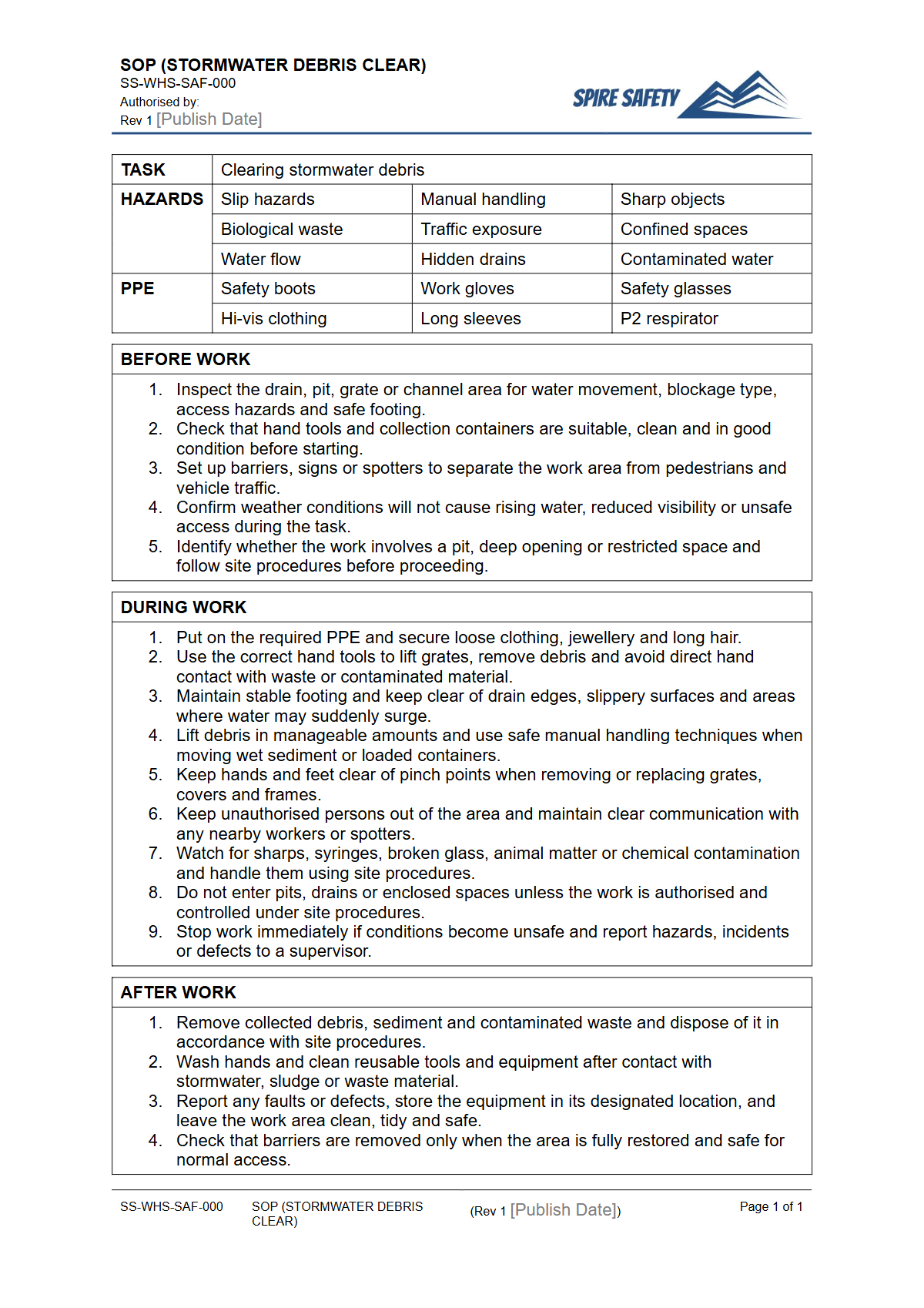
Download our free Safe Operating Procedure for stormwater debris clearing. This customisable template helps you outline step-by-step safety controls for this task.
Free Safe Operating Procedure (Stormwater Debris Clear) Template
DOCX • 126 KB + PDF
Updated Oct 2026
No signup required
Purpose of the Free Safe Operating Procedure (Stormwater Debris Clear) Template
Clearing debris from stormwater drains, pits, and channels is a critical maintenance task for preventing flooding and managing water quality. However, it introduces significant workplace hazards.
This free Safe Operating Procedure (Stormwater Debris Clear) Template provides a structured framework to help your organisation document a safe system of work for this activity. It prompts you to consider risks such as manual handling injuries from lifting heavy grates, slips and falls on wet surfaces, exposure to contaminated water, and unexpected encounters with hazardous materials or wildlife.
Using a documented SOP ensures that all workers follow a consistent, pre-assessed method, significantly reducing the likelihood of incidents. It forms a key part of your risk management process by identifying hazards, outlining control measures, and specifying the required personal protective equipment (PPE).
A thorough procedure demonstrates a commitment to health and safety and provides a clear training resource for employees.
Video walkthrough
How to use the Free Safe Operating Procedure (Stormwater Debris Clear) Template
This downloadable DOCX file is a starting point, not a finished document. You must adapt it to your specific site conditions, equipment, and legal obligations. To effectively use this template, follow these steps:
- Download the document and review its sections.
- Conduct a site-specific risk assessment for the stormwater clearing tasks your team performs.
- Consult with your workers. Their firsthand experience is invaluable for identifying practical hazards and effective controls.
- Customise the template by adding your company details, specific locations, types of debris, and the exact equipment used on your site.
- Detail the step-by-step process, from pre-start checks and securing the area to the final clean-up and waste disposal.
- Specify the required PPE, emergency procedures, and training requirements.
- Integrate the finished SOP into your broader safety framework. A well-written procedure is a vital component of robust WHS management systems.
- Train all relevant workers on the finalised SOP and document their training.
Important: This document is a template and must be customised to meet the specific needs and conditions of your workplace. We are not responsible for the implementation or the outcomes of your customised document. Regular reviews are essential to ensure ongoing effectiveness, and these can be checked during formal WHS compliance auditing.
When to use it
This Safe Operating Procedure should be used whenever workers are required to manually or mechanically clear debris from any part of a stormwater drainage system. This includes:
- Routine preventative maintenance scheduled throughout the year, especially before predicted wet seasons.
- Reactive clearing following storms, heavy rainfall, or high wind events that deposit large amounts of leaf litter, branches, and sediment.
- Clearing blockages identified during routine site inspections.
- As part of larger civil construction or landscaping projects that involve drainage infrastructure.
Who should use it
This SOP is intended for use by any person or business responsible for maintaining property and infrastructure. This includes:
- Persons Conducting a Business or Undertaking (PCBUs): To meet their primary duty of care to provide a safe system of work.
- Managers and Supervisors: To ensure work is planned, supervised, and carried out safely and according to the procedure.
- Workers: Maintenance staff, groundskeepers, civil workers, and contractors who perform the clearing task must be trained in and follow the SOP.
Depending on the scale of the blockage, specialised equipment may be required. For major earthworks near drainage systems, a separate scraper SOP might be necessary.
Similarly, for significant digging, a trencher SOP provides guidance on safe excavation. If heavy grates or bulk bags of debris need to be moved, a telehandler SOP will outline the safe use of that machinery. For more templates and guides, explore our complete free WHS resources library.
Common mistakes
Common mistakes to avoid
- Underestimating the weight of water-logged debris or drain covers.
- Assuming the water is just 'rainwater' and not contaminated with chemicals, fuels, or pathogens.
- Failing to adequately secure the work area from vehicle traffic or pedestrians.
- Working alone without a communication plan, especially in isolated areas or during adverse weather.
Legal references
Legal considerations
The following legal requirements may be relevant to this type of work.
- Work Health and Safety Act (Harmonised) — Provides the primary duties for protecting workers and other people from work health and safety risks.
- Work Health and Safety Regulations (Harmonised) — Sets out requirements supporting the management of workplace hazards and risks.
The following codes may be relevant to this type of work.
- Managing WHS Risks Code of Practice — Provides practical guidance on identifying hazards, assessing risks and applying effective controls.
- Work Health and Safety Consultation, Cooperation and Coordination Code of Practice — Provides practical guidance on consulting workers and coordinating with other duty holders.
- Managing the Work Environment and Facilities Code of Practice — Provides practical guidance on safe work environments, workplace facilities and related controls.
Did you know
Urban Runoff
Up to 80% of the pollution in our waterways, including heavy metals, pesticides, and bacteria, is carried there by stormwater runoff from urban and industrial areas.
Manual Handling Risks
A standard 600x600mm galvanised steel drain grate can weigh over 30kg, posing a significant manual handling risk if not lifted correctly or with mechanical aids.
FAQ
Frequently asked questions
01What PPE is required for clearing stormwater debris?
02How often should stormwater drains be cleared?
03What are the main hazards of clearing stormwater drains?
04Does this SOP cover work in confined spaces?
Share this resource
Free Safe Operating Procedure (Stormwater Debris Clear) Template
Browse Categories
How To Use It
- 1Download and open in Word or PDF.
- 2Replace the placeholders with your business details.
- 3Get it reviewed by a WHS specialist before rollout.
Need it customised?
Our WHS consultants can adapt this template to your site, run a gap analysis, or audit what you already have in place.
Book a Free Consultation WHS consulting servicesor call 1300 156 382
Related templates
- Free Safe Operating Procedure (Stormwater Inlet Clean) Template
- Free Safe Operating Procedure (Stormwater Pit Access) Template
- Free Safe Operating Procedure (Stormwater Pit Check) Template
- Free Safe Operating Procedure (Straddle Carrier) Template
- Free Safe Operating Procedure (Strapping Machine) Template
- Free Safe Operating Procedure (Street Garden Care) Template