
Free Safe Operating Procedure (Stormwater Inlet Clean) Template
Download our Free Safe Operating Procedure (Stormwater Inlet Clean) Template to formalise your safety processes.
Free Safe Operating Procedure (Stormwater Inlet Clean) Template
DOCX • 126 KB + PDF
Updated Oct 2026
No signup required
Purpose of the Free Safe Operating Procedure (Stormwater Inlet Clean) Template
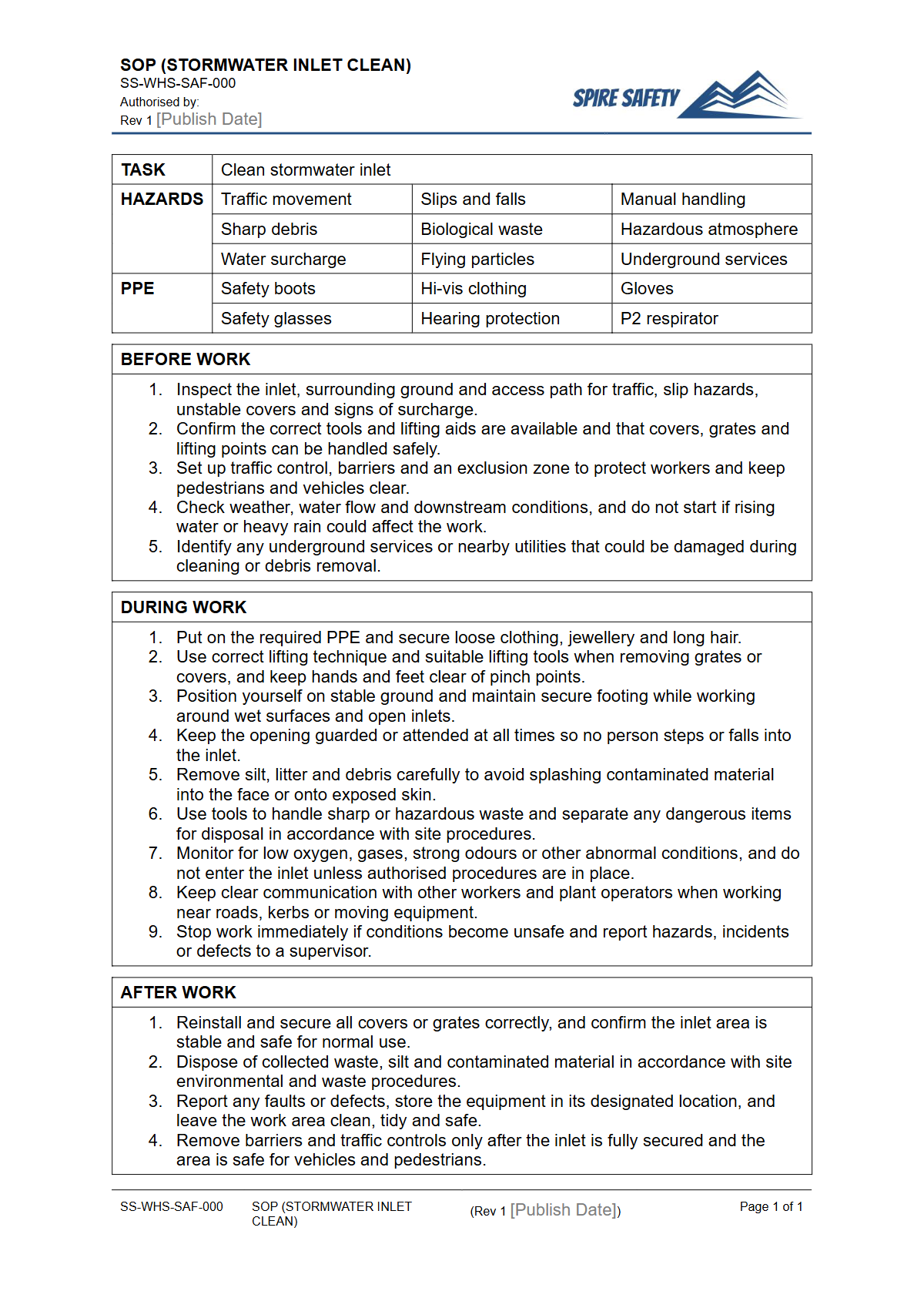
This Free Safe Operating Procedure (Stormwater Inlet Clean) Template provides a structured framework for businesses to document the required safety steps for cleaning and maintaining stormwater drains, pits, and inlets. The primary purpose of a Safe Operating Procedure (SOP) is to ensure tasks are performed consistently and safely every time, minimising the risk of injury to workers and damage to the environment.
It serves as a vital tool for training, supervision, and incident investigation.
Cleaning stormwater inlets involves significant hazards, including manual handling of heavy grates, exposure to biological and chemical contaminants, potential for engulfment, and risks from nearby traffic. This template guides you in outlining the controls for these risks, ensuring all personnel are aware of the correct sequence of operations, required Personal Protective Equipment (PPE), and emergency procedures.
By formalising your process, you demonstrate a commitment to a safe system of work and proactive risk management.
Key Safety Considerations
A comprehensive SOP for this task should address specific hazards such as:
- Manual Handling: Lifting heavy grates, shovelling sludge and debris.
- Confined Spaces: Some larger pits or drains may be classified as a confined space, requiring specific entry permits and procedures.
- Biological Hazards: Contact with stagnant water, decaying organic matter, animal waste, and pathogens.
- Traffic Management: Working near roads, car parks, or active worksites.
- Environmental Contamination: Correctly disposing of collected pollutants and preventing them from re-entering waterways.
- Tools and Equipment: Safe use of shovels, gully rakes, pressure washers, or vacuum trucks. For tasks involving digging or excavation, workers must also be trained on plant like that covered in our free Trencher SOP template.
Video walkthrough
How to use the Free Safe Operating Procedure (Stormwater Inlet Clean) Template
Our template is available as a fully editable DOCX file and a print-ready PDF. To get the most value, download the DOCX version and integrate it into your existing safety management system.
A well-developed SOP is a cornerstone of effective WHS management systems, providing clear instructions to your team.
Important: This document is a template only. It must be customised to reflect the specific equipment, chemical products, site conditions, and risks present in your workplace.
We recommend a competent person, in consultation with workers who perform the task, completes a site-specific risk assessment and adapts this procedure accordingly. Failure to tailor the SOP to your unique operational context can undermine its effectiveness and may not adequately control all identified risks.
When to use it
This Safe Operating Procedure should be developed, approved, and implemented before any worker undertakes the task of cleaning a stormwater inlet. It should be readily available at the point of work and used for several key activities:
- Worker Training and Induction: To ensure new and existing employees understand the approved safe method for the task.
- Pre-start Meetings: As a reference during toolbox talks to review hazards and controls before work begins.
- Routine Maintenance: For scheduled cleaning as part of a preventative maintenance program.
- Incident Response: Following heavy rainfall or a spill event that causes blockages.
- Audits and Reviews: During safety inspections to verify that established procedures are being followed correctly.
Regularly reviewing and updating your SOP, at least annually or after any incident, is a critical part of maintaining its relevance and effectiveness. This process can be supported through professional WHS compliance auditing to identify any gaps in your safety processes.
Who should use it
This template is designed for use by a broad range of organisations and personnel responsible for property and infrastructure maintenance. This includes:
- Persons Conducting a Business or Undertaking (PCBUs): To meet their primary duty of care to provide safe systems of work.
- Facility and Property Managers: For overseeing maintenance contractors and ensuring safety compliance on their sites.
- Grounds Maintenance and Landscaping Teams: As the primary operators who perform the cleaning task.
- Civil Construction and Maintenance Crews: For managing stormwater infrastructure on construction sites or public land.
- WHS Managers and Safety Officers: As a tool to standardise procedures and facilitate risk management across the organisation.
Ultimately, any worker assigned to clean stormwater inlets must be trained in the final, customised procedure and deemed competent to perform the task safely. For tasks that involve clearing large areas of spoil or debris, operators might use machinery detailed in documents like our free Scraper SOP template. Similarly, if compressed air is part of the cleaning process, refer to a specific procedure like our free Air Compressor SOP for guidance on associated hazards.
You can find many other relevant documents in our free WHS resources library to build out your safety documentation.
Common mistakes
Common mistakes to avoid
- Failing to implement traffic control measures when working near roads or vehicle paths.
- Incorrectly assuming a drain is not a confined space without a formal assessment.
- Using poor manual handling techniques to lift heavy grates, leading to back injuries.
- Disposing of collected pollutants improperly, causing environmental harm.
Legal references
Legal considerations
The following legal requirements may be relevant to this type of work.
- Work Health and Safety Act (Harmonised) — Provides the primary duties for protecting workers and other people from work health and safety risks.
- Work Health and Safety Regulations (Harmonised) — Sets out requirements supporting the management of workplace hazards and risks.
The following codes may be relevant to this type of work.
- Managing WHS Risks Code of Practice — Provides practical guidance on identifying hazards, assessing risks and applying effective controls.
- Work Health and Safety Consultation, Cooperation and Coordination Code of Practice — Provides practical guidance on consulting workers and coordinating with other duty holders.
- Managing the Work Environment and Facilities Code of Practice — Provides practical guidance on safe work environments, workplace facilities and related controls.
Did you know
Urban Pollutants
Up to 70% of the pollution in our urban waterways is carried there by stormwater run-off. This includes litter, sediment, chemicals, and organic matter collected from roads, roofs, and gardens.
Gross Pollutant Traps (GPTs)
Many modern stormwater systems include Gross Pollutant Traps (GPTs), which are engineered structures designed to capture litter, sediment, and debris before it can enter natural waterways. Regular cleaning of these traps is a critical environmental protection task.
FAQ
Frequently asked questions
01What PPE is required for cleaning a stormwater inlet?
02Is a confined space entry permit needed for stormwater inlet cleaning?
03How often should stormwater inlets be cleaned?
04What is the difference between a SOP and a SWMS for this task?
Share this resource
Free Safe Operating Procedure (Stormwater Inlet Clean) Template
Browse Categories
How To Use It
- 1Download and open in Word or PDF.
- 2Replace the placeholders with your business details.
- 3Get it reviewed by a WHS specialist before rollout.
Need it customised?
Our WHS consultants can adapt this template to your site, run a gap analysis, or audit what you already have in place.
Book a Free Consultation WHS consulting servicesor call 1300 156 382
Related templates
- Free Safe Operating Procedure (Stormwater Pit Access) Template
- Free Safe Operating Procedure (Stormwater Pit Check) Template
- Free Safe Operating Procedure (Straddle Carrier) Template
- Free Safe Operating Procedure (Strapping Machine) Template
- Free Safe Operating Procedure (Street Garden Care) Template
- Free Safe Operating Procedure (Street Litter Patrol) Template