
Free Safe Operating Procedure (Stormwater Pit Access) Template
Download our free Safe Operating Procedure for stormwater pit access to formalise your safety processes.
Free Safe Operating Procedure (Stormwater Pit Access) Template
DOCX • 126 KB + PDF
Updated Oct 2026
No signup required
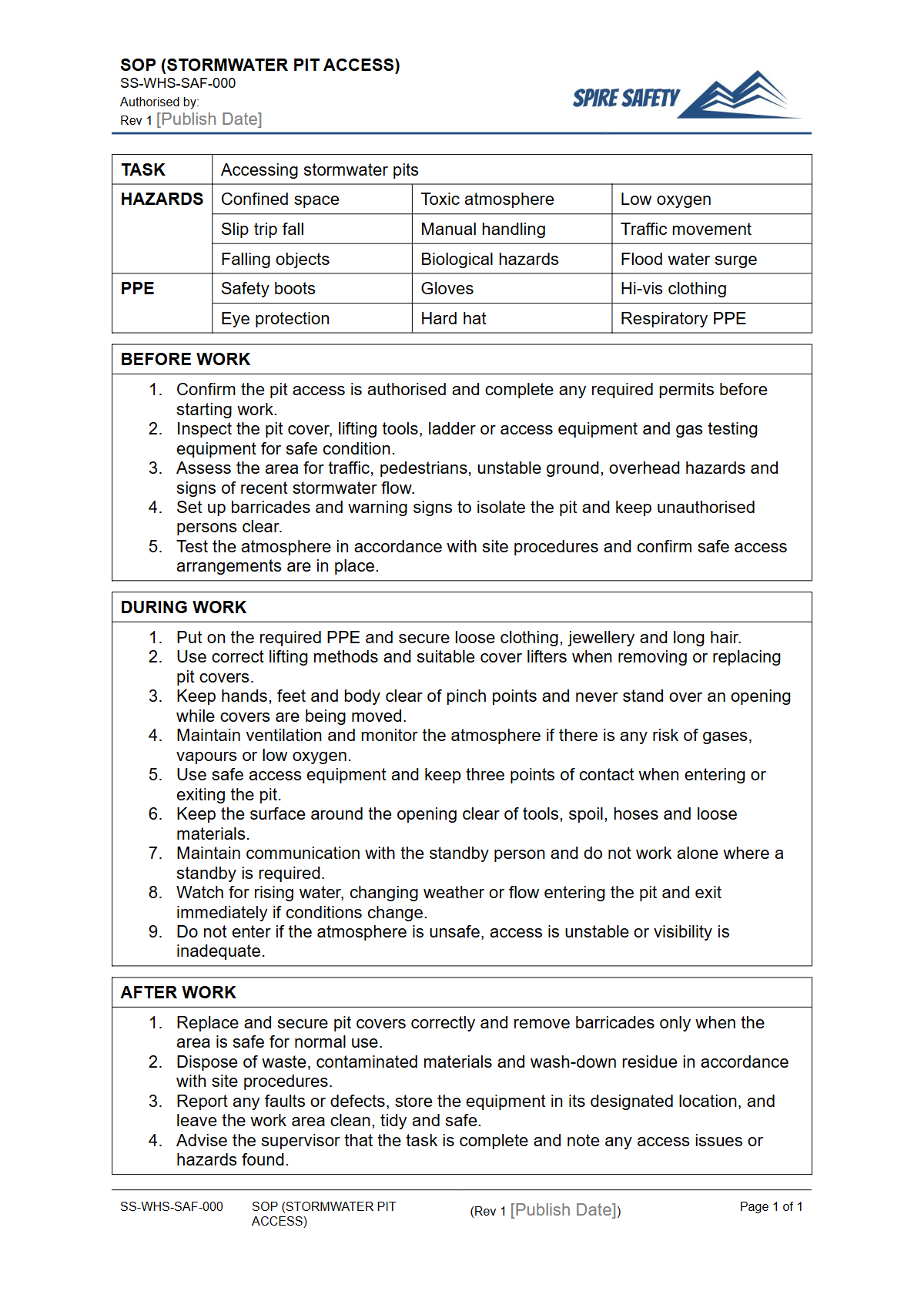
Purpose of the Free Safe Operating Procedure (Stormwater Pit Access) Template
Accessing stormwater pits and similar drainage structures presents significant, often underestimated, health and safety risks. This free Safe Operating Procedure (Stormwater Pit Access) Template provides a structured starting point for organisations to document the required safety controls for this high-risk task.
It is designed to guide you through the process of identifying hazards, assessing risks, and outlining a step-by-step method for workers to follow, ensuring their safety before, during, and after entry.
Using this template helps formalise your safety protocols, forming a critical component of a compliant safety management system. It prompts consideration of specific hazards such as atmospheric contamination, falls, engulfment, and biological agents.
Properly developed SOPs are a key element in establishing robust WHS management systems, demonstrating a commitment to proactive risk management.
Video walkthrough
How to use the Free Safe Operating Procedure (Stormwater Pit Access) Template
This template is provided in both DOCX and PDF formats for your convenience. After downloading, you must customise the document to reflect the specific circumstances of your workplace.
A generic procedure is not sufficient; effective safety relies on site-specific details. You will need to conduct a risk assessment for the task at your location and incorporate the findings into the SOP.
To make this document useful, we have included placeholder sections and general advice; however, you must replace these with information specific to your site, equipment, training protocols, and personnel. For example, detail the exact model of gas detector used, the anchor points for fall arrest systems, and the specific emergency contacts for your site.
A periodic WHS compliance auditing program can help verify that your customised procedures are being followed correctly and remain effective.
When to use it
A Safe Operating Procedure for stormwater pit access should be developed, approved, and used for training well before any work is scheduled to begin. It is a critical planning document, not a reactive piece of paperwork.
The SOP should be reviewed by all personnel involved in the task during a pre-start meeting or toolbox talk immediately before work commences. This ensures everyone is aligned on the risks and control measures.
This SOP is relevant for any task requiring a worker to break the plane of a pit opening, whether for inspection, cleaning, maintenance, or repair. For related excavation tasks, our FREE Trencher SOP Template may also be a useful reference.
Who should use it
This template is intended for use by a Person Conducting a Business or Undertaking (PCBU), site supervisors, project managers, and WHS professionals. These individuals are responsible for adapting the template and implementing the resulting procedure.
All workers and contractors who are required to access stormwater pits must be trained in the finalised SOP and deemed competent to perform the task safely. Worker consultation is a mandatory part of developing safety procedures, as their direct experience is invaluable for identifying practical risks and effective controls.
If you require expert assistance in developing or reviewing your safety documentation, our WHS consulting team can provide tailored support.
Key Hazards and Controls to Document
When customising this SOP, pay close attention to the hierarchy of controls. Focus on eliminating or isolating hazards before relying on administrative controls or PPE. Key areas to address include:
- Confined Space Classification: Determine if the pit meets the legal definition of a confined space, which will trigger specific requirements like entry permits and standby personnel.
- Atmospheric Hazards: Specify procedures for gas testing (oxygen, flammable gases, hydrogen sulphide, carbon monoxide) before and during entry.
- Fall Prevention: Detail the methods for preventing falls into the pit, such as guardrails, and the use of fall arrest systems if entry is required. Lifting heavy lids may require mechanical aids, and you might have procedures similar to those in a FREE Telehandler SOP (Safe Operating Procedure) Template.
- Emergency Rescue: A detailed, site-specific emergency rescue plan is non-negotiable. It must outline the steps for a non-entry rescue, the equipment required, and the designated, trained rescue personnel.
- Isolation of Services: Document the procedure for isolating any connected pipes or energy sources that could introduce substances or energy into the pit. Equipment like pumps might be powered by compressed air, so ensure procedures align with other on-site rules, such as those found in a Free Air Compressor SOP (Safe Operating Procedure) Template.
By thoroughly documenting these elements, you create a comprehensive guide that significantly improves worker safety. For more templates and safety guides, you can browse our complete free WHS resources library.
Common mistakes
Common mistakes to avoid
- Assuming an atmosphere is safe without testing, based on previous entries or the pit being open.
- Failing to develop a specific, tested, and achievable emergency rescue plan before entry.
- Neglecting to positively isolate all services that could introduce water, gas, or other hazards into the pit.
- Using inadequate or uninspected equipment for access, egress, gas detection, or rescue.
Legal references
Legal considerations
The following legal requirements may be relevant to this type of work.
- Work Health and Safety Act (Harmonised) — Provides the primary duties for protecting workers and other people from work health and safety risks.
- Work Health and Safety Regulations (Harmonised) — Sets out requirements supporting the management of workplace hazards and risks.
The following codes may be relevant to this type of work.
- Managing WHS Risks Code of Practice — Provides practical guidance on identifying hazards, assessing risks and applying effective controls.
- Work Health and Safety Consultation, Cooperation and Coordination Code of Practice — Provides practical guidance on consulting workers and coordinating with other duty holders.
- Managing the Work Environment and Facilities Code of Practice — Provides practical guidance on safe work environments, workplace facilities and related controls.
Did you know
The Rescuer Risk
A significant percentage of fatalities in confined spaces are not the initial entrants but the would-be rescuers who enter unprepared and without proper equipment in an attempt to save their colleagues.
Silent Danger
Hydrogen sulphide (H2S), a common and highly toxic gas in drainage systems, deadens the sense of smell at high concentrations. This means a worker might initially smell 'rotten eggs' but then notice the smell disappear, falsely believing the gas has dissipated when the danger has actually increased.
FAQ
Frequently asked questions
01What are the main hazards of accessing a stormwater pit?
02Is a permit required to enter a stormwater pit?
03What personal protective equipment (PPE) is needed for stormwater pit access?
04How often should a Safe Operating Procedure for stormwater pit access be reviewed?
Share this resource
Free Safe Operating Procedure (Stormwater Pit Access) Template
Browse Categories
How To Use It
- 1Download and open in Word or PDF.
- 2Replace the placeholders with your business details.
- 3Get it reviewed by a WHS specialist before rollout.
Need it customised?
Our WHS consultants can adapt this template to your site, run a gap analysis, or audit what you already have in place.
Book a Free Consultation WHS consulting servicesor call 1300 156 382
Related templates
- Free Safe Operating Procedure (Stormwater Pit Check) Template
- Free Safe Operating Procedure (Straddle Carrier) Template
- Free Safe Operating Procedure (Strapping Machine) Template
- Free Safe Operating Procedure (Street Garden Care) Template
- Free Safe Operating Procedure (Street Litter Patrol) Template
- Free Safe Operating Procedure (Street Sign Cleaning) Template