
Free Safe Operating Procedure (Storm Drain Inspection) Template
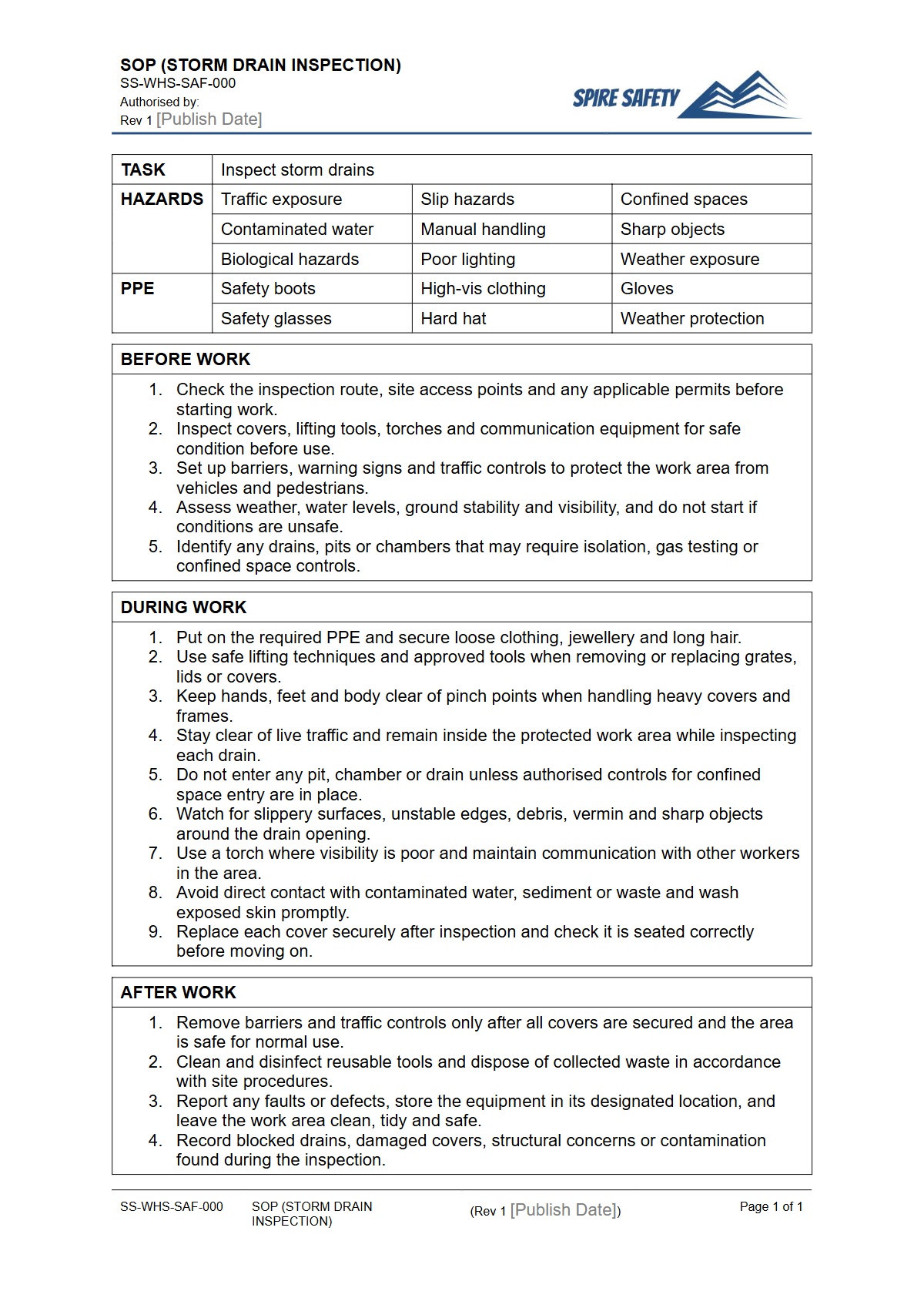
Download our free Safe Operating Procedure for storm drain inspections. This customisable template helps you outline hazards and controls for the task.
Free Safe Operating Procedure (Storm Drain Inspection) Template
DOCX • 126 KB + PDF
Updated Oct 2026
No signup required
Purpose of the Free Safe Operating Procedure (Storm Drain Inspection) Template
Effectively managing health and safety during maintenance work requires clear, documented procedures. This free Safe Operating Procedure (Storm Drain Inspection) Template provides a structured framework for outlining the steps to safely inspect storm water drainage systems.
Its primary purpose is to help you identify and control the specific risks associated with this task, ensuring workers have a clear guide to follow before and during operations.
Inspecting storm drains can expose workers to a range of serious hazards, including live traffic, falls from height or into the drain, hazardous atmospheres, manual handling injuries from lifting heavy grates, and exposure to biological or chemical contaminants. This SOP template prompts you to consider these risks and document the required control measures, such as traffic management plans, fall prevention equipment, gas detection protocols, and correct PPE.
Using a formal SOP helps a Person Conducting a Business or Undertaking (PCBU) fulfil their primary duty of care under Australian WHS law. For expert assistance in developing and implementing site-specific risk controls, consider our WHS consulting services.
Video walkthrough
How to use the Free Safe Operating Procedure (Storm Drain Inspection) Template
This document is available for immediate download in both DOCX and PDF formats. The DOCX file is fully editable, allowing you to adapt it to the unique conditions of your workplace.
To use it effectively, you should methodically work through each section, replacing the placeholder text with information specific to your site, the equipment being used, and the personnel involved.
Important: This is a template only. While it is aligned with Australian WHS practice, it must be customised to your specific workplace, equipment, and tasks.
We recommend a thorough risk assessment and consultation with your team before finalising and implementing the document.
Customisation is critical. This includes identifying the specific models of gas detectors, the type of traffic control devices required, and the emergency response procedures relevant to each location.
A robust SOP is a cornerstone of effective WHS management systems, transforming safety policy into practical, on-the-ground action.
When to use this Safe Operating Procedure
A Safe Operating Procedure for storm drain inspection should be implemented and used before any related work begins. It serves as a critical planning and safety tool in several scenarios, including:
- Routine maintenance and cleaning schedules for municipal or private drainage systems.
- Post-storm assessments to check for blockages, damage, or overflow.
- Pre-work checks before commencing major repairs or construction in the vicinity of a drain.
- As a training document for new employees or for conducting refresher training with experienced teams.
- As a reference guide for toolbox talks to review hazards and controls before starting a shift.
The SOP should also be readily available during the work itself for workers to reference. Furthermore, it serves as crucial evidence of your documented safety processes during internal or external audits. Regular procedural reviews are essential for continuous improvement, a process often verified through WHS compliance auditing.
Who should use this Safe Operating Procedure
This SOP is designed for use by all personnel involved in the storm drain inspection process. This includes:
- WHS Managers and Advisors: To establish a standardised, safe system of work and ensure it aligns with the organisation's overall safety framework.
- Supervisors and Team Leaders: To plan the work, assign responsibilities, conduct pre-start briefings, and ensure the specified controls are in place and being used correctly.
- Workers and Operators: As a step-by-step guide and pre-start checklist to ensure they are aware of all hazards and are following the prescribed safety measures throughout the task.
Consultation is key. The workers performing the inspections possess invaluable practical knowledge and must be involved in the drafting and review of the SOP.
Many storm drain systems are installed during groundworks, making related safety procedures relevant. For tasks involving excavation, our free Trencher SOP template may also be a useful resource.
By standardising your approach with a clear SOP, you foster a proactive safety culture and reduce the likelihood of incidents. For more templates covering a wide range of tasks and equipment, browse our complete free WHS resources library.
Common mistakes
Common mistakes to avoid
- Failing to implement adequate traffic management, exposing workers to live traffic.
- Assuming the atmosphere inside a drain is safe without conducting gas testing prior to removing the cover.
- Using the template without customising it for site-specific hazards and controls.
- Neglecting to check for underground services (e.g., electrical, gas) before probing or disturbing the area around the drain.
Legal references
Legal considerations
The following legal requirements may be relevant to this type of work.
- Work Health and Safety Act (Harmonised) — Provides the primary duties for protecting workers and other people from work health and safety risks.
- Work Health and Safety Regulations (Harmonised) — Sets out requirements supporting the management of workplace hazards and risks.
The following codes may be relevant to this type of work.
- Managing WHS Risks Code of Practice — Provides practical guidance on identifying hazards, assessing risks and applying effective controls.
- Work Health and Safety Consultation, Cooperation and Coordination Code of Practice — Provides practical guidance on consulting workers and coordinating with other duty holders.
- Managing the Work Environment and Facilities Code of Practice — Provides practical guidance on safe work environments, workplace facilities and related controls.
Did you know
Grate Weight
A standard cast iron storm drain grate can weigh over 100kg. This makes mechanical lifting aids or approved team lifting techniques essential to prevent serious musculoskeletal injuries.
Urban Flooding
Blocked or poorly maintained storm drains are a leading cause of localised urban flooding. Regular and, more importantly, safe inspections are critical for community infrastructure resilience.
FAQ
Frequently asked questions
01What are the main hazards involved in storm drain inspection?
02Is a Safe Operating Procedure a legal requirement in Australia?
03Can this template be used for confined space entry into drains?
04How often should our storm drain inspection SOP be reviewed?
Share this resource
Free Safe Operating Procedure (Storm Drain Inspection) Template
Browse Categories
How To Use It
- 1Download and open in Word or PDF.
- 2Replace the placeholders with your business details.
- 3Get it reviewed by a WHS specialist before rollout.
Need it customised?
Our WHS consultants can adapt this template to your site, run a gap analysis, or audit what you already have in place.
Book a Free Consultation WHS consulting servicesor call 1300 156 382
Related templates
- Free Safe Operating Procedure (Stormwater Debris Clear) Template
- Free Safe Operating Procedure (Stormwater Inlet Clean) Template
- Free Safe Operating Procedure (Stormwater Pit Access) Template
- Free Safe Operating Procedure (Stormwater Pit Check) Template
- Free Safe Operating Procedure (Straddle Carrier) Template
- Free Safe Operating Procedure (Strapping Machine) Template