
Free Safe Operating Procedure (Storeroom Deep Cleaning) Template
Download our free Safe Operating Procedure for storeroom deep cleaning to manage workplace hazards.
Free Safe Operating Procedure (Storeroom Deep Cleaning) Template
DOCX • 126 KB + PDF
Updated Oct 2026
No signup required
Purpose of the Free Safe Operating Procedure (Storeroom Deep Cleaning) Template
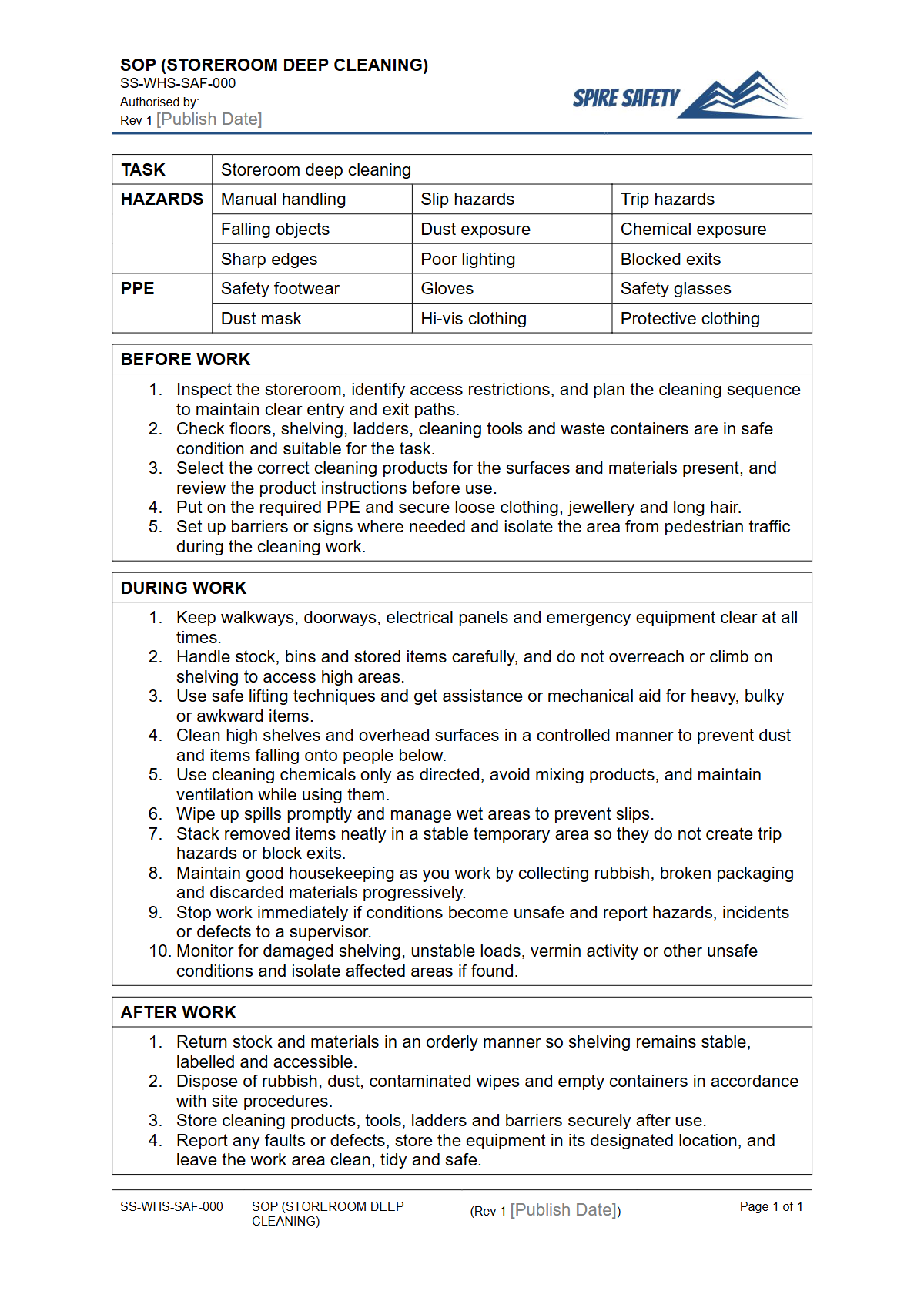
A storeroom deep clean involves more than simple tidying; it's a critical task that can introduce significant workplace hazards if not managed correctly. Our free Safe Operating Procedure (Storeroom Deep Cleaning) template provides a structured framework for outlining the risks and control measures associated with this task.
This document is designed to help you formalise a step-by-step process that ensures the health and safety of your workers. It prompts you to consider hazards such as chemical exposure from cleaning agents, manual handling risks from moving stock and shelving, electrical dangers from equipment, and slip, trip, and fall hazards.
Using this template helps standardise your cleaning process, making it an effective tool for worker training and inductions. By documenting the procedure, you create a clear reference point for expected safety behaviour and performance.
Systematically addressing each step, from preparation and PPE selection to waste disposal and emergency response, demonstrates a commitment to proactive risk management. Integrating this SOP into your wider WHS management systems is essential for building a consistent and robust safety culture across your organisation.
Video walkthrough
How to use the Free Safe Operating Procedure (Storeroom Deep Cleaning) Template
This Safe Operating Procedure template is available for immediate download in both DOCX and PDF formats. The DOCX version is fully editable, allowing you to tailor the content to the unique circumstances of your workplace.
To use it, simply download the file and open it in a compatible word processor. Work through each section, replacing the placeholder text with specific details relevant to your storeroom, equipment, and the cleaning chemicals you use.
Be sure to reference the Safety Data Sheet (SDS) for each chemical product.
Important: It's crucial to remember that this is a template, not a finished document. We strongly advise that you customise every section to reflect the specific chemicals, equipment, layout, and risks of your storeroom.
A generic SOP is insufficient for ensuring safety; its effectiveness depends entirely on its relevance to your site-specific conditions. Once customised, the SOP should be reviewed by a competent person, communicated to all relevant workers, and made easily accessible in the work area.
Regular reviews and checks are also vital. Engaging in a WHS compliance auditing process can help identify gaps between your documented procedures and actual work practices.
When to use it
A Safe Operating Procedure for storeroom deep cleaning should be developed and implemented before any such work commences. It is an essential planning document that should be used in several key situations:
- Periodic Cleaning: Before scheduled quarterly, bi-annual, or annual deep cleaning activities.
- Worker Training: As a primary training document for new employees or those newly assigned to cleaning duties.
- Refresher Training: For periodic refresher sessions to ensure consistent and safe work practices are maintained.
- Risk Assessments: As a reference during the WHS consulting and risk assessment process for cleaning tasks.
- Post-Incident: The SOP should be reviewed and updated following any incident or near-miss related to storeroom cleaning to prevent recurrence.
While this SOP covers general storeroom cleaning, you may need additional procedures for specific equipment used in the process. For example, if your storeroom is part of a logistics chain, you may also need a Conveyer System SOP.
Who should use it
This template is designed for a broad range of personnel responsible for workplace safety and operations. Primary users include:
- WHS Managers and Safety Officers: To develop and formalise safety documentation as part of the overall safety management system.
- Supervisors and Team Leaders: To train their teams, supervise the cleaning process, and enforce safe work standards.
- Business Owners: To meet their duty of care obligations under WHS legislation by ensuring safe systems of work are in place.
- Cleaning Staff and Maintenance Workers: As a practical, step-by-step guide to follow while performing their duties.
The document is applicable across various industries, including hospitality, retail, manufacturing, warehousing, and healthcare—anywhere a storeroom requires periodic, thorough cleaning. In large warehouse environments where staff interact with heavy machinery, procedures like a Telehandler SOP may be required in conjunction with cleaning protocols.
For those in hospitality, you may also find our Safe Operating Procedure for deep fryer operation useful. If this document isn't quite right, you can explore our complete free WHS resources library for other templates.
Common mistakes
Common mistakes to avoid
- Using generic, non-customised SOPs that don't reflect actual workplace conditions.
- Failing to review and update the SOP after an incident or when new cleaning chemicals are introduced.
- Not providing practical training to workers on the procedures outlined in the SOP.
- Forgetting to reference the specific Safety Data Sheets (SDS) for cleaning chemicals used.
Legal references
Legal considerations
The following legal requirements may be relevant to this type of work.
- Work Health and Safety Act (Harmonised) — Provides the primary duties for protecting workers and other people from work health and safety risks.
- Work Health and Safety Regulations (Harmonised) — Sets out requirements supporting the management of workplace hazards and risks.
The following codes may be relevant to this type of work.
- Managing WHS Risks Code of Practice — Provides practical guidance on identifying hazards, assessing risks and applying effective controls.
- Work Health and Safety Consultation, Cooperation and Coordination Code of Practice — Provides practical guidance on consulting workers and coordinating with other duty holders.
- Managing the Work Environment and Facilities Code of Practice — Provides practical guidance on safe work environments, workplace facilities and related controls.
Did you know
Slips, Trips, and Falls
Slips, trips, and falls are a leading cause of workplace injuries in Australia, with poor housekeeping and wet floors from cleaning activities being major contributors.
Chemical Safety
Under WHS regulations, employers must provide workers with information, training, and instruction on the safe use, storage, and handling of hazardous chemicals.
FAQ
Frequently asked questions
01What is a Safe Operating Procedure (SOP)?
02Are chemical handling procedures included in this template?
03Does this storeroom deep cleaning SOP cover manual handling?
04Is this template suitable for all industries?
Share this resource
Free Safe Operating Procedure (Storeroom Deep Cleaning) Template
Browse Categories
How To Use It
- 1Download and open in Word or PDF.
- 2Replace the placeholders with your business details.
- 3Get it reviewed by a WHS specialist before rollout.
Need it customised?
Our WHS consultants can adapt this template to your site, run a gap analysis, or audit what you already have in place.
Book a Free Consultation WHS consulting servicesor call 1300 156 382
Related templates
- Free Safe Operating Procedure (Storm Drain Cleaning) Template
- Free Safe Operating Procedure (Storm Drain Inspection) Template
- Free Safe Operating Procedure (Stormwater Debris Clear) Template
- Free Safe Operating Procedure (Stormwater Inlet Clean) Template
- Free Safe Operating Procedure (Stormwater Pit Access) Template
- Free Safe Operating Procedure (Stormwater Pit Check) Template