
Free Safe Operating Procedure (Stored Energy Release) Template
Effectively manage hazards from uncontrolled energy release with our free Safe Operating Procedure template.
Free Safe Operating Procedure (Stored Energy Release) Template
DOCX • 126 KB + PDF
Updated Oct 2026
No signup required
Purpose of the Free Safe Operating Procedure (Stored Energy Release) Template
Hazardous energy exists in many forms within the workplace, including electrical, mechanical, hydraulic, pneumatic, chemical, thermal, and gravitational energy. The unexpected release of this stored energy during servicing or maintenance can cause severe injuries or fatalities.
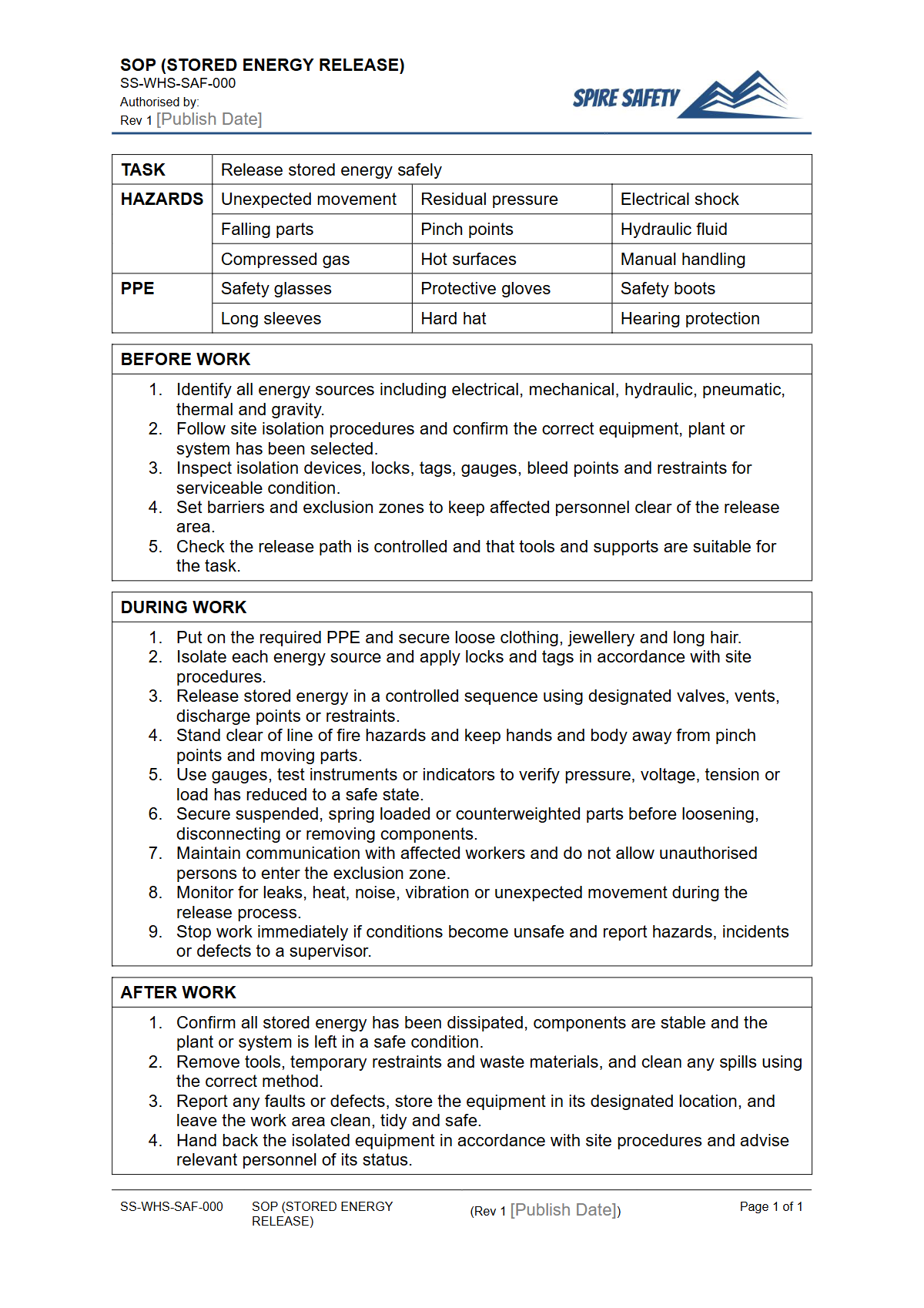
This Free Safe Operating Procedure (Stored Energy Release) Template provides a structured framework for developing a site-specific procedure to control these risks. It guides users in documenting the formal process for isolating and de-energising equipment, ensuring it cannot be restarted unexpectedly.
A well-documented SOP is a critical component of a company's safety management framework. It demonstrates a commitment to proactive risk management and forms part of the evidence for how an organisation meets its duty of care.
Integrating these procedures into broader WHS management systems ensures a consistent and systematic approach to workplace safety, moving beyond ad-hoc measures to a fully organised safety culture.
Video walkthrough
How to use the Free Safe Operating Procedure (Stored Energy Release) Template
This document is provided in both DOCX and PDF formats. The DOCX version is fully editable, allowing your organisation to adapt it to your specific machinery, operational environment, and legal obligations. To use the template effectively, follow these steps:
- Download: Select the DOCX file to begin customisation.
- Assess: Conduct a thorough risk assessment for the specific plant or equipment the SOP will cover. Identify all potential energy sources.
- Customise: Populate the template with details specific to your workplace. This includes identifying the exact machinery, isolation points, lockout/tagout (LOTO) devices to be used, and steps for verifying de-energisation. A common application is for equipment with pressurised systems, which is also covered in our free Air Compressor SOP template.
- Review and Approve: Have the draft procedure reviewed by competent persons, such as supervisors and the workers who will use it. Once finalised, it should be formally approved by management.
- Train: Ensure all relevant workers receive training on the specific procedures outlined in the finalised SOP.
Important: This is a template, not a finished document. We have provided a structured starting point, but you must customise it with your site-specific information to ensure it is effective and relevant to the risks in your workplace.
When to use a Stored Energy SOP
A Safe Operating Procedure for stored energy should be used whenever a worker is required to perform tasks such as maintenance, repairs, cleaning, inspection, or setup on a piece of plant or machinery. It is applicable in any situation where a worker could be harmed by the unexpected start-up of the equipment or the release of residual energy.
This includes tasks where a guard must be removed or a body part is placed into a danger zone.
Regular WHS compliance audits can help identify gaps in your safety systems and highlight specific tasks or equipment that require a formal stored energy SOP. This proactive process ensures that control measures are implemented before an incident occurs, rather than in response to one.
Who should use it
This SOP is intended for use by multiple roles within an organisation. Primarily, it is for 'authorised persons'—the workers who are trained and authorised to perform servicing and maintenance tasks that require energy isolation.
This often includes maintenance fitters, electricians, and specialised technicians. Supervisors and managers are responsible for ensuring the procedures are followed correctly and that workers are competent to perform the tasks.
Persons conducting a business or undertaking (PCBUs) have the ultimate responsibility to ensure safe systems of work are in place. This template assists them in fulfilling that duty.
The principles can be applied to a wide range of equipment, from simple machines to complex automated lines like those detailed in a Conveyer System SOP template. Every organisation with machinery that stores energy should have a documented procedure for its control. For specialised processes involving chemical and thermal energy, you might also require procedures like our free Oxy Acetylene SOP.
Developing and implementing these critical safety documents can be complex. Seeking expert WHS consulting can provide clarity and ensure your procedures are robust and aligned with industry best practice.
Find more templates and checklists in our free WHS resources library to continue building out your safety documentation.
Common mistakes
Common mistakes to avoid
- Assuming a machine is de-energised without testing to verify 'zero energy state'.
- Failing to dissipate or block residual energy, such as bleeding pneumatic lines or chocking wheels.
- Overlooking non-electrical energy sources like gravity, springs, or hydraulic pressure.
- Inadequate communication or handover procedures between shifts, leading to premature re-energisation.
Legal references
Legal considerations
The following legal requirements may be relevant to this type of work.
- Work Health and Safety Act (Harmonised) — Provides the primary duties for protecting workers and other people from work health and safety risks.
- Work Health and Safety Regulations (Harmonised) — Sets out requirements supporting the management of workplace hazards and risks.
The following codes may be relevant to this type of work.
- Managing WHS Risks Code of Practice — Provides practical guidance on identifying hazards, assessing risks and applying effective controls.
- Work Health and Safety Consultation, Cooperation and Coordination Code of Practice — Provides practical guidance on consulting workers and coordinating with other duty holders.
- Managing the Work Environment and Facilities Code of Practice — Provides practical guidance on safe work environments, workplace facilities and related controls.
Did you know
A Leading Cause of Injury
According to safe work authorities, failure to control hazardous energy accounts for a significant number of serious workplace injuries and fatalities each year, particularly during maintenance and servicing activities.
Beyond the 'Off' Switch
Simply turning a machine off is rarely enough to make it safe. Gravity can cause elevated parts to fall, and pressure can remain in pneumatic or hydraulic lines long after the power is disconnected, posing a significant hazard.
FAQ
Frequently asked questions
01What is stored energy in a WHS context?
02Is this template the same as a Lockout/Tagout (LOTO) procedure?
03Who is responsible for implementing the Stored Energy Release SOP?
04How often should our Stored Energy Release SOP be reviewed?
Share this resource
Free Safe Operating Procedure (Stored Energy Release) Template
Browse Categories
How To Use It
- 1Download and open in Word or PDF.
- 2Replace the placeholders with your business details.
- 3Get it reviewed by a WHS specialist before rollout.
Need it customised?
Our WHS consultants can adapt this template to your site, run a gap analysis, or audit what you already have in place.
Book a Free Consultation WHS consulting servicesor call 1300 156 382
Related templates
- Free Safe Operating Procedure (Storeroom Deep Cleaning) Template
- Free Safe Operating Procedure (Storm Drain Cleaning) Template
- Free Safe Operating Procedure (Storm Drain Inspection) Template
- Free Safe Operating Procedure (Stormwater Debris Clear) Template
- Free Safe Operating Procedure (Stormwater Inlet Clean) Template
- Free Safe Operating Procedure (Stormwater Pit Access) Template