
Free Safe Operating Procedure (Stockroom Trolley Use) Template
Formalise your stockroom safety with our free Safe Operating Procedure for trolley use. Download the customisable DOCX and PDF template to get started.
Free Safe Operating Procedure (Stockroom Trolley Use) Template
DOCX • 126 KB + PDF
Updated Oct 2026
No signup required
Purpose of the Free Safe Operating Procedure (Stockroom Trolley Use) Template
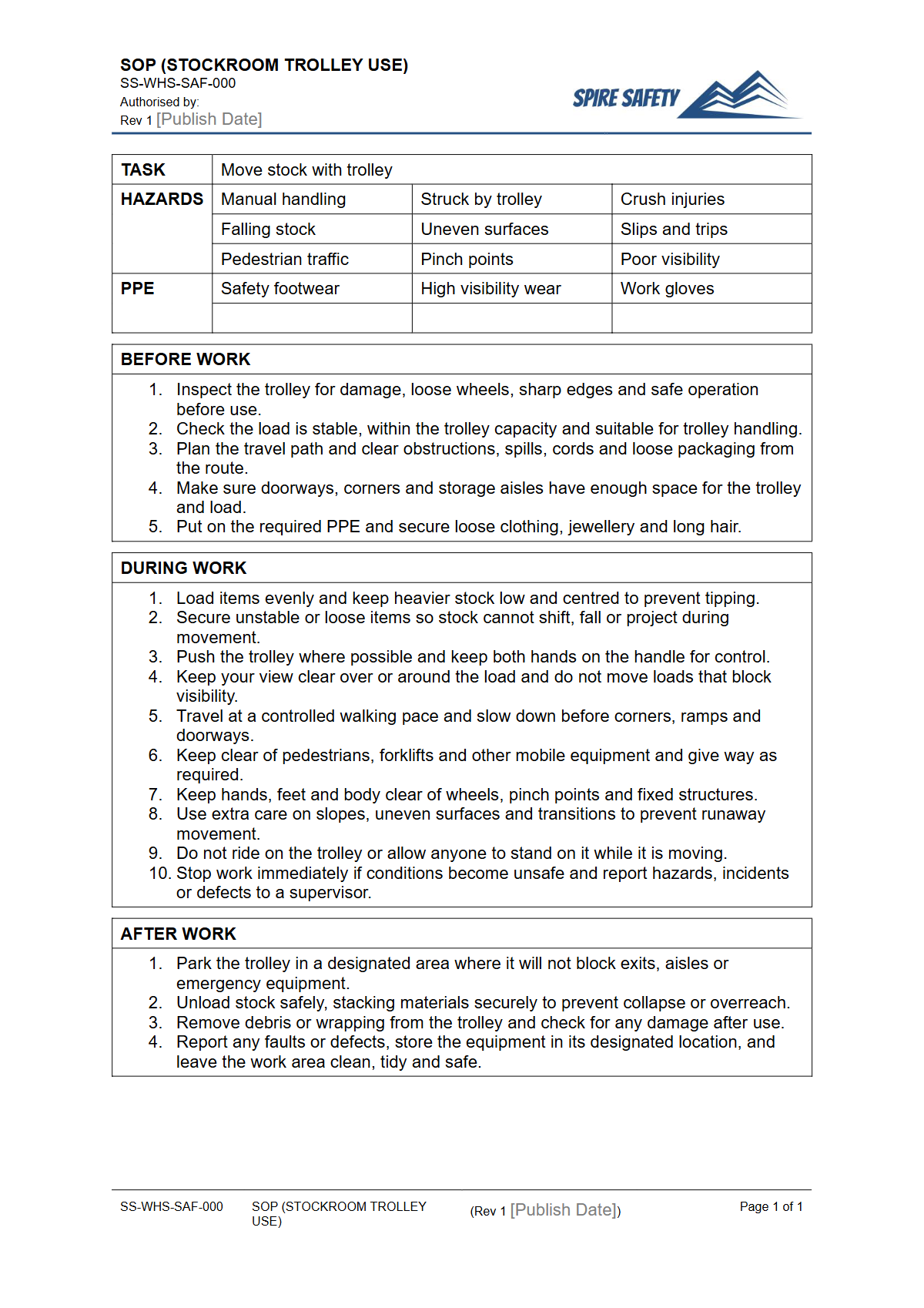
Stockroom trolleys are essential for moving goods, but their incorrect use is a leading cause of musculoskeletal injuries, strains, sprains, and impact incidents. This Free Safe Operating Procedure (Stockroom Trolley Use) Template provides a structured framework for documenting the safe use of trolleys in your workplace.
It helps your business meet its primary duty of care by providing clear, step-by-step instructions to workers, minimising the risk of injury and property damage. An effective SOP is a fundamental component of robust WHS management systems, demonstrating a proactive approach to hazard control.
By implementing a clear Safe Operating Procedure, you formalise expectations for pre-use checks, load management, and correct manual handling techniques. This document serves as a critical training tool for new employees and a valuable refresher for existing staff, helping to embed a culture of safety in your daily operations.
Video walkthrough
How to use the Free Safe Operating Procedure (Stockroom Trolley Use) Template
This document is provided in both DOCX and PDF formats for your convenience. To implement it effectively, you must adapt it to your specific operational context.
Download the Word document and methodically work through each section, consulting with the workers who actually use the trolleys. Their direct experience is invaluable for identifying specific hazards and practical control measures.
Important: We have drafted this document as a template. You MUST customise it to reflect the specific types of trolleys used, the typical loads carried, the layout of your stockroom and facility, and the unique environmental conditions of your workplace.
Ensure you update the procedure to include details specific to your site, such as designated parking areas, procedures for navigating ramps or uneven surfaces, and any required Personal Protective Equipment (PPE). Developing a suite of SOPs for all common equipment, such as our free Air Compressor SOP template, creates consistency in your safety documentation.
Key Steps for Customisation
- Identify Trolley Types: Detail the specific models used (e.g., cage trolleys, platform trolleys, multi-tier trolleys).
- Assess the Environment: Consider floor surfaces, aisle widths, doorways, ramps, and potential blind spots.
- Define Task-Specific Risks: Analyse risks associated with loading, unloading, stacking, and navigating different areas.
- Consult Your Team: Involve supervisors and operators to ensure the procedure is practical and reflects real-world tasks.
- Add Site-Specific Rules: Include details like speed limits, 'no-go' zones, and procedures for reporting faulty equipment.
When to use this Safe Operating Procedure
A Safe Operating Procedure for stockroom trolleys is not a document to be filed away and forgotten. It should be a live and active part of your daily safety management.
It is primarily used during worker induction and task-specific training to ensure everyone starts with a clear understanding of safe practices. The SOP should also be used for regular refresher training and as a reference point for toolbox talks.
Following an incident or near-miss involving a trolley, the SOP should be reviewed and updated to incorporate any learnings. It is also a key document reviewed during formal WHS compliance auditing to verify that controls for manual handling risks are documented and communicated.
Who should use this Safe Operating Procedure
This SOP should be used by a range of personnel within the organisation. WHS Managers and Supervisors will use it to develop training programs and to establish a benchmark for safe performance.
Stockroom staff, retail workers, warehouse operators, and any other employees tasked with using a trolley must be trained on the procedure and have easy access to it. Using SOPs for common equipment is a foundational WHS practice, whether it involves simple manual handling or more complex machinery like that covered in our FREE Conveyer System SOP.
Implementing the SOP in Your Workplace
Effective implementation goes beyond simply making the document available. Ensure supervisors are equipped to monitor adherence to the SOP and provide corrective coaching when they observe unsafe behaviour.
Display key instructions, such as load limits and proper pushing/pulling techniques, as visual aids in the stockroom. Integrate a review of the SOP into your regular workplace inspection checklists to ensure its continued relevance and use.
For large-scale equipment, the principles remain the same, as seen in our FREE Telehandler SOP Template, where clear instruction is paramount for safety.
Building a truly safe system of work requires more than just documentation. It involves leadership commitment, worker consultation, and ongoing supervision to ensure procedures are followed correctly every time.
If you need assistance embedding these documents into a broader safety framework, our expert WHS consulting team can provide tailored support to your organisation.
Common mistakes
Common mistakes to avoid
- Overloading the trolley beyond its specified safe working load (SWL).
- Moving the trolley with an obstructed view, preventing the operator from seeing hazards ahead.
- Leaving trolleys unattended in walkways, creating significant trip and collision hazards.
- Failing to perform a basic pre-use check for faults like damaged wheels, a broken frame, or wobbly handles.
Legal references
Legal considerations
The following legal requirements may be relevant to this type of work.
- Work Health and Safety Act (Harmonised) — Provides the primary duties for protecting workers and other people from work health and safety risks.
- Work Health and Safety Regulations (Harmonised) — Sets out requirements supporting the management of workplace hazards and risks.
The following codes may be relevant to this type of work.
- Managing WHS Risks Code of Practice — Provides practical guidance on identifying hazards, assessing risks and applying effective controls.
- Work Health and Safety Consultation, Cooperation and Coordination Code of Practice — Provides practical guidance on consulting workers and coordinating with other duty holders.
- Managing the Work Environment and Facilities Code of Practice — Provides practical guidance on safe work environments, workplace facilities and related controls.
Did you know
Manual Handling Risk
Injuries from hazardous manual tasks, such as pushing and pulling heavily loaded trolleys, are a leading cause of serious workers' compensation claims in Australia, resulting in significant time off work and productivity loss.
The Force of Friction
Poorly maintained trolley wheels can dramatically increase the force required to start and sustain movement. A damaged or flat-spotted wheel can require over 50% more push/pull force, substantially elevating the risk of a strain injury.
FAQ
Frequently asked questions
01What is a Safe Operating Procedure (SOP) for a stockroom trolley?
02Why do I need an SOP for a simple, non-powered trolley?
03Is this free stockroom trolley SOP template ready to use immediately?
04How often should a Safe Operating Procedure be reviewed?
Share this resource
Free Safe Operating Procedure (Stockroom Trolley Use) Template
Browse Categories
How To Use It
- 1Download and open in Word or PDF.
- 2Replace the placeholders with your business details.
- 3Get it reviewed by a WHS specialist before rollout.
Need it customised?
Our WHS consultants can adapt this template to your site, run a gap analysis, or audit what you already have in place.
Book a Free Consultation WHS consulting servicesor call 1300 156 382
Related templates
- Free Safe Operating Procedure (Stone Floor Cleaning) Template
- Free Safe Operating Procedure (Storage Cage Cleaning) Template
- Free Safe Operating Procedure (Store Closing Check) Template
- Free Safe Operating Procedure (Store Opening Check) Template
- Free Safe Operating Procedure (Stored Energy Release) Template
- Free Safe Operating Procedure (Storeroom Deep Cleaning) Template