
Free Safe Operating Procedure (Stone Floor Cleaning) Template
Download our free Safe Operating Procedure for stone floor cleaning, designed to help you outline safe work steps. Get your DOCX and PDF template today.
Free Safe Operating Procedure (Stone Floor Cleaning) Template
DOCX • 126 KB + PDF
Updated Oct 2026
No signup required
Purpose of the Free Safe Operating Procedure (Stone Floor Cleaning) Template
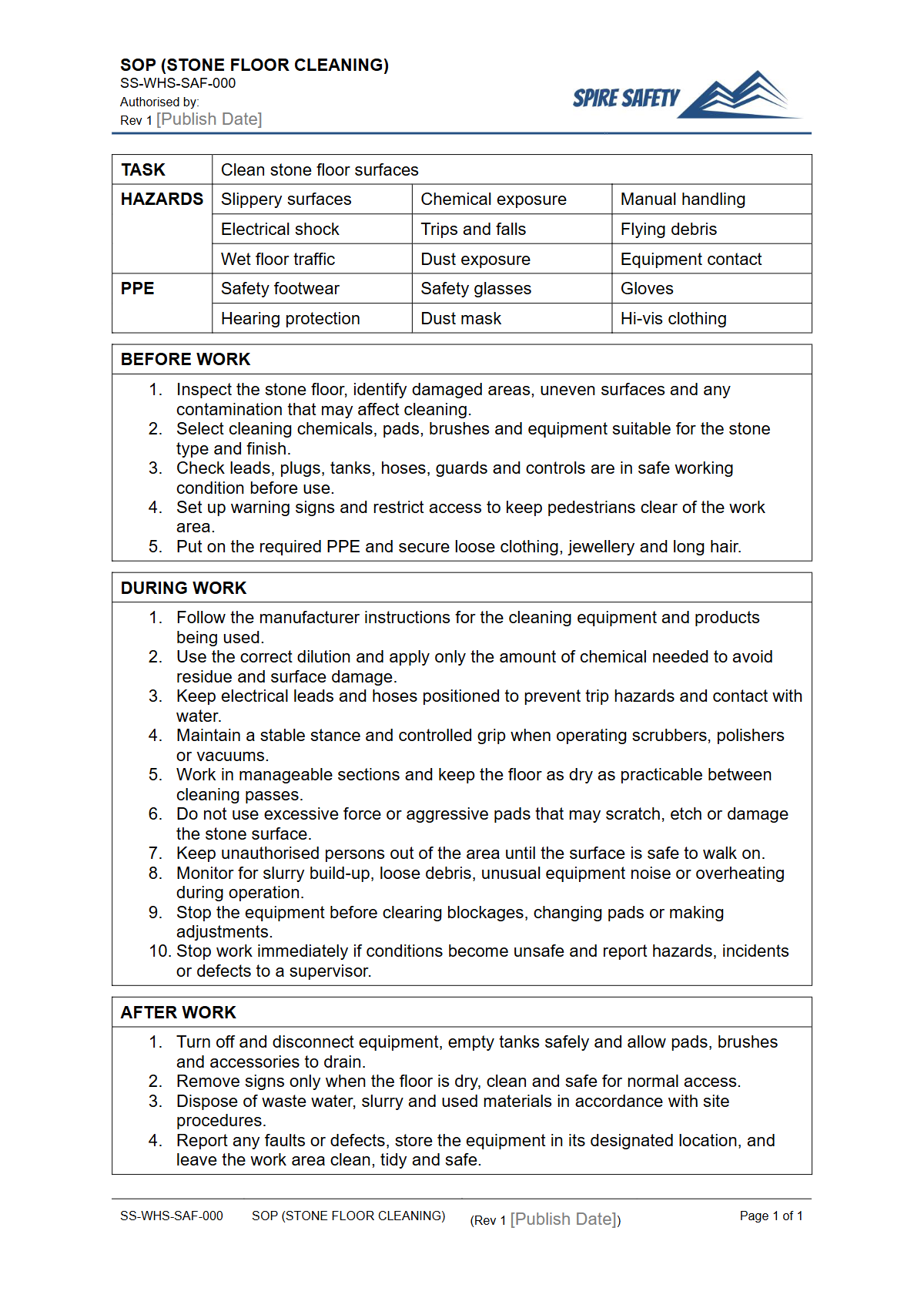
This Free Safe Operating Procedure (Stone Floor Cleaning) Template provides a structured starting point for developing a comprehensive guide to cleaning stone floors safely. The primary purpose of a Safe Operating Procedure (SOP) is to standardise a task, ensuring it is performed consistently and safely every time.
Cleaning floors, especially durable surfaces like stone, tile, or marble, involves significant hazards, including slips from wet surfaces, exposure to cleaning chemicals, and ergonomic injuries from manual handling. Using a formal SOP helps a Person Conducting a Business or Undertaking (PCBU) meet their primary duty of care under Australian WHS laws.
By documenting the required steps, personal protective equipment (PPE), and hazard controls, you create a vital tool for worker training, supervision, and risk management. This document helps to minimise the risk of incidents and forms a critical component of your broader WHS management systems. It clearly communicates expectations and safe work methods to all team members involved in cleaning and maintenance operations.
Video walkthrough
How to use the Free Safe Operating Procedure (Stone Floor Cleaning) Template
This downloadable template is provided in both DOCX and PDF formats for your convenience. The DOCX file is fully editable, allowing you to tailor it to your specific operational needs.
It is crucial to understand that a generic document is not sufficient for ensuring safety or compliance. You must adapt this template to reflect the unique environment of your workplace.
Effective customisation involves:
- Site-Specific Details: Add the name of your business, the specific locations where the procedure applies, and relevant contact information.
- Equipment and Chemicals: List the exact make and model of any equipment used (e.g., polishers, wet vacuums) and the specific names of all cleaning chemicals. Reference the Safety Data Sheet (SDS) for each chemical.
- Task-Specific Steps: Review and modify the step-by-step instructions to match your process precisely. This includes preparation, cleaning, and post-task clean-up.
- Consultation: Involve the workers who perform the cleaning tasks. Their direct experience is invaluable for identifying practical hazards and effective controls. Consultation is a key part of managing WHS risks.
Remember, we provide this template as a starting point. You must customise it to ensure it is relevant and effective for your workplace.
For complex environments or if you are unsure about your obligations, seeking professional advice from a WHS consulting firm can provide clarity and assurance.
When to use it
A Safe Operating Procedure for stone floor cleaning should be used consistently as a reference and training guide. It is not a document to be filed away and forgotten.
It should be readily accessible to workers and supervisors in the areas where the work is performed. Use this SOP when inducting new cleaning staff, conducting refresher training for existing employees, or planning a non-routine cleaning job.
It also serves as a critical reference document during incident investigations or when conducting safety inspections. If your site uses larger, powered equipment for similar tasks, you may also need our Free Safe Operating Procedure (Floor Scrubber Operation) Template.
Who should use it
This SOP template is designed for anyone responsible for the health and safety of cleaning operations in a commercial or public setting. This includes:
- WHS Managers and Safety Officers: To develop and implement formal safety procedures as part of the overall safety system.
- Facility and Building Managers: To ensure maintenance and cleaning tasks are conducted safely and to a consistent standard.
- Supervisors and Team Leaders: For training their teams and overseeing daily work activities.
- Business Owners: To fulfil their WHS duties and protect their workers and the public from harm.
The procedure itself is to be followed by all cleaning personnel assigned to stone floor maintenance tasks. Regular reviews of the SOP's effectiveness, perhaps as part of scheduled WHS compliance auditing, will ensure it remains relevant and effective.
Explore our complete free WHS resources library for more templates to support your safety management system.
Common mistakes
Common mistakes to avoid
- Using a generic template without customising it for the specific workplace, chemicals, and equipment.
- Failing to adequately train workers on the SOP and verify their understanding before they start work.
- Not using sufficient signage (e.g., 'Wet Floor' signs) or barricades to prevent public access to the area.
- Incorrectly diluting or mixing cleaning chemicals, which can lead to hazardous reactions or an ineffective clean.
Legal references
Legal considerations
The following legal requirements may be relevant to this type of work.
- Work Health and Safety Act (Harmonised) — Provides the primary duties for protecting workers and other people from work health and safety risks.
- Work Health and Safety Regulations (Harmonised) — Sets out requirements supporting the management of workplace hazards and risks.
The following codes may be relevant to this type of work.
- Managing WHS Risks Code of Practice — Provides practical guidance on identifying hazards, assessing risks and applying effective controls.
- Work Health and Safety Consultation, Cooperation and Coordination Code of Practice — Provides practical guidance on consulting workers and coordinating with other duty holders.
- Managing the Work Environment and Facilities Code of Practice — Provides practical guidance on safe work environments, workplace facilities and related controls.
Did you know
Slip Risk Statistics
Slips, trips, and falls are a leading cause of serious injuries in Australian workplaces. The cleaning industry has a particularly high rate of these injuries, often resulting from wet and slippery floors.
Chemical Safety
The Globally Harmonized System (GHS) provides standardised pictograms and information on Safety Data Sheets (SDS) to help workers quickly understand the hazards associated with cleaning chemicals.
FAQ
Frequently asked questions
01What are the main hazards of stone floor cleaning?
02Is a Safe Operating Procedure a legal requirement in Australia?
03How often should I review my Stone Floor Cleaning SOP?
04What key sections should a Stone Floor Cleaning SOP include?
Share this resource
Free Safe Operating Procedure (Stone Floor Cleaning) Template
Browse Categories
How To Use It
- 1Download and open in Word or PDF.
- 2Replace the placeholders with your business details.
- 3Get it reviewed by a WHS specialist before rollout.
Need it customised?
Our WHS consultants can adapt this template to your site, run a gap analysis, or audit what you already have in place.
Book a Free Consultation WHS consulting servicesor call 1300 156 382
Related templates
- Free Safe Operating Procedure (Storage Cage Cleaning) Template
- Free Safe Operating Procedure (Store Closing Check) Template
- Free Safe Operating Procedure (Store Opening Check) Template
- Free Safe Operating Procedure (Stored Energy Release) Template
- Free Safe Operating Procedure (Storeroom Deep Cleaning) Template
- Free Safe Operating Procedure (Storm Drain Cleaning) Template