
Free Safe Operating Procedure (Stockroom Cleaning) Template
Standardise your stockroom cleaning process with our customisable Safe Operating Procedure.
Free Safe Operating Procedure (Stockroom Cleaning) Template
DOCX • 126 KB + PDF
Updated Oct 2026
No signup required
Purpose of the Free Safe Operating Procedure (Stockroom Cleaning) Template
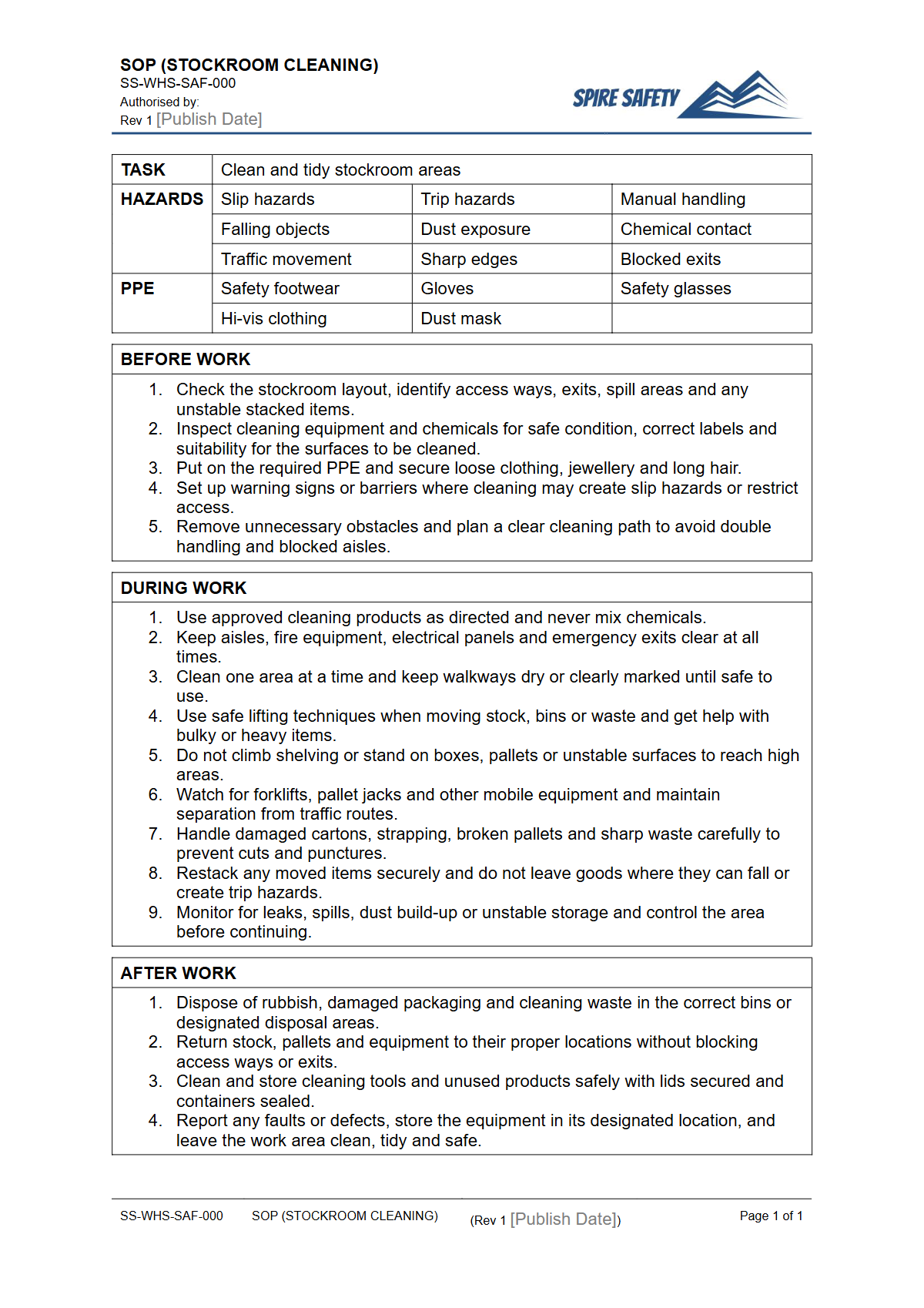
A stockroom, whether in a retail, warehouse, or workshop environment, requires regular cleaning to maintain safety and organisation. This free Safe Operating Procedure (Stockroom Cleaning) Template provides a structured starting point for documenting the required steps to perform this task safely.
Using a standardised procedure helps control common workplace hazards such as slips from wet floors, trips over cleaning equipment, manual handling injuries from moving stock, and exposure to hazardous chemicals. An SOP formalises instructions, ensuring every worker performs the task to the same safe standard, every time.
Implementing a formal SOP is a key administrative control measure that supports a robust safe system of work. It helps a Person Conducting a Business or Undertaking (PCBU) meet their primary duty of care under WHS legislation to provide and maintain a work environment without risks to health and safety.
By documenting procedures, you create a clear record of the expected safety standards and controls for the task, which can be used for training and supervision. You can browse our free WHS resources library for other templates to help manage workplace risks.
Video walkthrough
How to use the Free Safe Operating Procedure (Stockroom Cleaning) Template
This document is a downloadable template, available in both DOCX and PDF formats, designed to be adapted to your specific operational needs. It is not a complete, ready-to-use document.
You must consult with your workers and other stakeholders to ensure the final procedure accurately reflects your workplace environment, the specific tasks involved, and the equipment and chemicals in use. If you are unsure how to complete this process, seeking advice from a professional can ensure your safety documentation is fit for purpose.
To effectively customise this template, you should:
- Identify all steps of the cleaning process from preparation to completion.
- Conduct a risk assessment for each step to identify potential hazards.
- Specify the control measures required to eliminate or minimise these risks (e.g., using 'wet floor' signage, ensuring adequate ventilation).
- List the mandatory Personal Protective Equipment (PPE), such as gloves, eye protection, or non-slip footwear.
- Reference the specific names and handling requirements of all cleaning chemicals used, drawing information from their Safety Data Sheets (SDS).
- Outline clear emergency procedures for spills, chemical exposure, or other incidents.
When to use this Safe Operating Procedure
This Safe Operating Procedure should be the go-to document for all routine and non-routine stockroom cleaning tasks. It should be readily accessible to workers and actively used during daily or weekly scheduled cleaning, as well as for responding to unexpected spills or messes.
It also serves as a critical document for pre- and post-stocktake clean-ups, where stock movement and clutter can introduce additional risks.
Beyond its use during the task itself, the SOP is a fundamental training tool. It must be integrated into the induction process for all new employees who may be required to clean the stockroom.
It should also be used for regular refresher training sessions to reinforce safe work habits and communicate any updates to the procedure. Documented SOPs form a vital component of a comprehensive WHS management system, providing evidence of your commitment to proactive safety management.
What to include in your finalised SOP
Your finished Safe Operating Procedure for stockroom cleaning must be comprehensive and easy to understand. It should detail pre-operational checks, such as inspecting cleaning equipment for faults and ensuring the correct chemicals and PPE are available.
The core of the document will be the step-by-step instructions, written in clear, simple language, covering everything from diluting chemicals to mopping techniques and waste disposal.
For stockrooms that utilise mechanised equipment, other dedicated procedures will be necessary to cover their safe operation. For example, if your stockroom includes automated storage and retrieval systems, you may also require a Safe Operating Procedure for conveyer systems. The procedure must also include post-operational steps, such as cleaning and correctly storing equipment, washing hands, and reporting any issues or hazards identified during the task.
Who should use this Safe Operating Procedure
This SOP should be used by all personnel responsible for or involved in cleaning the stockroom. This typically includes dedicated cleaners, warehouse assistants, logistics staff, or retail employees, depending on the structure of the organisation.
Every person who performs the task must be trained on the contents of the finalised SOP and demonstrate their understanding of it before working unsupervised.
Supervisors and managers also have a critical role in using the SOP. They are responsible for ensuring workers are trained, for supervising the task to confirm the procedure is being followed correctly, and for enforcing the documented safety requirements. The SOP provides a clear, objective benchmark for safe performance, which is an essential tool for workplace observations and for verifying safe work practices during a formal WHS compliance audit.
Common mistakes
Common mistakes to avoid
- Using a generic template without customising it for the site-specific layout, equipment, and chemicals.
- Failing to consult with the workers who actually perform the cleaning task, leading to an impractical procedure.
- Not providing adequate, practical training on the SOP, assuming workers will read and follow it without guidance.
- Forgetting to review and update the SOP after a near-miss or when cleaning processes or chemicals change.
Legal references
Legal considerations
The following legal requirements may be relevant to this type of work.
- Work Health and Safety Act (Harmonised) — Provides the primary duties for protecting workers and other people from work health and safety risks.
- Work Health and Safety Regulations (Harmonised) — Sets out requirements supporting the management of workplace hazards and risks.
The following codes may be relevant to this type of work.
- Managing WHS Risks Code of Practice — Provides practical guidance on identifying hazards, assessing risks and applying effective controls.
- Work Health and Safety Consultation, Cooperation and Coordination Code of Practice — Provides practical guidance on consulting workers and coordinating with other duty holders.
- Managing the Work Environment and Facilities Code of Practice — Provides practical guidance on safe work environments, workplace facilities and related controls.
Did you know
Slips, Trips and Falls
Slips, trips, and falls are a leading cause of serious workplace injury in Australia. They are often caused by contaminated, wet, or cluttered floors—all common hazards during and after cleaning activities.
Chemical Safety
A Safety Data Sheet (SDS) is a critical document that provides essential safety information for handling cleaning chemicals. Your Safe Operating Procedure should always be developed in conjunction with and refer to the SDS for each chemical used.
FAQ
Frequently asked questions
01What is the difference between an SOP and a SWMS?
02Do I legally need an SOP for stockroom cleaning in Australia?
03Who should be involved in writing a Safe Operating Procedure for stockroom cleaning?
04How often should our stockroom cleaning SOP be reviewed?
Share this resource
Free Safe Operating Procedure (Stockroom Cleaning) Template
Browse Categories
How To Use It
- 1Download and open in Word or PDF.
- 2Replace the placeholders with your business details.
- 3Get it reviewed by a WHS specialist before rollout.
Need it customised?
Our WHS consultants can adapt this template to your site, run a gap analysis, or audit what you already have in place.
Book a Free Consultation WHS consulting servicesor call 1300 156 382
Related templates
- Free Safe Operating Procedure (Stockroom Ladder Use) Template
- Free Safe Operating Procedure (Stockroom Trolley Use) Template
- Free Safe Operating Procedure (Stone Floor Cleaning) Template
- Free Safe Operating Procedure (Storage Cage Cleaning) Template
- Free Safe Operating Procedure (Store Closing Check) Template
- Free Safe Operating Procedure (Store Opening Check) Template