
Free Safe Operating Procedure (Stock Replenishment) Template
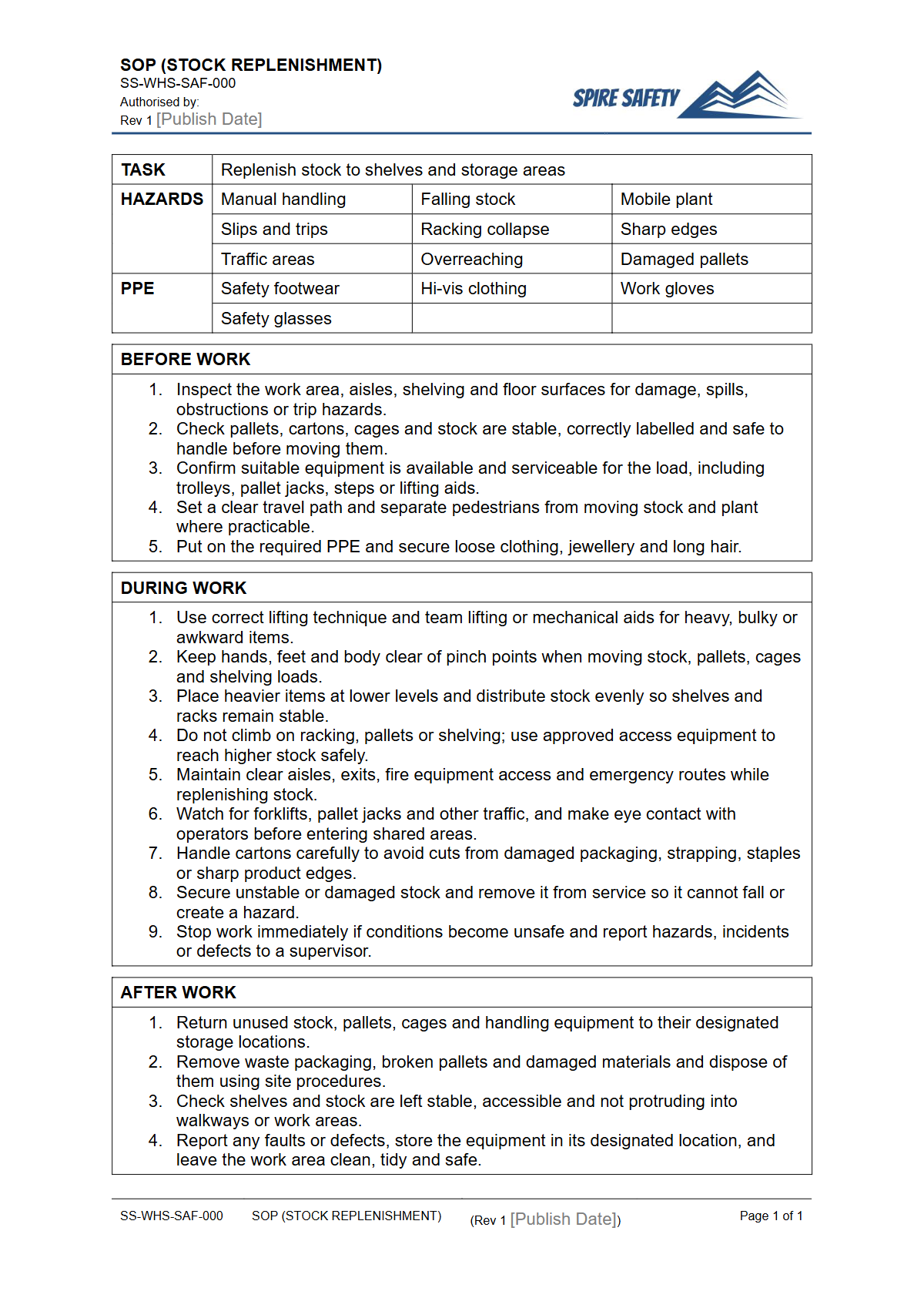
Download our free Safe Operating Procedure for stock replenishment tasks. This template provides a structured format to detail safety measures for your workplace.
Free Safe Operating Procedure (Stock Replenishment) Template
DOCX • 126 KB + PDF
Updated Oct 2026
No signup required
Purpose of the Free Safe Operating Procedure (Stock Replenishment) Template
Stock replenishment is a common task in many industries, from retail and hospitality to warehousing and logistics. While routine, it carries significant risks, including manual handling injuries, falls from height, and slips, trips, and falls.
This Free Safe Operating Procedure (Stock Replenishment) Template provides a structured framework for documenting a safe system of work for these activities. It helps organisations identify hazards, assess risks, and implement control measures to protect their workers.
Using a clear SOP is a key part of building a comprehensive WHS management system, ensuring consistency and clarity in safety protocols.
Video walkthrough
How to use the Free Safe Operating Procedure (Stock Replenishment) Template
This document is a template, not a finished procedure. It must be adapted to the specific equipment, environment, and tasks at your workplace.
Start by conducting a thorough risk assessment for your stock replenishment processes, involving the workers who perform the job. Use the findings to populate the sections of the template, detailing your site-specific hazards and control measures.
Controls should follow the hierarchy of controls, prioritising higher-level solutions over reliance on personal protective equipment (PPE) alone. For replenishment tasks involving specific machinery, you may need to cross-reference with other SOPs, such as our free Telehandler SOP template if one is used in your warehouse.
Worker consultation is a mandatory part of the risk management process. Engage with your team to ensure the procedure is practical, accurate, and reflects how the work is actually done.
Once drafted, the SOP should be reviewed and approved by management. Remember, a template is only a starting point.
We strongly recommend you customise this template to reflect the unique risks and operational procedures of your business. Regular reviews, potentially as part of broader WHS compliance audits, are essential to keep your safety documents effective and relevant.
When to use this Safe Operating Procedure
A Safe Operating Procedure for stock replenishment should be a central part of your safety documentation. It is used in several key situations:
- Worker Induction: As a training tool for new employees to ensure they understand the approved, safe method for completing the task.
- Refresher Training: For existing workers to reinforce safe work practices and introduce any updates to the procedure.
- Task Planning: As a reference before commencing a non-routine or particularly hazardous replenishment job.
- Incident Investigation: To determine if the established procedure was followed and if it needs revision following a near miss or injury.
Integrating this SOP into your training and operational workflows helps embed a culture of safety. You can find more templates and checklists to support your WHS program in our extensive library of free WHS resources.
Who should use this Safe Operating Procedure
This SOP is intended for use by a range of personnel within an organisation:
- Workers: Employees in retail, warehouse, or logistics roles who physically perform stock replenishment tasks must be trained on and follow the procedure.
- Supervisors and Team Leaders: Responsible for ensuring workers are trained, competent, and adhere to the SOP during their shifts. They also provide oversight and correct unsafe behaviours.
- WHS Managers/Officers: Use the SOP as a tool for risk management, training, and auditing safety performance. They are often responsible for developing, reviewing, and updating the document.
- PCBUs (Persons Conducting a Business or Undertaking): The PCBU has the primary duty of care to ensure a safe working environment. Implementing effective SOPs is a key way they can meet this legal obligation. In many workplaces, this process will interact with other procedures, like those outlined in our free Conveyer System SOP template.
What a Good Stock Replenishment SOP Includes
A robust SOP for this task should be comprehensive yet easy to understand. Key sections to include after customisation are:
- Required PPE: Specifies mandatory personal protective equipment, such as safety footwear, gloves, or high-visibility clothing.
- Pre-Operational Checks: Lists checks for any equipment used, like step ladders, pallet jacks, or box cutters. This may also involve checking machinery such as a workshop Air Compressor SOP if used for cleaning shelves or areas.
- Step-by-Step Procedure: A logical sequence of steps for completing the task safely, from accessing the stock to placing it on shelves and managing waste packaging.
- Identified Hazards and Controls: Clearly outlines potential hazards at each step (e.g., awkward postures, over-reaching, unstable loads) and the corresponding control measures.
- Emergency Procedures: Instructions on what to do in case of an incident, such as a spillage, injury, or equipment failure.
Finally, ensure the SOP is reviewed periodically—annually, after an incident, or when processes change. Keeping your safety documents current is crucial for maintaining a safe workplace.
If you need support in developing or reviewing your safety systems, our team of expert WHS consultants can provide tailored assistance.
Common mistakes
Common mistakes to avoid
- Using a generic template without customising it for specific site hazards and equipment.
- Failing to consult with workers who actually perform the stock replenishment tasks.
- Treating the SOP as a 'set-and-forget' document that is never reviewed or updated.
- Neglecting to provide practical, hands-on training on the finalised procedure for all relevant staff.
Legal references
Legal considerations
The following legal requirements may be relevant to this type of work.
- Work Health and Safety Act (Harmonised) — Provides the primary duties for protecting workers and other people from work health and safety risks.
- Work Health and Safety Regulations (Harmonised) — Sets out requirements supporting the management of workplace hazards and risks.
The following codes may be relevant to this type of work.
- Managing WHS Risks Code of Practice — Provides practical guidance on identifying hazards, assessing risks and applying effective controls.
- Work Health and Safety Consultation, Cooperation and Coordination Code of Practice — Provides practical guidance on consulting workers and coordinating with other duty holders.
- Managing the Work Environment and Facilities Code of Practice — Provides practical guidance on safe work environments, workplace facilities and related controls.
Did you know
Manual Handling Risk
According to Safe Work Australia, serious claims for injuries resulting from hazardous manual tasks represent a significant proportion of all workers' compensation claims. Stock replenishment often involves repetitive lifting, carrying, and bending, making it a high-risk activity.
Administrative Controls
Safe Operating Procedures are considered an 'administrative control' in the hierarchy of controls. While essential, they should be used to support higher-level controls like eliminating the hazard or substituting it with a safer alternative wherever possible.
FAQ
Frequently asked questions
01What is a Safe Operating Procedure (SOP) for stock replenishment?
02Is this stock replenishment SOP template ready to use immediately?
03Who is responsible for creating and implementing this SOP?
04How often should a stock replenishment SOP be reviewed?
Share this resource
Free Safe Operating Procedure (Stock Replenishment) Template
Browse Categories
How To Use It
- 1Download and open in Word or PDF.
- 2Replace the placeholders with your business details.
- 3Get it reviewed by a WHS specialist before rollout.
Need it customised?
Our WHS consultants can adapt this template to your site, run a gap analysis, or audit what you already have in place.
Book a Free Consultation WHS consulting servicesor call 1300 156 382
Related templates
- Free Safe Operating Procedure (Stock Transfer Handover) Template
- Free Safe Operating Procedure (Stock Trough Cleaning) Template
- Free Safe Operating Procedure (Stockroom Cleaning) Template
- Free Safe Operating Procedure (Stockroom Ladder Use) Template
- Free Safe Operating Procedure (Stockroom Trolley Use) Template
- Free Safe Operating Procedure (Stone Floor Cleaning) Template