
Free Safe Operating Procedure (Stock Trough Cleaning) Template
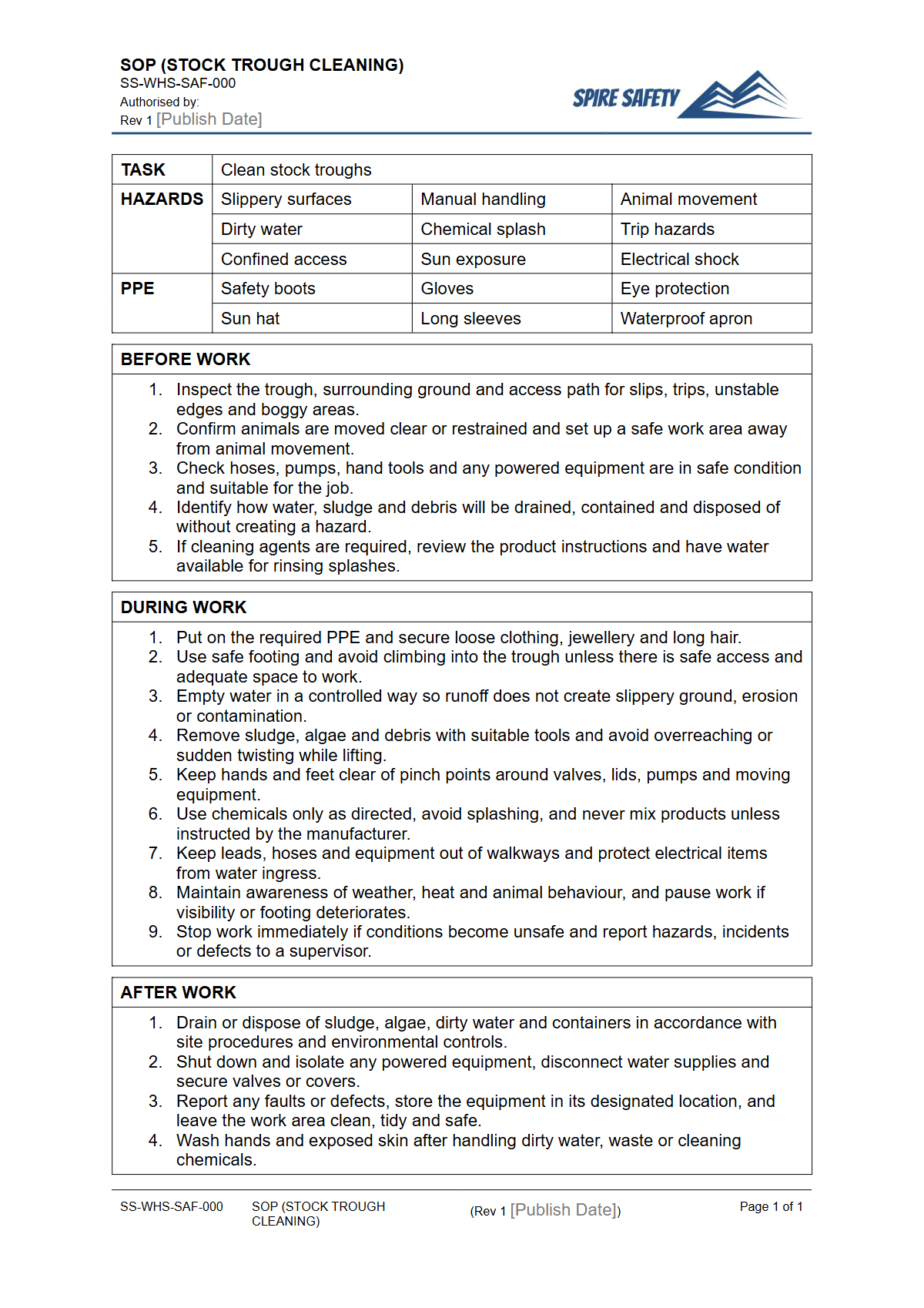
Download our free Safe Operating Procedure for stock trough cleaning. This template provides a solid framework for your farm's safety management system.
Free Safe Operating Procedure (Stock Trough Cleaning) Template
DOCX • 126 KB + PDF
Updated Oct 2026
No signup required
Purpose of the Free Safe Operating Procedure (Stock Trough Cleaning) Template
Ensuring a clean, reliable water source for livestock is fundamental to good farm management and animal welfare. However, the task of cleaning stock troughs carries significant health and safety risks.
This Free Safe Operating Procedure (Stock Trough Cleaning) Template provides a structured framework to help you document the safest way to perform this common but hazardous job. By formalising your process, you can effectively manage risks such as manual handling injuries, slips and falls on wet surfaces, exposure to cleaning chemicals, and contact with biological hazards like bacteria and algae.
A well-developed Safe Operating Procedure (SOP) is a critical component of a proactive safety culture. It serves as a clear instruction manual for workers, a key training resource, and a record of your organisation's commitment to managing risks.
Implementing robust procedures for all tasks is a cornerstone of effective WHS management systems, helping to standardise operations and reduce the likelihood of incidents. Whether managing simple tasks or operating machinery detailed in our free Telehandler SOP template, a documented procedure is vital for safety.
Video walkthrough
How to use the Free Safe Operating Procedure (Stock Trough Cleaning) Template
Our template is designed as a comprehensive starting point, aligned with Australian WHS best practices. It is not an out-of-the-box solution.
To be effective, you must adapt it to the specific conditions, equipment, chemicals, and hazards present in your workplace. We've laid out the core sections, but it's your responsibility to populate them with details relevant to your farm or station.
Follow these steps to implement the SOP:
- Download: Save the DOCX file to your computer.
- Consult: Involve the workers who regularly clean the troughs. Their firsthand experience is invaluable for identifying all the practical risks and effective control measures.
- Customise: Walk through the task step-by-step. Detail the specific types of troughs, the location, the water source, the cleaning agents used (including Safety Data Sheets), the tools required (e.g., brushes, scrapers, pumps), and the required Personal Protective Equipment (PPE).
- Train: Use the finalised SOP as a training document for all relevant workers. Ensure they understand every step and have a chance to ask questions. Keep a record of who has been trained.
- Review: The SOP should be a living document. Review it annually or whenever a change occurs—such as the introduction of a new cleaning chemical, a change in procedure, or after an incident or near miss. This process is similar for other farm-related procedures, like those you would develop using our free Spreader SOP template.
When to use it
This Safe Operating Procedure should be the default guide for every stock trough cleaning activity. It should be used consistently to build safe habits and ensure no steps are missed.
Specifically, it should be referenced during worker inductions and task-specific training for new employees or contractors. It also serves as the standard for regular, scheduled cleaning activities and for unscheduled cleans required due to contamination events, extreme weather, or changes in stock numbers.
Integrating the SOP into your regular maintenance schedule ensures it becomes part of your business-as-usual safety practices.
Who should use it
This SOP is intended for any person required to clean stock troughs. This includes farmhands, station workers, maintenance staff, and agricultural contractors.
Managers and supervisors should use the document to guide their training, supervision, and performance monitoring. Furthermore, the document is a valuable resource for WHS officers and farm managers responsible for risk management and demonstrating due diligence. Periodically checking that the SOP is being followed correctly on the ground can be a key part of internal safety checks or more formal WHS compliance auditing.
Key Hazards and Control Measures
Stock trough cleaning involves a range of hazards that must be identified and controlled. The risk assessment process, which informs this SOP, should address:
- Physical Hazards: Slips, trips, and falls on wet or uneven ground; musculoskeletal injuries from awkward postures, bending, and lifting; and ergonomic risks from using high-pressure washers.
- Chemical Hazards: Skin irritation, burns, or respiratory issues from incorrect use or storage of cleaning chemicals like chlorine or acids.
- Biological Hazards: Exposure to bacteria (e.g., E. coli, Leptospirosis), viruses, and parasites present in contaminated water, mud, and animal faeces.
- Other Hazards: Bites or kicks from nearby livestock, potential for drowning in very large troughs or dams, and electrical hazards if using powered equipment near water. You might find parallels with hazards identified for other farm equipment, such as that covered in our free Scraper SOP template.
Implementing Control Measures
Your customised SOP must outline the specific controls to mitigate these risks. Using the hierarchy of controls, you should aim to eliminate risks where possible (e.g., automating the cleaning process).
Where that's not feasible, implement engineering controls (long-handled brushes to reduce bending), administrative controls (this SOP, signage, training), and finally, specify the correct Personal Protective Equipment (PPE) like steel-capped non-slip boots, waterproof gloves, and safety glasses. If you need help conducting a thorough risk assessment for your agricultural tasks, our WHS consulting services can provide expert guidance.
Training and Consultation
A document alone does not create a safe workplace. The value of this SOP lies in its use as a tool for consultation and training.
Workers must be actively involved in its development to ensure it is practical and reflects the realities of the job. Once finalised, the SOP should be the foundation of your training program for the task.
Use it in toolbox talks to refresh knowledge and discuss any new hazards identified by the team. Fostering an environment where workers feel empowered to stop and report unsafe conditions is the ultimate goal. For more guidance and tools, explore our extensive free WHS resources library.
Common mistakes
Common mistakes to avoid
- Using a 'one-size-fits-all' SOP without site-specific customisation.
- Neglecting to consult with the workers who actually perform the task.
- Failing to provide or mandate the specific PPE listed in the procedure.
- Treating the SOP as a document for the shelf, not a live tool for training and supervision.
Legal references
Legal considerations
The following legal requirements may be relevant to this type of work.
- Work Health and Safety Act (Harmonised) — Provides the primary duties for protecting workers and other people from work health and safety risks.
- Work Health and Safety Regulations (Harmonised) — Sets out requirements supporting the management of workplace hazards and risks.
The following codes may be relevant to this type of work.
- Managing WHS Risks Code of Practice — Provides practical guidance on identifying hazards, assessing risks and applying effective controls.
- Work Health and Safety Consultation, Cooperation and Coordination Code of Practice — Provides practical guidance on consulting workers and coordinating with other duty holders.
- Managing the Work Environment and Facilities Code of Practice — Provides practical guidance on safe work environments, workplace facilities and related controls.
Did you know
Water Quality Matters
Contaminated water can reduce livestock water intake by over 50%, impacting animal health, growth, and productivity. Regular trough cleaning is a direct investment in your stock's performance.
Biofilm Dangers
The slimy layer (biofilm) inside troughs can harbour harmful bacteria like E. coli and Salmonella, posing a health risk to both animals and the workers cleaning them.
FAQ
Frequently asked questions
01What are the main hazards when cleaning a stock trough?
02Do I legally need a Safe Operating Procedure for cleaning troughs?
03How often should stock troughs be cleaned?
04What PPE is required for cleaning stock troughs?
Share this resource
Free Safe Operating Procedure (Stock Trough Cleaning) Template
Browse Categories
How To Use It
- 1Download and open in Word or PDF.
- 2Replace the placeholders with your business details.
- 3Get it reviewed by a WHS specialist before rollout.
Need it customised?
Our WHS consultants can adapt this template to your site, run a gap analysis, or audit what you already have in place.
Book a Free Consultation WHS consulting servicesor call 1300 156 382
Related templates
- Free Safe Operating Procedure (Stockroom Cleaning) Template
- Free Safe Operating Procedure (Stockroom Ladder Use) Template
- Free Safe Operating Procedure (Stockroom Trolley Use) Template
- Free Safe Operating Procedure (Stone Floor Cleaning) Template
- Free Safe Operating Procedure (Storage Cage Cleaning) Template
- Free Safe Operating Procedure (Store Closing Check) Template