
Free Safe Operating Procedure (Stick Blender) Template
Formalise your kitchen safety with our Safe Operating Procedure for stick blenders. Download this customisable template to get started today.
Free Safe Operating Procedure (Stick Blender) Template
DOCX • 126 KB + PDF
Updated Oct 2026
No signup required
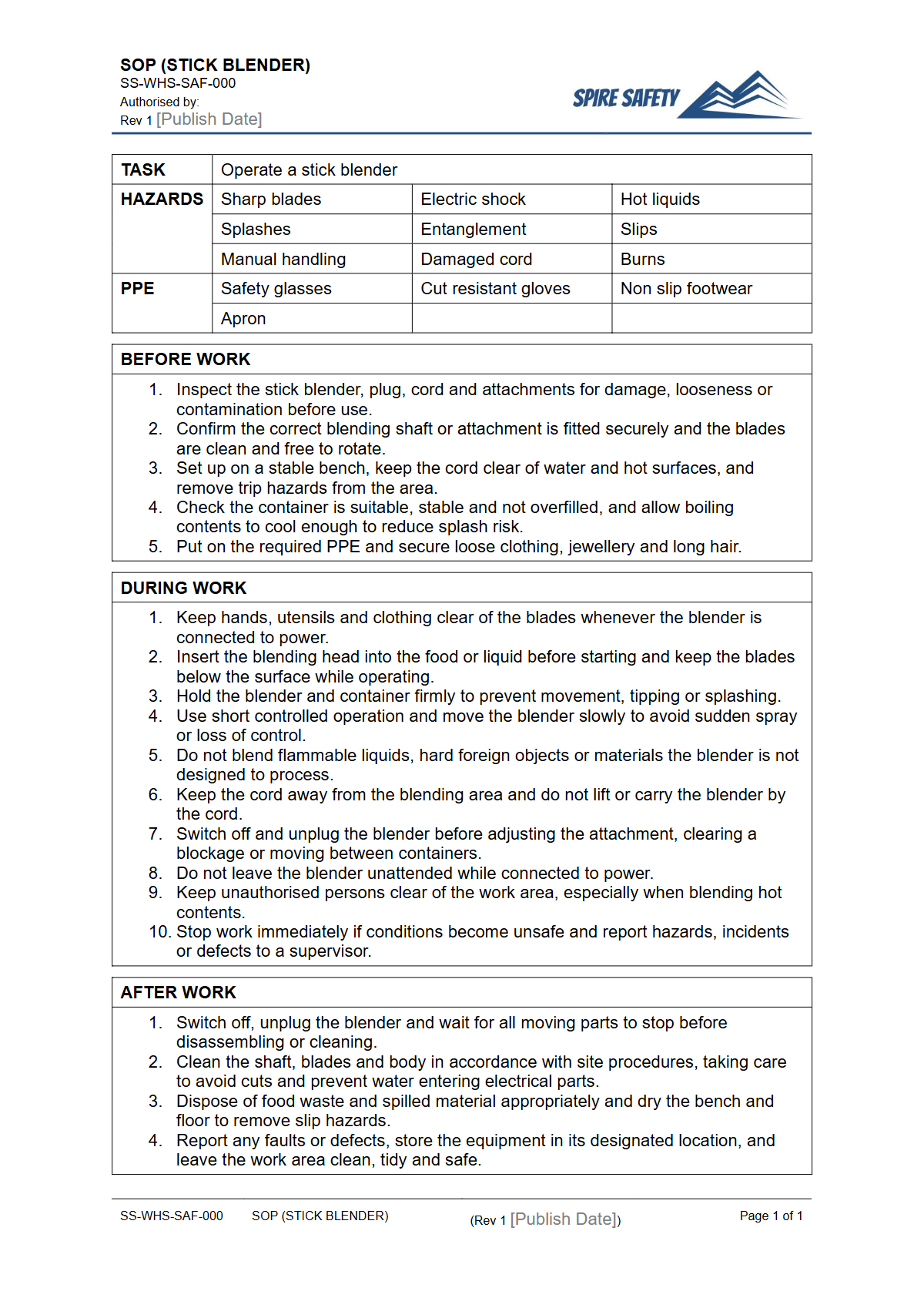
Purpose of the Free Safe Operating Procedure (Stick Blender) Template
A stick blender, or immersion blender, is a common tool in commercial kitchens, but its high-speed blades and electrical components present real hazards. This Free Safe Operating Procedure (Stick Blender) Template provides a structured framework for documenting the safest way to use this equipment.
Its primary purpose is to help businesses establish a clear, repeatable process that minimises risks such as cuts, burns from splashing hot liquids, and electric shock. By implementing a formal SOP, you provide workers with essential instructions, standardise training, and demonstrate a commitment to a safe work environment.
Documenting procedures like this is a fundamental part of a comprehensive WHS management system. It acts as a key administrative control measure, ensuring that the identified safe methods for performing a task are communicated effectively to all relevant personnel. Using a standardised template ensures that all critical safety elements—from pre-start checks to cleaning protocols—are considered and addressed, forming a reliable reference for both new and experienced staff.
Video walkthrough
How to use the Free Safe Operating Procedure (Stick Blender) Template
This resource is available for download as a DOCX file for easy editing, as well as a print-ready PDF. To use the template effectively, you should add your company name and logo, and then meticulously review and adapt each section to align with your specific operational context.
This includes detailing the exact models of stick blenders in use, the types of substances they are used for, and the specific personal protective equipment (PPE) required in your kitchen environment.
Important: It is crucial to remember that this is a template, not a finished document. We have designed it as a starting point, and you must customise it to reflect the specific equipment, tasks, and environment in your workplace.
A generic procedure that doesn't account for your unique situation may not adequately control risks. For other kitchen equipment, you should use equally specific documents, such as our deep fryer SOP template.
When to use a Safe Operating Procedure
A Safe Operating Procedure for a stick blender should be integrated into your daily kitchen operations. It is not a document to be filed away and forgotten. It should be used:
- As a primary training tool for new kitchen staff, apprentices, or anyone unfamiliar with the equipment.
- For regular refresher training to prevent complacency among experienced workers.
- As a reference guide, kept in an accessible location near the food preparation area.
- During incident investigations to understand if procedural deviations contributed to the event.
- As a benchmark document during internal safety checks and formal WHS compliance audits.
Who should use it
This Safe Operating Procedure should be used by anyone who interacts with the stick blender. This includes a range of roles within a food service or processing environment:
- Operators: Chefs, cooks, and kitchen hands who physically use the blender to prepare food.
- Supervisors and Managers: To ensure staff are trained correctly and are following the established safe work practices.
- Cleaning and Maintenance Staff: The SOP should contain specific instructions on how to safely de-energise, disassemble, and clean the equipment.
- WHS Personnel: For use in risk assessments, training development, and compliance activities. In larger operations, this SOP complements other procedures like a conveyer system SOP to build a complete safety picture.
Key Hazard Control Measures for Stick Blenders
While your customised SOP will contain detailed steps, the core of the procedure revolves around controlling key hazards. Effective risk management involves implementing a hierarchy of controls. For a stick blender, your procedure should emphasise the following:
- Pre-Operational Checks: Before every use, inspect the power cord for damage, ensure the blade is secure and undamaged, and check that the blender's housing is free from cracks.
- Correct Assembly: Ensure detachable shafts are locked in place correctly before plugging the unit into a power source.
- Safe Operating Technique: Always immerse the blade guard completely in the substance before turning the motor on. Use a container that is deep and wide enough to prevent splashing and suctioning to the bottom.
- Electrical Safety: Always plug the unit into a socket protected by a residual-current device (RCD). Keep the cord away from hot surfaces, water, and sharp edges.
- Cleaning and Maintenance: Critically, always unplug the blender from the power source before cleaning, handling the blades, or attempting to dislodge food.
If you need assistance developing robust risk assessments and control measures for your workplace equipment, our specialist WHS consulting team can provide expert guidance. For more templates and safety guides, feel free to browse our complete free WHS resources library.
Common mistakes
Common mistakes to avoid
- Using a container that is too shallow or narrow, causing dangerous splashing.
- Failing to unplug the unit before cleaning or attempting to clear a blockage from the blades.
- Operating the blender for extended periods without a break, leading to motor overheating.
- Ignoring pre-operational checks for frayed cords, damaged blades, or cracked housing.
Legal references
Legal considerations
The following legal requirements may be relevant to this type of work.
- Work Health and Safety Act (Harmonised) — Provides the primary duties for protecting workers and other people from work health and safety risks.
- Work Health and Safety Regulations (Harmonised) — Sets out requirements supporting the management of workplace hazards and risks.
The following codes may be relevant to this type of work.
- Managing WHS Risks Code of Practice — Provides practical guidance on identifying hazards, assessing risks and applying effective controls.
- Work Health and Safety Consultation, Cooperation and Coordination Code of Practice — Provides practical guidance on consulting workers and coordinating with other duty holders.
- Managing the Work Environment and Facilities Code of Practice — Provides practical guidance on safe work environments, workplace facilities and related controls.
Did you know
The Immersion Rule
A primary cause of splash injuries from stick blenders is starting the motor before the blade is fully submerged. A simple rule—'blades in before power on'—can prevent many painful burns and eye injuries.
Electrical Hazard
Damaged power cords are a leading electrical hazard with portable kitchen appliances. Regular inspection of cords and plugs is a critical step in any stick blender pre-start check.
FAQ
Frequently asked questions
01Is a Safe Operating Procedure a legal requirement for a stick blender in Australia?
02How often should we review our stick blender SOP?
03Can this template be used for other kitchen equipment?
04What's the difference between an SOP and a SWMS?
Share this resource
Free Safe Operating Procedure (Stick Blender) Template
Browse Categories
How To Use It
- 1Download and open in Word or PDF.
- 2Replace the placeholders with your business details.
- 3Get it reviewed by a WHS specialist before rollout.
Need it customised?
Our WHS consultants can adapt this template to your site, run a gap analysis, or audit what you already have in place.
Book a Free Consultation WHS consulting servicesor call 1300 156 382
Related templates
- Free Safe Operating Procedure (Stillages) Template
- Free Safe Operating Procedure (Stock Picking Trolley) Template
- Free Safe Operating Procedure (Stock Replenishment) Template
- Free Safe Operating Procedure (Stock Transfer Handover) Template
- Free Safe Operating Procedure (Stock Trough Cleaning) Template
- Free Safe Operating Procedure (Stockroom Cleaning) Template