
Free Safe Operating Procedure (Stillages) Template
Establish clear guidelines for handling stillages in your workplace with our customisable template. Download your free Safe Operating Procedure today.
Free Safe Operating Procedure (Stillages) Template
DOCX • 126 KB + PDF
Updated Oct 2026
No signup required
Purpose of the Free Safe Operating Procedure (Stillages) Template
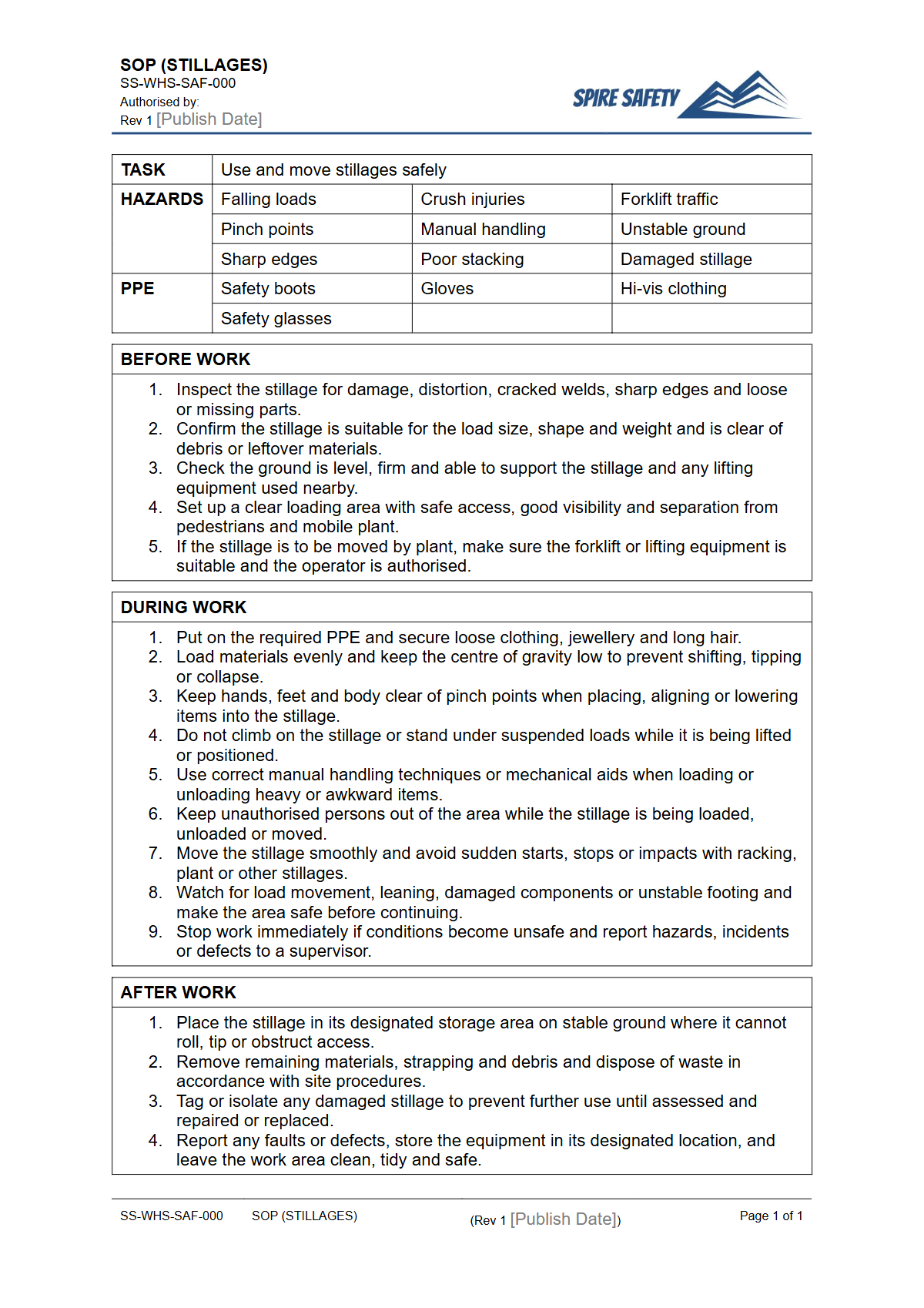
Effectively managing the risks associated with material handling is a cornerstone of workplace safety. This Free Safe Operating Procedure (Stillages) Template provides a structured starting point for organisations to document the required steps for safely using, handling, and storing stillages.
Stillages, which are essentially pallets or cages typically made of steel, are vital for transporting and storing goods in warehouses, manufacturing facilities, and construction sites. However, they also introduce significant hazards, including manual handling injuries, crushing from unstable stacks, and falling objects.
The primary purpose of this Safe Operating Procedure is to outline a clear, step-by-step process that minimises these risks. By formalising procedures, you create a consistent and safe method of work that can be used for training, supervision, and performance monitoring. A documented SOP is a critical element in demonstrating how your business manages specific operational risks, forming a key part of your broader WHS management systems.
Video walkthrough
How to use the Free Safe Operating Procedure (Stillages) Template
This template is provided in both DOCX and PDF formats for your convenience. The DOCX version is fully editable, allowing you to tailor the content to your specific operational needs.
It is designed as a foundation, not a finished document.
Important: You must customise this Safe Operating Procedure to reflect the unique aspects of your workplace. This includes the types of stillages used, the specific mechanical aids available (e.g., forklifts, pallet jacks, cranes), the layout of your storage areas, and the nature of the goods being handled.
We strongly recommend that a competent person, in consultation with workers who perform the tasks, completes this customisation process.
To implement it effectively:
- Download the DOCX file.
- Replace the placeholder text with your company's name, logo, and relevant site-specific details.
- Review each step in the procedure and modify it to match your actual work processes. Add or remove steps as necessary.
- Detail the specific PPE required, such as steel-capped boots, gloves, and high-visibility clothing.
- Incorporate any manufacturer instructions for the stillages or associated lifting equipment. Your processes may also need to reference a FREE Telehandler SOP Template if that plant is used for movement.
- Have the final document reviewed and approved by a manager or supervisor.
- Use the finalised SOP as a tool for training and inducting new workers.
Key Elements of this Safe Operating Procedure
Our template prompts you to consider several critical safety areas, including:
- Pre-operational checks: Instructions for inspecting stillages for damage, such as bent frames, broken welds, or corrosion, before use.
- Safe Loading/Unloading: Guidelines for distributing weight evenly and ensuring loads are secure to prevent shifting or falling.
- Stacking and Storage: Rules for maximum stacking heights, ensuring level and stable ground, and maintaining clearance from walkways and emergency exits.
- Mechanical Lifting: Procedures for engaging stillages correctly with forklift tynes or crane lifting points.
- Emergency Procedures: Steps to take in case a stillage stack becomes unstable or a load collapses.
When to use it
A Safe Operating Procedure for stillages should be a living document that is integrated into your daily operations. It should be used during worker inductions to establish safety expectations from day one, as well as for specific task training for new and existing employees.
It serves as a vital on-the-job reference to reinforce correct procedures.
Furthermore, this SOP should be a key reference document during incident investigations involving stillages and can be used proactively for refresher training sessions. It is also an essential piece of evidence during safety reviews and WHS compliance auditing to demonstrate that your organisation has defined safe systems of work.
Who should use it
This SOP is intended for anyone involved in the lifecycle of stillage use within a workplace. This includes:
- Workers and Operators: Warehouse staff, forklift operators, factory workers, and transport personnel who physically handle, load, or move stillages.
- Supervisors and Team Leaders: To monitor compliance, conduct toolbox talks, and ensure their teams are working according to the established safe procedure.
- WHS/HSE Personnel: To integrate the SOP into the overall safety management system, use it for risk assessments, and guide training development. Their work might involve standardising processes across different material handling equipment, such as those covered in our FREE Conveyer System SOP.
By providing clear, actionable guidance, this template helps everyone in the organisation understand their responsibilities for ensuring stillages are used safely. For more templates and safety resources, explore our complete free WHS resources library.
Common mistakes
Common mistakes to avoid
- Exceeding the Safe Working Load (SWL) or not knowing what it is.
- Stacking stillages on uneven, unstable, or sloped ground.
- Continuing to use stillages that are visibly bent, cracked, or corroded.
- Using incorrect lifting techniques, such as failing to fully engage forklift tynes.
Legal references
Legal considerations
The following legal requirements may be relevant to this type of work.
- Work Health and Safety Act (Harmonised) — Provides the primary duties for protecting workers and other people from work health and safety risks.
- Work Health and Safety Regulations (Harmonised) — Sets out requirements supporting the management of workplace hazards and risks.
The following codes may be relevant to this type of work.
- Managing WHS Risks Code of Practice — Provides practical guidance on identifying hazards, assessing risks and applying effective controls.
- Work Health and Safety Consultation, Cooperation and Coordination Code of Practice — Provides practical guidance on consulting workers and coordinating with other duty holders.
- Managing the Work Environment and Facilities Code of Practice — Provides practical guidance on safe work environments, workplace facilities and related controls.
Did you know
Industrial Revolution Origins
The design of modern stillages and pallets evolved from simple wooden skids used in factories during the late 19th and early 20th centuries to streamline the movement of goods with early lift trucks.
Falling Objects Risk
According to Safe Work Australia data, being hit by falling objects is a leading mechanism of injury for serious workers' compensation claims, particularly in the warehousing and manufacturing industries where stillages are common.
FAQ
Frequently asked questions
01What is a Safe Operating Procedure for stillages?
02Are stillages required to be inspected before use?
03What are the main hazards of using stillages?
04Who is responsible for writing a stillages SOP?
Share this resource
Free Safe Operating Procedure (Stillages) Template
Browse Categories
How To Use It
- 1Download and open in Word or PDF.
- 2Replace the placeholders with your business details.
- 3Get it reviewed by a WHS specialist before rollout.
Need it customised?
Our WHS consultants can adapt this template to your site, run a gap analysis, or audit what you already have in place.
Book a Free Consultation WHS consulting servicesor call 1300 156 382
Related templates
- Free Safe Operating Procedure (Stock Picking Trolley) Template
- Free Safe Operating Procedure (Stock Replenishment) Template
- Free Safe Operating Procedure (Stock Transfer Handover) Template
- Free Safe Operating Procedure (Stock Trough Cleaning) Template
- Free Safe Operating Procedure (Stockroom Cleaning) Template
- Free Safe Operating Procedure (Stockroom Ladder Use) Template