
Free Safe Operating Procedure (Standing Aid Cleaning) Template
Download our Free Safe Operating Procedure for standing aid cleaning. This template helps outline hygiene protocols for patient handling equipment.
Free Safe Operating Procedure (Standing Aid Cleaning) Template
DOCX • 126 KB + PDF
Updated Oct 2026
No signup required
Purpose of the Free Safe Operating Procedure (Standing Aid Cleaning) Template
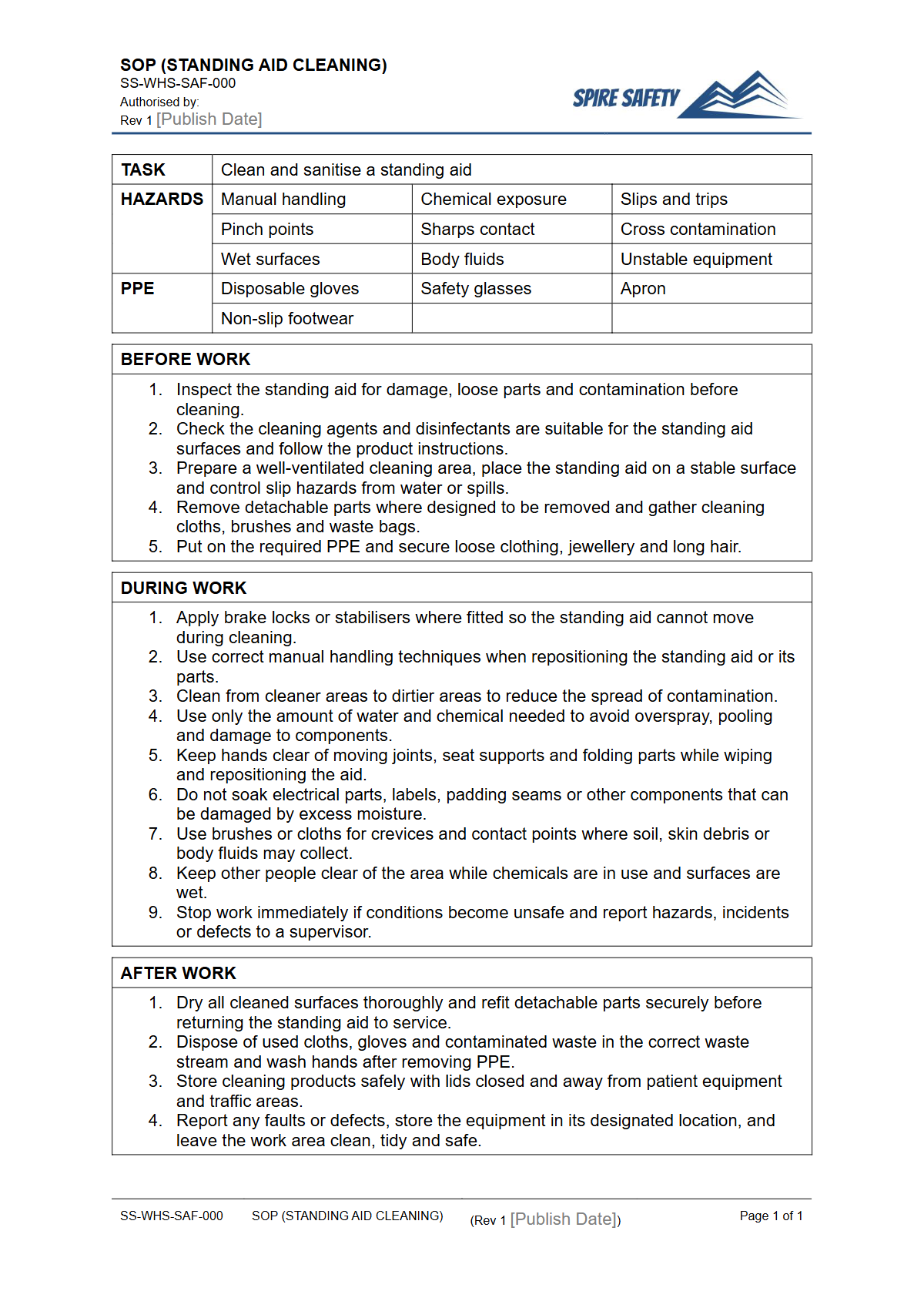
This Free Safe Operating Procedure (Standing Aid Cleaning) Template provides a structured starting point for developing a clear, step-by-step guide for the cleaning and disinfection of patient standing aids. In healthcare, aged care, and disability support settings, standing aids are high-touch pieces of equipment that can pose a significant risk of cross-contamination if not managed correctly.
Implementing a standardised cleaning procedure is a critical control measure to prevent the spread of Healthcare Associated Infections (HAIs) and protect both patients and staff.
A documented Safe Operating Procedure (SOP) ensures that cleaning tasks are performed consistently and to a required standard, regardless of who performs the task. It details the required personal protective equipment (PPE), approved cleaning agents, step-by-step instructions for cleaning and disinfection, and post-cleaning checks.
This process not only promotes a safer environment but also forms a key part of your broader WHS management systems, demonstrating a proactive approach to risk management.
Video walkthrough
How to use the Free Safe Operating Procedure (Standing Aid Cleaning) Template
This template is designed for easy customisation to suit the specific equipment and cleaning products used in your facility. Simply download the DOCX file and edit the sections to reflect your workplace's unique requirements.
It's crucial to consult the standing aid manufacturer’s instructions and the Safety Data Sheets (SDS) for your chosen cleaning and disinfectant chemicals to ensure all information is accurate.
Once customised, the SOP should be used as a training tool for all relevant staff, including care workers, nurses, and cleaning personnel. It should be readily accessible in the areas where standing aids are used and stored. While the process of cleaning a standing aid is very different from preparing commercial kitchen equipment, the core principle of documenting specific steps for safety and hygiene remains the same, as demonstrated in our deep fryer SOP template.
Important: Customise to Your Workplace
This document is a template and not a complete Safe Operating Procedure. It is essential that you customise it to reflect the specific standing aid models, cleaning chemicals, and unique environmental conditions of your workplace.
We are not familiar with your operational specifics, so you must review and adapt this template to ensure it is suitable for your business. Spire Safety assumes no liability for the use or misuse of this document.
When to use a Standing Aid Cleaning SOP
A Safe Operating Procedure for cleaning standing aids should be followed consistently. The procedure should be performed:
- After each patient use: To prevent cross-contamination between individuals.
- At regular scheduled intervals: As part of a routine deep cleaning schedule for the facility (e.g., daily or weekly), even if the aid has not been used.
- When visibly soiled: Immediate cleaning is required if the aid becomes contaminated with bodily fluids or any other substance.
- Before and after maintenance: To ensure the equipment is clean for service technicians and safe for patient use upon its return.
Integrating this SOP into daily workflows helps build a strong culture of safety and infection control. This is just one of many procedures that may be required in a complex facility; other tasks involving machinery, for example, would also require documented procedures, such as those in our Free Air Compressor SOP Template.
Who should use this Safe Operating Procedure
This SOP is intended for any person responsible for cleaning, handling, or maintaining patient standing aids. This typically includes:
- Care Staff and Personal Care Assistants (PCAs): Who often perform cleaning between patient uses as part of their duties.
- Nurses and Allied Health Professionals: Who oversee patient care and equipment safety.
- Cleaning and Environmental Services Staff: Who may be responsible for scheduled deep cleaning of all facility equipment.
- Work Health and Safety (WHS) Managers: Who are responsible for developing, implementing, and reviewing safety procedures.
Regular training and competency checks are essential to ensure all users understand and correctly follow the procedure. The effectiveness of this and other SOPs can be verified through periodic workplace inspections and WHS compliance auditing to ensure the documented process matches on-the-ground practice.
This is one of many templates designed to assist in creating a safer workplace. You can browse our complete free WHS resources library for other useful documents and guides.
Common mistakes
Common mistakes to avoid
- Using non-approved or incorrect cleaning chemicals that can damage the equipment or be ineffective.
- Failing to clean the aid after every patient use, significantly increasing cross-contamination risk.
- Neglecting hard-to-reach areas of the aid, such as wheels, joins, and undersides of handles.
- Not allowing sufficient contact time for disinfectants to work, rendering the process ineffective.
Legal references
Legal considerations
The following legal requirements may be relevant to this type of work.
- Work Health and Safety Act (Harmonised) — Provides the primary duties for protecting workers and other people from work health and safety risks.
- Work Health and Safety Regulations (Harmonised) — Sets out requirements supporting the management of workplace hazards and risks.
The following codes may be relevant to this type of work.
- Managing WHS Risks Code of Practice — Provides practical guidance on identifying hazards, assessing risks and applying effective controls.
- Work Health and Safety Consultation, Cooperation and Coordination Code of Practice — Provides practical guidance on consulting workers and coordinating with other duty holders.
- Managing the Work Environment and Facilities Code of Practice — Provides practical guidance on safe work environments, workplace facilities and related controls.
Did you know
Infection Control
The Australian Commission on Safety and Quality in Health Care states that on any given day, about 1 in 10 patients in an Australian hospital has a healthcare-associated infection (HAI).
Surface Viability
Many pathogens can survive on dry surfaces for extended periods—from hours to days and even months. This makes routine cleaning and disinfection of high-touch equipment like standing aids a critical infection control measure.
FAQ
Frequently asked questions
01What is a standing aid and why is it a high-risk item?
02What cleaning chemicals should be used for a standing aid?
03How often does a standing aid need to be cleaned?
04Does this template cover the use of the standing aid itself?
Share this resource
Free Safe Operating Procedure (Standing Aid Cleaning) Template
Browse Categories
How To Use It
- 1Download and open in Word or PDF.
- 2Replace the placeholders with your business details.
- 3Get it reviewed by a WHS specialist before rollout.
Need it customised?
Our WHS consultants can adapt this template to your site, run a gap analysis, or audit what you already have in place.
Book a Free Consultation WHS consulting servicesor call 1300 156 382
Related templates
- Free Safe Operating Procedure (Static Line Use) Template
- Free Safe Operating Procedure (Steam Cleaner) Template
- Free Safe Operating Procedure (Steam Iron) Template
- Free Safe Operating Procedure (Steam Room Cleaning) Template
- Free Safe Operating Procedure (Steam Wand Cleaning) Template
- Free Safe Operating Procedure (Stick Blender) Template