
Free Safe Operating Procedure (Static Line Use) Template
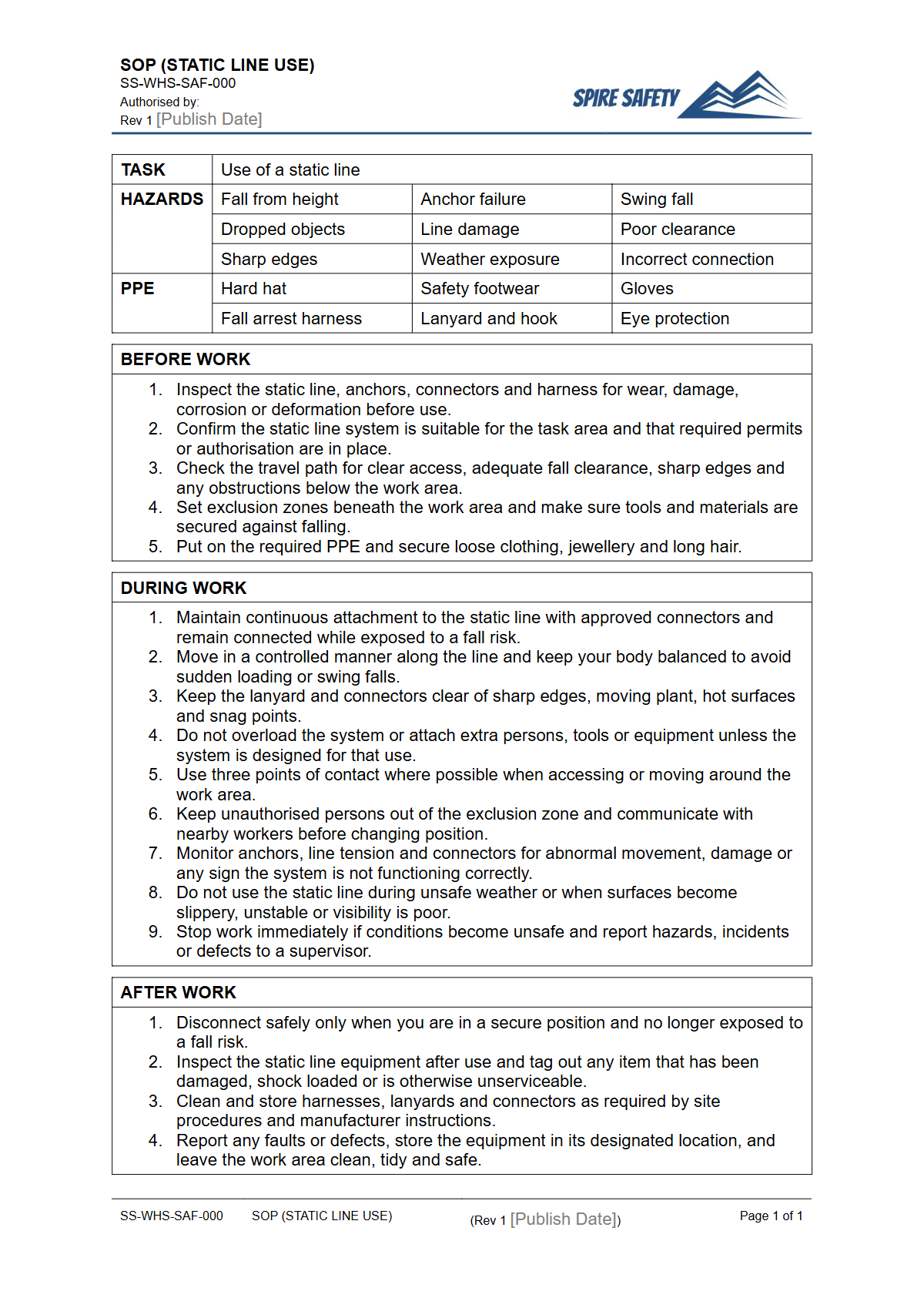
Download our free Safe Operating Procedure (Static Line Use) Template. This structured document helps you outline key safety steps for working with static lines.
Free Safe Operating Procedure (Static Line Use) Template
DOCX • 126 KB + PDF
Updated Oct 2026
No signup required
Purpose of the Free Safe Operating Procedure (Static Line Use) Template
Working at height presents one of the most significant risks in many Australian industries. A static line system is a common and effective control measure for preventing falls, but its safety relies on correct installation, inspection, and use.
This Free Safe Operating Procedure (Static Line Use) Template provides a structured starting point for documenting the required safety protocols for your workplace. It is designed to help a Person Conducting a Business or Undertaking (PCBU) fulfil their primary duty of care by formalising the steps for pre-use checks, equipment setup, correct usage, and emergency planning related to static lines.
A documented SOP ensures that all workers follow a consistent, safe method for every task involving the system, reducing the chance of human error. It serves as a critical training resource for inductions and refresher courses, and acts as a foundation for building robust WHS management systems that proactively manage high-risk activities.
Using this template helps translate legislative requirements and Australian Standards into practical, actionable steps for your team.
Video walkthrough
How to use the Free Safe Operating Procedure (Static Line Use) Template
This template is available for download in both DOCX and PDF formats. The DOCX version is fully editable, allowing you to adapt it to your specific operational needs.
To use the template effectively, you must review and customise each section to reflect the unique conditions of your site, the specific type of static line system in use (e.g., permanent vs. temporary), and the competency levels of your workers.
Important: This is a template, not a finished document. We have included placeholder text and prompts to guide you.
You must replace these with information specific to your business, including details about your equipment, fall clearance calculations, inspection schedules, and site-specific emergency and rescue plans. If you need assistance in tailoring this document or implementing it effectively, our WHS consulting services can provide expert guidance.
When to use a Static Line SOP
A Safe Operating Procedure for static line use should be developed, implemented, and reviewed before any work at height commences where such a system is the primary means of fall protection. It is not a document to be filed away; it is an active tool for daily use.
It should be readily accessible to all relevant personnel, including supervisors and workers, at the point of work.
This SOP is essential for:
- Training and inducting new workers on fall arrest systems.
- Conducting pre-start meetings and task-specific risk assessments.
- Providing a clear reference for workers during tasks like roof plumbing, solar panel installation, or façade maintenance.
- Supervising high-risk work to ensure procedures are being followed correctly.
- Periodic refresher training to maintain worker competency.
For complex tasks that involve multiple high-risk activities, this SOP should be used alongside other relevant procedures. For instance, accessing a roof area with a specialised piece of plant would require referencing both this document and a specific telehandler SOP to ensure all stages of the job are covered.
Who should use it
This template is designed for use by anyone responsible for workplace safety and the direct management of work at height. This includes:
- WHS Managers and Safety Officers: To develop and integrate the SOP into the broader safety management system.
- Supervisors and Team Leaders: To train their teams, enforce the procedure, and conduct pre-use inspections.
- Workers: As a guide for safely performing their duties and understanding their responsibilities when using a static line.
- PCBUs and Directors: To ensure they have a formal system in place to manage the risks associated with falls from height.
The effectiveness of any SOP depends on its consistent application and regular review. The procedure should be reviewed whenever there is a change in equipment or work methods, or after an incident.
Regular safety checks, which can be validated through formal WHS compliance auditing, ensure the procedures remain relevant and effective over time. Workers performing a variety of tasks at height, such as those doing hot work, should use this in conjunction with other task-specific documents like an Oxy Acetylene SOP. For more templates and safety guides, you can browse our complete free WHS resources library.
Common mistakes
Common mistakes to avoid
- Using anchor points that have not been certified by a competent person.
- Allowing more users on the static line than it is rated for.
- Failing to conduct and document a visual inspection of all components before each use.
- Incorrectly calculating fall clearance, leading to a worker hitting the ground or a lower level despite the system arresting the fall.
Legal references
Legal considerations
The following legal requirements may be relevant to this type of work.
- Work Health and Safety Act (Harmonised) — Provides the primary duties for protecting workers and other people from work health and safety risks.
- Work Health and Safety Regulations (Harmonised) — Sets out requirements supporting the management of workplace hazards and risks.
The following codes may be relevant to this type of work.
- Managing WHS Risks Code of Practice — Provides practical guidance on identifying hazards, assessing risks and applying effective controls.
- Work Health and Safety Consultation, Cooperation and Coordination Code of Practice — Provides practical guidance on consulting workers and coordinating with other duty holders.
- Managing the Work Environment and Facilities Code of Practice — Provides practical guidance on safe work environments, workplace facilities and related controls.
Did you know
Fall Forces
A fall from height can generate immense forces. A fall arrest system must be designed to limit the force on the worker's body to under 6kN, but the anchor points and static line itself may be subjected to much higher loads during a fall event.
Australia's Leading Cause of Fatalities
According to Safe Work Australia, falls from height are a leading cause of workplace fatalities and serious injuries in the construction industry. Having robust procedures like an SOP is a critical control measure.
FAQ
Frequently asked questions
01What is a static line system?
02Who is qualified to install or certify a static line?
03Does this SOP template cover rescue procedures?
04How often should static line equipment be inspected?
Share this resource
Free Safe Operating Procedure (Static Line Use) Template
Browse Categories
How To Use It
- 1Download and open in Word or PDF.
- 2Replace the placeholders with your business details.
- 3Get it reviewed by a WHS specialist before rollout.
Need it customised?
Our WHS consultants can adapt this template to your site, run a gap analysis, or audit what you already have in place.
Book a Free Consultation WHS consulting servicesor call 1300 156 382
Related templates
- Free Safe Operating Procedure (Steam Cleaner) Template
- Free Safe Operating Procedure (Steam Iron) Template
- Free Safe Operating Procedure (Steam Room Cleaning) Template
- Free Safe Operating Procedure (Steam Wand Cleaning) Template
- Free Safe Operating Procedure (Stick Blender) Template
- Free Safe Operating Procedure (Stillages) Template