
Free Safe Operating Procedure (Stand Up Paddleboard) Template
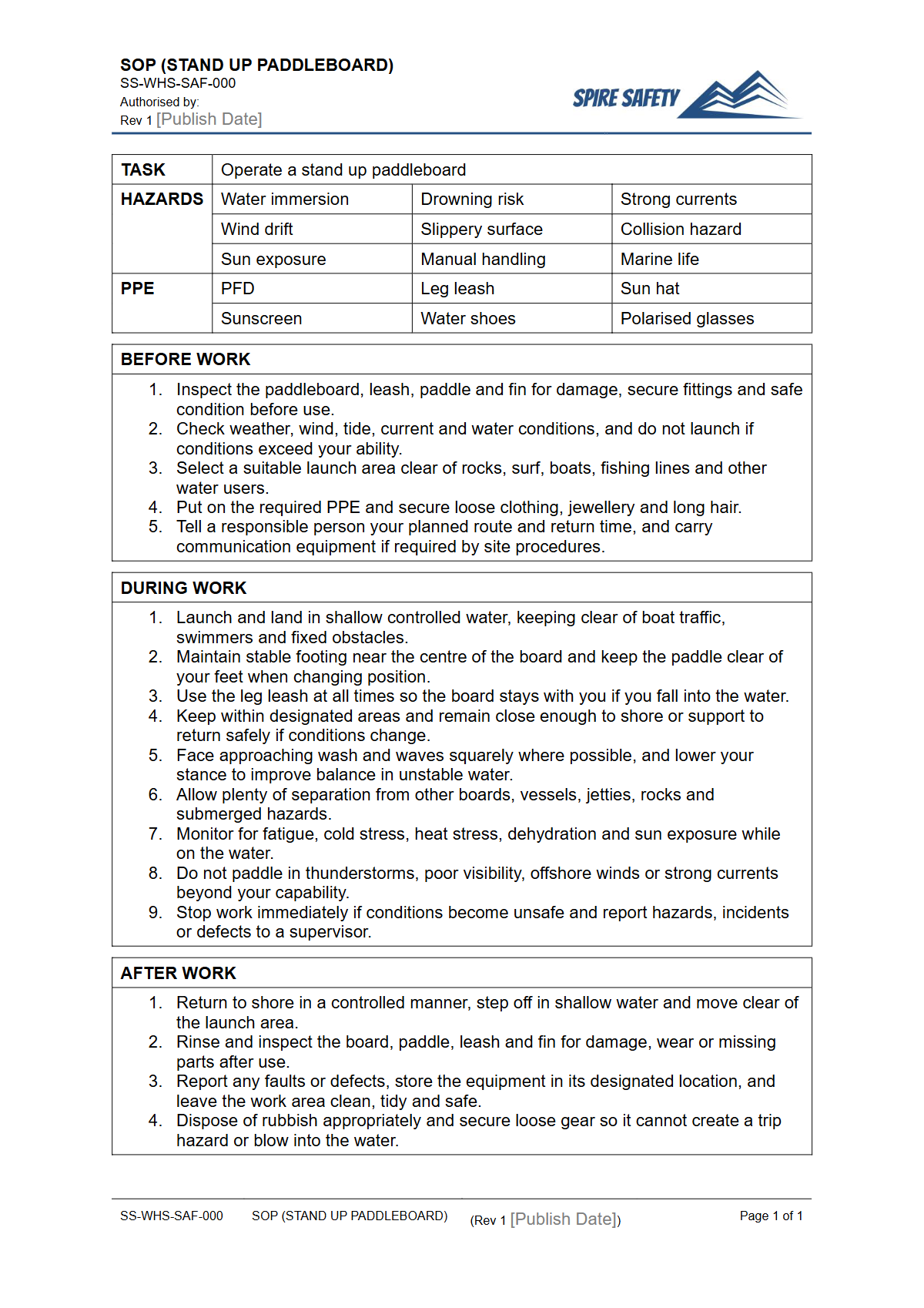
Formalise safety protocols for stand up paddleboard use with our free SOP template. Download the customisable DOCX to define controls and ensure safe operation.
Free Safe Operating Procedure (Stand Up Paddleboard) Template
DOCX • 126 KB + PDF
Updated Oct 2026
No signup required
Purpose of the Free Safe Operating Procedure (Stand Up Paddleboard) Template
This Free Safe Operating Procedure (Stand Up Paddleboard) Template provides a structured framework for documenting the safety requirements for using stand up paddleboards (SUPs) in a commercial or organisational setting. Whether you operate a rental business, run tours, or manage a club, having a clear, documented SOP is a critical step in managing risk and demonstrating due diligence.
It helps standardise safety practices, ensuring everyone from instructors to clients understands the potential hazards and control measures involved.
The primary purpose of this Safe Operating Procedure template is to help you create a task-specific risk management document. It guides you through identifying hazards associated with SUP activities—such as drowning, changing weather conditions, marine life, and other water users—and implementing effective control measures. A well-developed SOP forms a key component of your overall safety framework, contributing to more robust WHS management systems.
Video walkthrough
How to use the Free Safe Operating Procedure (Stand Up Paddleboard) Template
To get started, download the template in your preferred format (DOCX for easy editing or PDF). The document is structured with key sections ready for you to complete.
This includes fields for personal protective equipment (PPE) like life jackets and sun protection, pre-operational checks on the board and paddle, and a logical, step-by-step guide to the activity itself.
This template provides a solid foundation based on Australian WHS principles. However, it is essential that you customise it to reflect the specific environment, equipment, and operational context of your workplace.
We cannot guarantee it will cover all unique hazards you may face; compliance depends entirely on your specific implementation and customisation.
When to use it
An SOP for stand up paddleboarding should be an active part of your operations. It should be used during staff training and inductions to establish a baseline of safe behaviour.
It serves as a practical reference tool for supervisors and employees before activities commence, especially as a checklist for weather and equipment checks. The document is also invaluable during safety reviews and audits, providing clear evidence of your documented safety processes. Regular reviews of your SOPs are a core part of effective WHS compliance auditing.
Who should use it
This template is designed for Persons Conducting a Business or Undertaking (PCBUs), managers, and WHS representatives in the tourism and recreation industries. This includes beachfront rental businesses, tour operators, and surf schools.
It is also highly beneficial for sporting clubs, community groups, and educational institutions that offer SUP activities, helping them meet their duty of care obligations.
Key Elements of a SUP Safety Procedure
A robust SOP for paddleboarding must address several key areas. Start with a thorough hazard identification process, considering environmental factors (wind, tides, currents), equipment issues (board or paddle failure), and human factors (fatigue, lack of skill).
Your control measures should directly address these hazards; for example, setting wind speed limits for operation, mandating leg leashes and PFDs, and defining 'no-go' zones. The procedure should also contain a clear emergency response plan, detailing steps for self-rescue, assisting others, and contacting emergency services.
A Safe Operating Procedure is a fundamental tool for managing risk for any specific task. By standardising procedures, you create consistency and reduce the likelihood of incidents, whether the task involves operating heavy machinery, for which we offer a FREE Telehandler SOP Template, or using powered hand tools, covered in our FREE Circular Saw SOP. The principles of hazard identification, risk control, and clear instructions apply universally.
Even seemingly simple equipment benefits from a documented procedure, reinforcing the importance of a safety-first culture. For instance, our Free Air Compressor SOP Template outlines the checks needed for a common piece of workshop equipment that can pose significant risks if used incorrectly.
Systematically documenting procedures for all equipment and tasks strengthens your overall safety posture. You can explore our complete range of templates in our free WHS resources library to find documents relevant to your other operational needs.
Common mistakes
Common mistakes to avoid
- Forgetting to check detailed weather forecasts, including wind speed, wind direction, and tide charts.
- Paddling alone without informing someone of your intended route and estimated return time.
- Failing to wear a suitable Personal Flotation Device (PFD) and leg leash.
- Underestimating offshore winds that can make returning to shore extremely difficult or impossible.
Legal references
Legal considerations
The following legal requirements may be relevant to this type of work.
- Work Health and Safety Act (Harmonised) — Provides the primary duties for protecting workers and other people from work health and safety risks.
- Work Health and Safety Regulations (Harmonised) — Sets out requirements supporting the management of workplace hazards and risks.
The following codes may be relevant to this type of work.
- Managing WHS Risks Code of Practice — Provides practical guidance on identifying hazards, assessing risks and applying effective controls.
- Work Health and Safety Consultation, Cooperation and Coordination Code of Practice — Provides practical guidance on consulting workers and coordinating with other duty holders.
- Managing the Work Environment and Facilities Code of Practice — Provides practical guidance on safe work environments, workplace facilities and related controls.
Did you know
The Leash is a Lifeline
In windy conditions or strong currents, a paddleboard can be swept away faster than a person can swim. A leg or waist leash is critical safety equipment that keeps you connected to your board, which serves as your primary source of flotation.
PFD vs. Life Jacket
PFDs (Personal Flotation Devices) are designed to assist with flotation and are often more comfortable for constant wear. Traditional life jackets provide more buoyancy and are designed to turn an unconscious person face-up in the water, but can be bulkier.
FAQ
Frequently asked questions
01What should be included in a Safe Operating Procedure for stand up paddleboarding?
02Is a life jacket legally required for stand up paddleboarding in Australia?
03How often should an SOP for SUPs be reviewed?
04Can this template be used for commercial stand up paddleboard tours?
Share this resource
Free Safe Operating Procedure (Stand Up Paddleboard) Template
Browse Categories
How To Use It
- 1Download and open in Word or PDF.
- 2Replace the placeholders with your business details.
- 3Get it reviewed by a WHS specialist before rollout.
Need it customised?
Our WHS consultants can adapt this template to your site, run a gap analysis, or audit what you already have in place.
Book a Free Consultation WHS consulting servicesor call 1300 156 382
Related templates
- Free Safe Operating Procedure (Standing Aid Check) Template
- Free Safe Operating Procedure (Standing Aid Cleaning) Template
- Free Safe Operating Procedure (Static Line Use) Template
- Free Safe Operating Procedure (Steam Cleaner) Template
- Free Safe Operating Procedure (Steam Iron) Template
- Free Safe Operating Procedure (Steam Room Cleaning) Template