
Free Safe Operating Procedure (Stable Manure Removal) Template
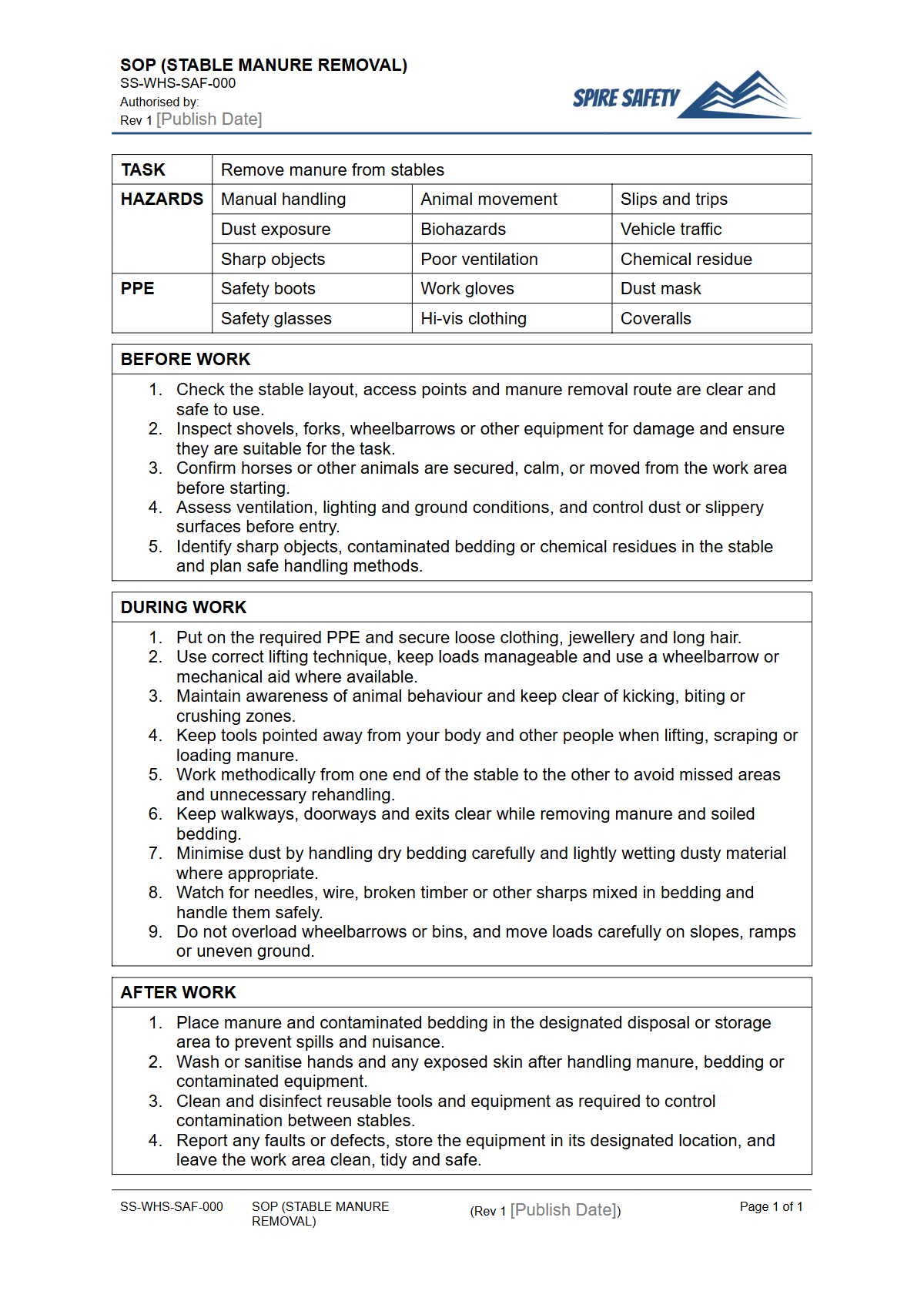
Manage the risks of stable manure removal with our structured template. Download this free Safe Operating Procedure to establish clear, safe work instructions.
Free Safe Operating Procedure (Stable Manure Removal) Template
DOCX • 126 KB + PDF
Updated Oct 2026
No signup required
Purpose of the Free Safe Operating Procedure (Stable Manure Removal) Template
Effectively managing workplace health and safety in agricultural and equestrian environments requires clear, documented processes for routine tasks. This Free Safe Operating Procedure (Stable Manure Removal) Template provides a structured framework for outlining the risks and required control measures for cleaning stables and yards.
Documenting the process helps to standardise your approach, ensuring every worker understands the sequence of tasks, the hazards involved (such as biological contaminants, manual handling, and equipment operation), and the safety precautions required. By implementing a formal SOP, you create a safer work environment and take a crucial step in fulfilling your duties as a Person Conducting a Business or Undertaking (PCBU) under Australian WHS legislation.
Video walkthrough
A well-defined SOP is a fundamental component of effective WHS management systems. It serves as a practical tool for training, supervision, and incident investigation, demonstrating a proactive commitment to risk management. This template helps you systematically address hazards before they lead to injury or illness.
How to use the Free Safe Operating Procedure (Stable Manure Removal) Template
This resource is available for immediate download in both DOCX and PDF formats. The DOCX file is fully editable, allowing you to tailor the content to the specific conditions, equipment, and procedures of your workplace.
The PDF version is ideal for printing and display in relevant work areas once finalised.
Important: This is a template, not a finished document. To be effective, you must customise it to reflect your site's unique environment.
We recommend a competent person reviews and adapts the content, adding details about the specific types of manure, cleaning agents used, models of any machinery involved, emergency procedures, and required Personal Protective Equipment (PPE). If you need assistance with customisation or developing more complex safety documents, our WHS consulting services can provide expert guidance.
When to use this Safe Operating Procedure
An SOP for stable manure removal should be used as a primary reference document for the task. It is essential for inducting new workers and for providing refresher training to existing staff to prevent procedural drift.
It should also be reviewed before commencing work, especially if the task is performed infrequently. Integrating this SOP into your safety management system ensures a consistent and safe approach every time.
If mechanical aids are used, this procedure should be used in conjunction with equipment-specific documents, like our free Scraper SOP, to cover all aspects of the operation.
Who should use this Safe Operating Procedure
This template is designed for use by anyone with responsibilities for workplace health and safety in settings where manure is managed. This includes stable owners, farm managers, team leaders, and agricultural business owners (PCBUs).
It is also a vital resource for the workers who perform the task, giving them clear, step-by-step instructions to follow for their own safety and the safety of others. Using this document helps ensure everyone involved has access to the same approved methodology for completing the job safely.
For tasks that follow manure removal, such as field application, a separate procedure is necessary. Our free Spreader SOP template can provide a starting point for documenting that process.
Similarly, if larger equipment is part of your operation, you may need additional procedures like a Telehandler SOP to ensure all machinery use is covered.
Developing task-specific procedures is a core part of a robust safety framework. For a broader understanding of how to structure these documents for any task, you might find our general Safe Operating Procedure (SOP) Template a useful reference.
Properly documented procedures form the backbone of a safe system of work, helping to minimise risk and streamline operations. Feel free to browse our complete library of free WHS resources for more templates and checklists to support your safety goals.
Common mistakes
Common mistakes to avoid
- Underestimating the risk of biological hazards and not using appropriate PPE (gloves, masks).
- Using incorrect manual handling techniques, leading to back and shoulder strains.
- Failing to adequately train workers on the procedure, especially new or casual staff.
- Neglecting to inspect tools and equipment (e.g., wheelbarrows, forks, loaders) for defects before use.
Legal references
Legal considerations
The following legal requirements may be relevant to this type of work.
- Work Health and Safety Act (Harmonised) — Provides the primary duties for protecting workers and other people from work health and safety risks.
- Work Health and Safety Regulations (Harmonised) — Sets out requirements supporting the management of workplace hazards and risks.
The following codes may be relevant to this type of work.
- Managing WHS Risks Code of Practice — Provides practical guidance on identifying hazards, assessing risks and applying effective controls.
- Work Health and Safety Consultation, Cooperation and Coordination Code of Practice — Provides practical guidance on consulting workers and coordinating with other duty holders.
- Managing the Work Environment and Facilities Code of Practice — Provides practical guidance on safe work environments, workplace facilities and related controls.
Did you know
Biological Hazards
Horse manure can contain pathogens such as Salmonella, E. coli, and Clostridium tetani (which causes tetanus), making PPE like gloves and proper hand hygiene essential.
Weight and Volume
A single horse can produce over 20kg of manure and soiled bedding per day. Repetitive lifting and moving of this weight is a major risk factor for musculoskeletal disorders.
FAQ
Frequently asked questions
01What are the main hazards of stable manure removal?
02Is an SOP a legal requirement for removing stable manure?
03How often should I review a Stable Manure Removal SOP?
04Can I use this template for a large-scale commercial composting facility?
Share this resource
Free Safe Operating Procedure (Stable Manure Removal) Template
Browse Categories
How To Use It
- 1Download and open in Word or PDF.
- 2Replace the placeholders with your business details.
- 3Get it reviewed by a WHS specialist before rollout.
Need it customised?
Our WHS consultants can adapt this template to your site, run a gap analysis, or audit what you already have in place.
Book a Free Consultation WHS consulting servicesor call 1300 156 382
Related templates
- Free Safe Operating Procedure (Stadium Seat Cleaning) Template
- Free Safe Operating Procedure (Stair Chair Operation) Template
- Free Safe Operating Procedure (Stair Handrail Clean) Template
- Free Safe Operating Procedure (Stair Tread Cleaning) Template
- Free Safe Operating Procedure (Stand Up Paddleboard) Template
- Free Safe Operating Procedure (Standing Aid Check) Template