
Free Safe Operating Procedure (Stair Handrail Clean) Template
Download our free Safe Operating Procedure (Stair Handrail Clean) Template to formalise your cleaning processes. This customisable document helps ensure safety.
Free Safe Operating Procedure (Stair Handrail Clean) Template
DOCX • 126 KB + PDF
Updated Oct 2026
No signup required
Purpose of the Free Safe Operating Procedure (Stair Handrail Clean) Template
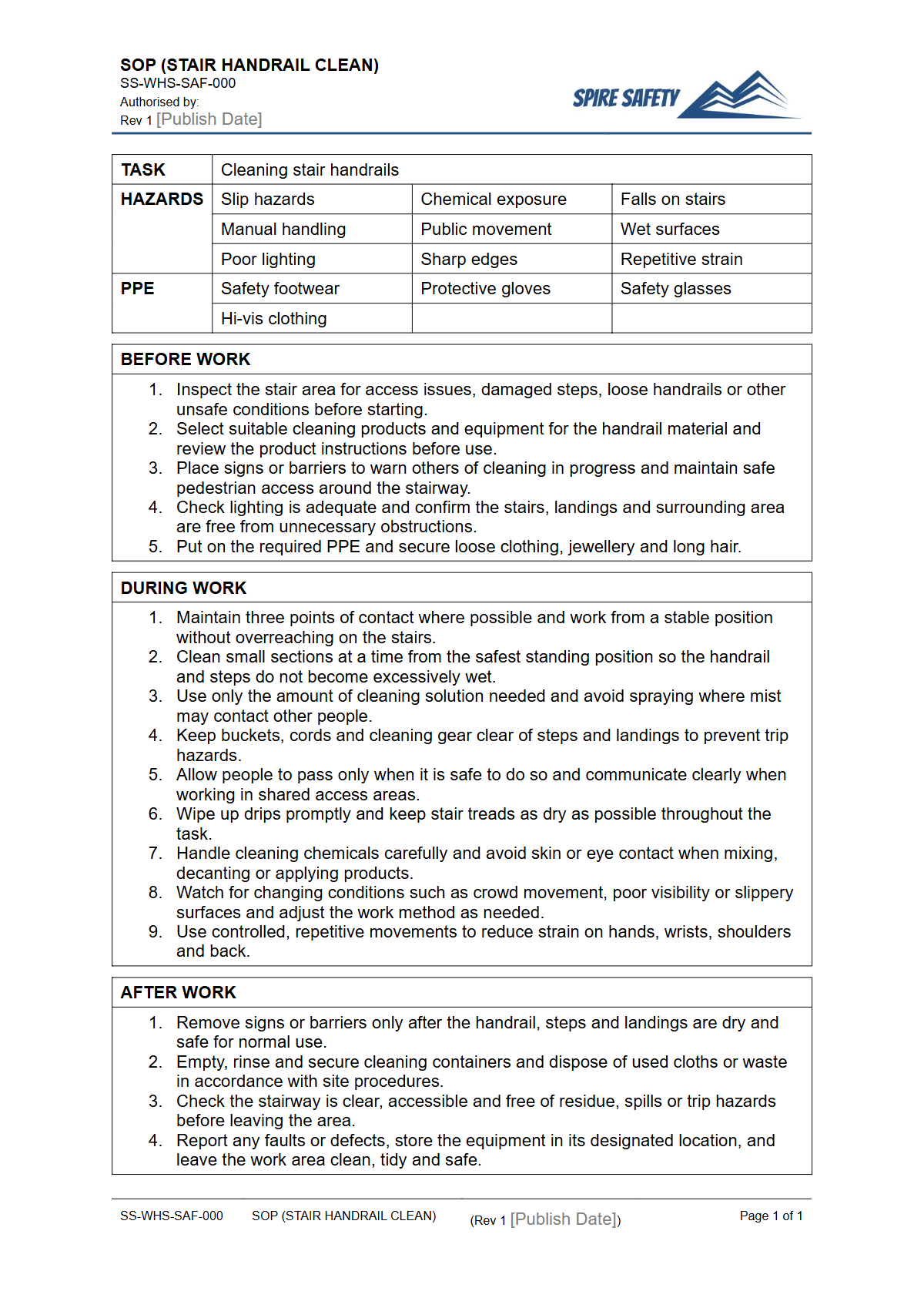
This Free Safe Operating Procedure (Stair Handrail Clean) Template provides a structured framework for documenting the safe and correct method for cleaning and disinfecting stair handrails. While seemingly a simple task, cleaning activities carry inherent risks, including exposure to hazardous chemicals, slips and trips from wet surfaces, and ergonomic strains.
Formalising the process in an SOP helps mitigate these risks by ensuring all workers perform the task consistently and safely.
An effective SOP is a vital tool for worker training, operational consistency, and demonstrating due diligence in managing workplace health and safety. It clearly outlines potential hazards, required personal protective equipment (PPE), and the step-by-step process to be followed.
This helps maintain high standards of hygiene and safety, which is crucial in any facility. The principles are similar to those in a Safe Operating Procedure for deep fryer cleaning, where specific hazards and controls must be clearly defined for a routine task.
Video walkthrough
How to use the Free Safe Operating Procedure (Stair Handrail Clean) Template
To use this Safe Operating Procedure for stair handrail cleaning, simply download the customisable DOCX file or the ready-to-print PDF. The DOCX version is designed to be adapted to your specific operational needs.
It is essential to review and modify the template to align with the unique context of your workplace.
It's crucial to remember that this is a template, not a finished document. We have designed it to be a starting point, but you must adapt it to reflect the specific chemicals, equipment, PPE, and environmental conditions of your workplace. Key areas for customisation include:
- Identifying the specific cleaning agents and disinfectants used, referencing their Safety Data Sheets (SDS).
- Listing the exact PPE required (e.g., type of gloves, eye protection).
- Detailing site-specific hazards (e.g., high-traffic areas, poor lighting on stairs).
- Outlining emergency procedures for chemical spills or exposure.
- Assigning responsibilities for performing, supervising, and reviewing the task.
Integrating tailored SOPs into your daily operations is a cornerstone of effective safety management. These documents should form part of your organisation's broader robust WHS management systems, ensuring that safety is embedded in every task.
When to use it
A Safe Operating Procedure for cleaning stair handrails should be used consistently as part of your facility's cleaning and maintenance schedule. It is particularly important during the induction and training of new cleaning or maintenance staff to ensure they understand the correct, safe method from the outset.
The document also serves as a valuable reference for experienced staff and can be used for regular refresher training sessions to reinforce safe work practices.
Beyond routine use, the SOP should be referenced before starting a clean in a new or unfamiliar area and reviewed as part of any incident investigation related to cleaning tasks. You can find SOPs for a wide range of other tasks and equipment in our free WHS resources library to build out your procedural documentation.
Who should use it
This SOP is primarily intended for the workers who perform the cleaning tasks. It provides them with clear, unambiguous instructions to follow, helping to protect them from injury and illness.
By standardising the procedure, it ensures every worker approaches the task with the same level of safety awareness.
Supervisors and managers also have a key role. They should use the SOP to train their teams, monitor performance, and supports your compliance efforts with the documented safety measures.
WHS officers and facility managers can use the document as part of their risk management processes and to demonstrate that control measures for identified hazards are in place and communicated effectively. Regular WHS compliance audits can verify that procedures like this are being followed correctly and are still effective.
Key Elements of a Handrail Cleaning SOP
A comprehensive SOP for this task will always include several critical sections. The first is Hazard Identification, which lists potential risks such as chemical exposure, slips from wet floors, and ergonomic issues from repetitive motions or awkward postures.
For complex ergonomic challenges beyond the scope of a simple SOP, engaging with WHS consulting professionals can provide tailored assessments and solutions.
The second key element is Control Measures. This section details the practical steps taken to eliminate or minimise the identified hazards.
Examples include specifying the correct dilution ratios for chemicals, mandating the use of 'Wet Floor' signs, and requiring specific PPE like chemical-resistant gloves and safety glasses. While cleaning handrails seems straightforward, the principles of identifying hazards and controls are the same as for more complex tasks, such as those covered in our conveyer system SOP.
Finally, the SOP should outline requirements for training and competency. It should state that all operators must be trained on the procedure before undertaking the task and that records of this training should be maintained.
This ensures a consistent and safe approach across the entire workforce.
Common mistakes
Common mistakes to avoid
- Using incorrect or improperly diluted cleaning chemicals, which can be ineffective or hazardous.
- Forgetting to place 'Wet Floor' or other appropriate warning signs, creating a slip hazard for others.
- Failing to customise the generic SOP template to reflect site-specific chemicals, hazards, and conditions.
- Neglecting to provide, wear, or maintain the personal protective equipment (PPE) specified in the SOP.
Legal references
Legal considerations
The following legal requirements may be relevant to this type of work.
- Work Health and Safety Act (Harmonised) — Provides the primary duties for protecting workers and other people from work health and safety risks.
- Work Health and Safety Regulations (Harmonised) — Sets out requirements supporting the management of workplace hazards and risks.
The following codes may be relevant to this type of work.
- Managing WHS Risks Code of Practice — Provides practical guidance on identifying hazards, assessing risks and applying effective controls.
- Work Health and Safety Consultation, Cooperation and Coordination Code of Practice — Provides practical guidance on consulting workers and coordinating with other duty holders.
- Managing the Work Environment and Facilities Code of Practice — Provides practical guidance on safe work environments, workplace facilities and related controls.
Did you know
Surface Viability
Studies have shown that pathogens like influenza viruses and coronaviruses can survive on non-porous surfaces like stainless steel handrails for several hours to multiple days, highlighting the importance of regular, effective cleaning.
Slips, Trips, and Falls
According to Safe Work Australia, slips, trips and falls are a leading cause of serious workplace injuries. Using warning signs for wet floors during cleaning is a simple but critical control measure to prevent such incidents.
FAQ
Frequently asked questions
01What should be included in an SOP for cleaning stair handrails?
02How often should stair handrail cleaning procedures be reviewed?
03Is a Safe Operating Procedure legally required for cleaning handrails in Australia?
04What's the difference between an SOP and a SWMS for this task?
Share this resource
Free Safe Operating Procedure (Stair Handrail Clean) Template
Browse Categories
How To Use It
- 1Download and open in Word or PDF.
- 2Replace the placeholders with your business details.
- 3Get it reviewed by a WHS specialist before rollout.
Need it customised?
Our WHS consultants can adapt this template to your site, run a gap analysis, or audit what you already have in place.
Book a Free Consultation WHS consulting servicesor call 1300 156 382
Related templates
- Free Safe Operating Procedure (Stair Tread Cleaning) Template
- Free Safe Operating Procedure (Stand Up Paddleboard) Template
- Free Safe Operating Procedure (Standing Aid Check) Template
- Free Safe Operating Procedure (Standing Aid Cleaning) Template
- Free Safe Operating Procedure (Static Line Use) Template
- Free Safe Operating Procedure (Steam Cleaner) Template