
Free Safe Operating Procedure (Stable Bedding Change) Template
Streamline safety in your stables with a structured procedure for changing animal bedding. Download our free template to help manage risks and guide workers.
Free Safe Operating Procedure (Stable Bedding Change) Template
DOCX • 126 KB + PDF
Updated Oct 2026
No signup required
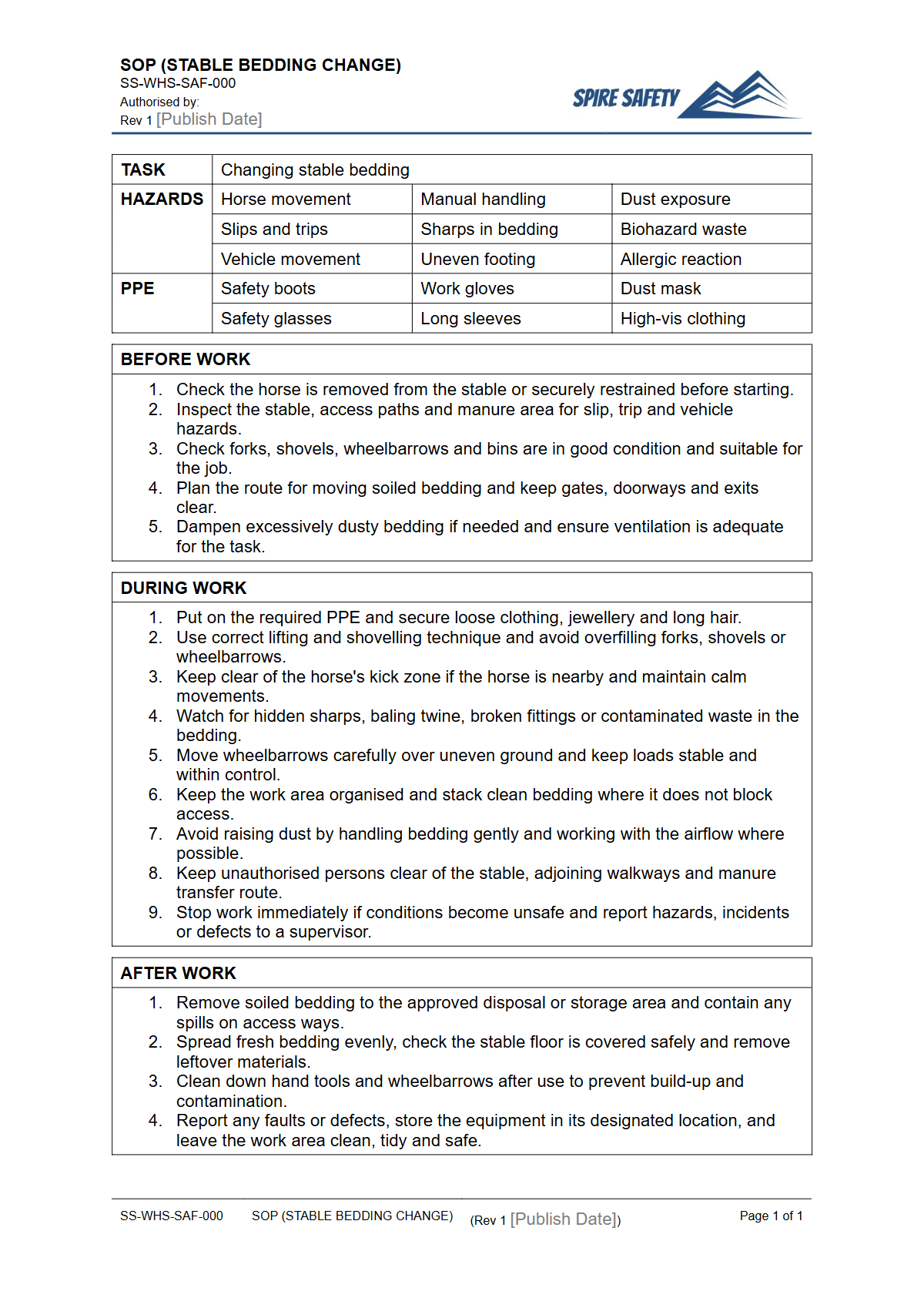
Purpose of the Free Safe Operating Procedure (Stable Bedding Change) Template
Managing an equestrian centre, farm, or animal care facility requires robust safety protocols for routine tasks. This Free Safe Operating Procedure (Stable Bedding Change) Template provides a structured framework for documenting the steps, hazards, and controls associated with mucking out and replacing animal bedding.
By implementing a clear SOP, you can reduce the risk of musculoskeletal injuries, respiratory illness, and incidents involving animals or equipment.
Changing stable bedding is a high-frequency task that combines manual handling, potential interaction with animals, and exposure to organic dust and ammonia. A documented SOP ensures that all workers follow the same safe process every time, promoting a consistent standard of care and safety. This document serves as an essential tool for worker induction, training, and ongoing risk management, forming a key part of your overall WHS management system.
Video walkthrough
How to use the Free Safe Operating Procedure (Stable Bedding Change) Template
This template is a comprehensive starting point, designed to be adapted for your specific operational needs. To use it effectively, download the DOCX file and customise it with details relevant to your workplace.
This includes specifying the types of tools used (e.g., pitchforks, shovels, wheelbarrows), the kind of bedding material (straw, shavings, pellets), and the specific layout of your facility. It is also critical to detail the correct use of any machinery involved, such as a front-end loader or a purpose-built scraper; for more detailed guidance on specific plant, consider using a dedicated free Scraper Safe Operating Procedure.
Important: This is a template, not a finished document. You must consult with your workers and review your specific site conditions to identify all relevant hazards and establish effective controls.
We recommend a competent person reviews and approves the final document before implementation. If you require assistance with customisation or a broader safety review, our WHS consulting team can provide expert support.
When to Use a Safe Operating Procedure
A Safe Operating Procedure (SOP) for stable bedding changes should be used as a primary reference document. It is most effective when integrated into daily operations.
Use it during the induction and training of new employees to ensure they understand the approved method from day one. It should also be readily available in the work area for quick reference by any worker performing the task.
Furthermore, the SOP serves as a critical checklist during safety observations, incident investigations, and periodic reviews of your safety processes. If machinery like a telehandler is used for moving large bales, its operation should be covered here or in a separate document like our FREE Telehandler SOP Template.
Who Should Use This Template
This SOP template is designed for anyone responsible for health and safety in an environment with stabled animals. This includes:
- Business Owners and Managers: To meet their duty of care by providing safe systems of work.
- Supervisors and Team Leaders: To train workers, enforce safety standards, and supervise the task correctly.
- WHS Officers and Coordinators: To develop and formalise workplace safety documentation and risk assessments.
- Workers: As a clear guide on how to perform the task safely, protecting themselves and their colleagues.
Ultimately, the SOP fosters a shared understanding of risk and responsibility. If you need a more generic framework that can be adapted for any task, our general Free Safe Operating Procedure (SOP) Template may also be useful.
Bedding may be added or removed using machinery, so a specific SOP for that equipment is also vital; for instance, you may find our FREE Spreader SOP Template a useful addition.
By standardising procedures, you create a more predictable and controlled work environment. This not only improves safety but can also enhance efficiency. For more tools and templates to support your safety goals, browse our complete free WHS resources library.
Common mistakes
Common mistakes to avoid
- Failing to remove the animal from the stable before cleaning, increasing the risk of injury.
- Not using appropriate respiratory protection (RPE) in poorly ventilated areas.
- Using incorrect manual handling techniques when lifting soiled bedding or new bales.
- Working alone in an isolated area without a proper communication or check-in system.
Legal references
Legal considerations
The following legal requirements may be relevant to this type of work.
- Work Health and Safety Act (Harmonised) — Provides the primary duties for protecting workers and other people from work health and safety risks.
- Work Health and Safety Regulations (Harmonised) — Sets out requirements supporting the management of workplace hazards and risks.
The following codes may be relevant to this type of work.
- Managing WHS Risks Code of Practice — Provides practical guidance on identifying hazards, assessing risks and applying effective controls.
- Work Health and Safety Consultation, Cooperation and Coordination Code of Practice — Provides practical guidance on consulting workers and coordinating with other duty holders.
- Managing the Work Environment and Facilities Code of Practice — Provides practical guidance on safe work environments, workplace facilities and related controls.
Did you know
A Hidden Hazard
Organic dust from hay and bedding can contain fungi and endotoxins that lead to serious respiratory conditions like "Farmer's Lung," a type of hypersensitivity pneumonitis.
Manual Task Risk
The agriculture sector has one of the highest rates of musculoskeletal injury claims in Australia, with tasks like shovelling and lifting being major contributors.
FAQ
Frequently asked questions
01What PPE is required when changing stable bedding?
02Is a Safe Operating Procedure a legal requirement in Australia?
03How should animals be managed during the bedding change process?
04How often should an SOP for stable bedding changes be reviewed?
Share this resource
Free Safe Operating Procedure (Stable Bedding Change) Template
Browse Categories
How To Use It
- 1Download and open in Word or PDF.
- 2Replace the placeholders with your business details.
- 3Get it reviewed by a WHS specialist before rollout.
Need it customised?
Our WHS consultants can adapt this template to your site, run a gap analysis, or audit what you already have in place.
Book a Free Consultation WHS consulting servicesor call 1300 156 382
Related templates
- Free Safe Operating Procedure (Stable Manure Removal) Template
- Free Safe Operating Procedure (Stadium Seat Cleaning) Template
- Free Safe Operating Procedure (Stair Chair Operation) Template
- Free Safe Operating Procedure (Stair Handrail Clean) Template
- Free Safe Operating Procedure (Stair Tread Cleaning) Template
- Free Safe Operating Procedure (Stand Up Paddleboard) Template