
Free Safe Operating Procedure (Spreader Beam) Template
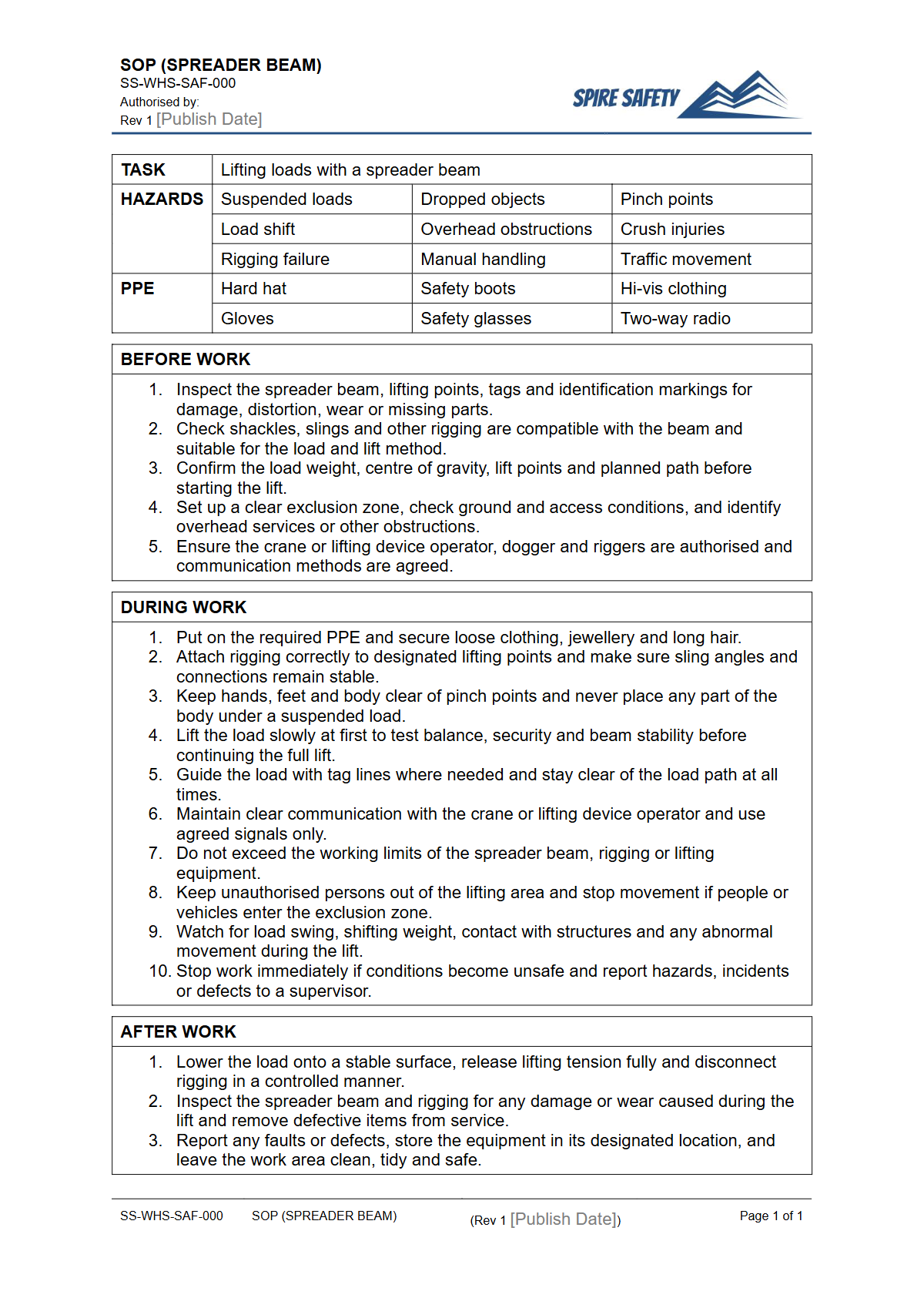
Download our free Safe Operating Procedure (Spreader Beam) Template to formalise instructions for safe lifting operations. Get your customisable DOCX now.
Free Safe Operating Procedure (Spreader Beam) Template
DOCX • 126 KB + PDF
Updated Oct 2026
No signup required
Purpose of the Free Safe Operating Procedure (Spreader Beam) Template
Using a spreader beam is a high-risk activity that requires precise planning and execution. This Free Safe Operating Procedure (Spreader Beam) Template provides a structured starting point for your business to document the required steps for safely setting up, using, and storing this critical lifting equipment.
Formalising your process helps prevent catastrophic failures, such as load instability, rigging failure, or structural collapse, which can lead to serious injuries or fatalities. A clear SOP ensures all personnel understand their roles, the equipment's limitations, and the emergency procedures.
It standardises safe work practices, assists in training, and demonstrates a commitment to managing workplace risks effectively.
By defining pre-operational checks, load calculation methods, and communication protocols, this procedure becomes a vital tool for supervisors and workers alike. Integrating this SOP into your operations is a practical step towards building a safer work environment.
These documents form a critical component of any well-structured WHS management system, providing auditable evidence of your risk control measures.
Video walkthrough
How to use the Free Safe Operating Procedure (Spreader Beam) Template
This template is provided in an easy-to-use DOCX format, allowing for full customisation to suit your specific operational needs. Once downloaded, you should meticulously review and adapt each section to align with the spreader beams, cranes, and lifting scenarios unique to your workplace.
Key areas for customisation include specifying the types of loads, the required personal protective equipment (PPE), site-specific environmental hazards, and your organisation's communication protocols. You can also add or remove steps to accurately reflect your processes.
Please note: This document is a template and must be customised to reflect the specific equipment, personnel, and operational environment of your workplace. We are not liable for any incidents that may arise from the use of this template.
It is designed to be a starting point, not a finished, document. For a more generic framework that you can adapt for other plant and equipment, consider downloading our general Safe Operating Procedure (SOP) Template.
When to use a Safe Operating Procedure for a Spreader Beam
A Safe Operating Procedure for a spreader beam should be consulted and strictly followed before, during, and after any lifting operation involving the device. It is not a document to be filed away; it is an active tool for risk management.
Its primary use is during the planning phase of any lift to ensure all safety checks and calculations are completed. It is also an essential resource for training new operators and riggers, providing them with a clear, step-by-step guide to safe operation.
This SOP should also be used for conducting regular competency assessments of your team members.
Furthermore, the SOP serves as a critical reference document during safety meetings, toolbox talks, and post-incident investigations. When lifting operations involve other machinery, it's crucial to have SOPs for all equipment, such as our FREE Telehandler SOP Template, to ensure all interfaces and concurrent activities are managed safely.
Who should use this Safe Operating Procedure
This SOP is intended for a range of personnel involved in lifting operations. Crane operators, doggers, and riggers are the primary users, as it dictates the practical steps they must follow to perform their tasks safely.
Site supervisors and project managers must also be thoroughly familiar with the procedure to effectively oversee operations, allocate resources, and ensure the process is being followed correctly. It provides them with a clear benchmark for performance and safety compliance.
Workplace Health and Safety (WHS) officers and managers will use this document to facilitate risk assessments, deliver training, and conduct workplace inspections. It forms a key piece of evidence during safety audits, demonstrating that risks associated with spreader beam use have been systematically addressed.
Having documented procedures for high-risk tasks is essential for anyone involved in WHS compliance auditing activities. You can find more specific procedural documents for other high-risk tasks in our free WHS resources library to support your team.
Common mistakes
Common mistakes to avoid
- Using incorrect sling angles, which dramatically increases forces on the beam and rigging.
- Failing to account for the total weight of the lift, including the beam and all rigging gear.
- Using incompatible or damaged shackles, slings, or attachment points.
- Conducting the lift without a clear, pre-agreed communication plan between the rigger and operator.
Legal references
Legal considerations
The following legal requirements may be relevant to this type of work.
- Work Health and Safety Act (Harmonised) — Provides the primary duties for protecting workers and other people from work health and safety risks.
- Work Health and Safety Regulations (Harmonised) — Sets out requirements supporting the management of workplace hazards and risks.
The following codes may be relevant to this type of work.
- Managing WHS Risks Code of Practice — Provides practical guidance on identifying hazards, assessing risks and applying effective controls.
- Work Health and Safety Consultation, Cooperation and Coordination Code of Practice — Provides practical guidance on consulting workers and coordinating with other duty holders.
- Managing the Work Environment and Facilities Code of Practice — Provides practical guidance on safe work environments, workplace facilities and related controls.
Did you know
Force Multiplication
The angle of the top slings on a spreader beam is critical. A shallow angle (less than 60 degrees to the horizontal) can dramatically increase the compressive force on the beam and the tension in the slings, potentially exceeding the equipment's rated capacity.
Weight Matters
The self-weight of the spreader beam and all associated rigging (shackles, slings) must be included in the total load calculation. Forgetting to account for this 'tare weight' is a common mistake that can lead to overloading the crane.
FAQ
Frequently asked questions
01What is the difference between a spreader beam and a lifting beam?
02How often should a spreader beam be inspected?
03Who is qualified to use a spreader beam?
04Does this template cover all legal WHS requirements for spreader beams?
Share this resource
Free Safe Operating Procedure (Spreader Beam) Template
Browse Categories
How To Use It
- 1Download and open in Word or PDF.
- 2Replace the placeholders with your business details.
- 3Get it reviewed by a WHS specialist before rollout.
Need it customised?
Our WHS consultants can adapt this template to your site, run a gap analysis, or audit what you already have in place.
Book a Free Consultation WHS consulting servicesor call 1300 156 382
Related templates
- Free Safe Operating Procedure (Spring Coiler) Template
- Free Safe Operating Procedure (Spring Compressor) Template
- Free Safe Operating Procedure (Sprinkler Head Change) Template
- Free Safe Operating Procedure (Sprinkler Head Cleaning) Template
- Free Safe Operating Procedure (Sprinkler Pump Test) Template
- Free Safe Operating Procedure (Sprinkler Valve Test) Template