
Free Safe Operating Procedure (Spring Compressor) Template
Manage high-risk vehicle maintenance tasks with our Safe Operating Procedure for spring compressors. Download your free, customisable template today.
Free Safe Operating Procedure (Spring Compressor) Template
DOCX • 126 KB + PDF
Updated Oct 2026
No signup required
Purpose of the Free Safe Operating Procedure (Spring Compressor) Template
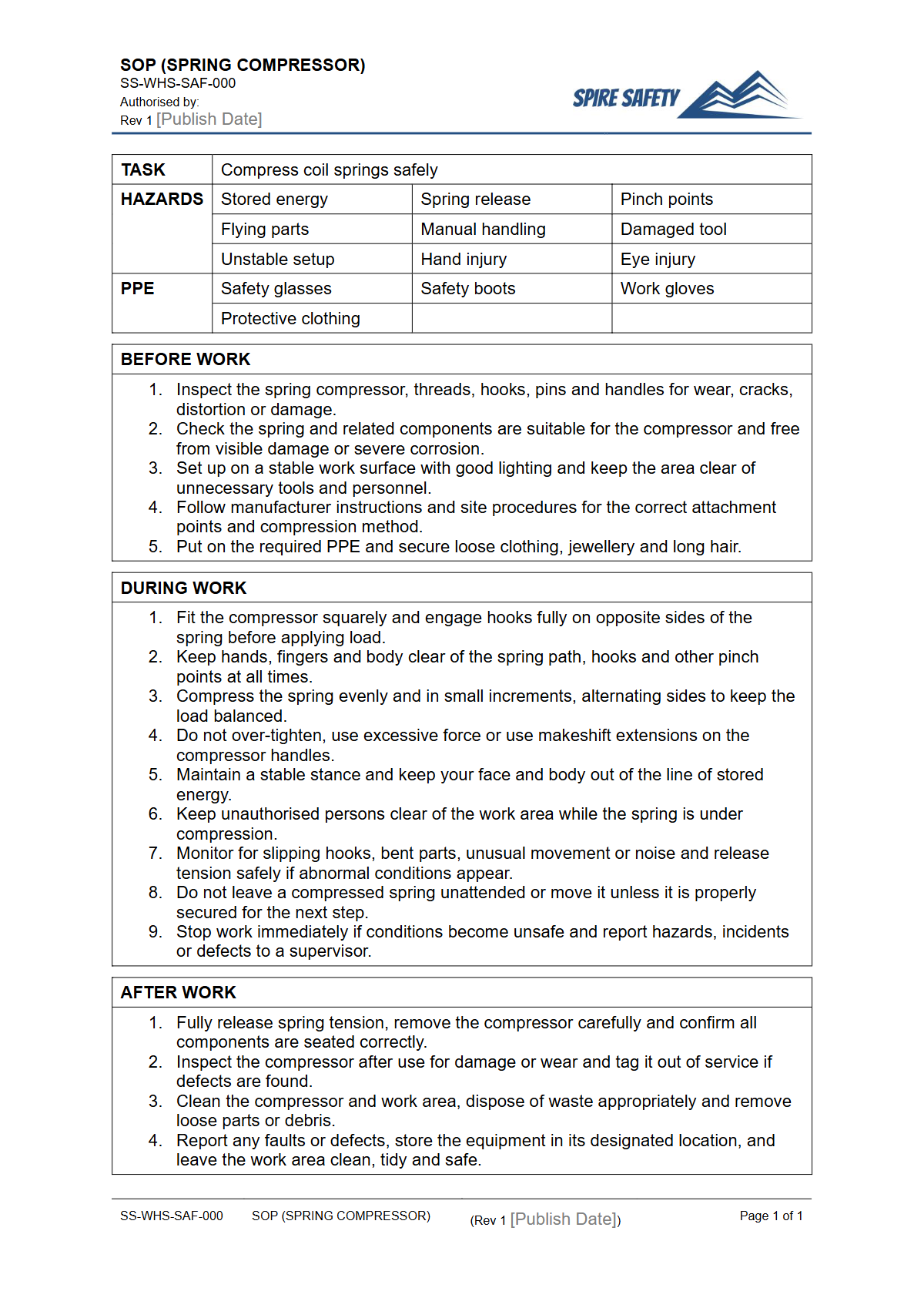
Working with vehicle suspension systems involves managing significant stored energy, a high-risk activity that can lead to severe injuries if not controlled. Our Free Safe Operating Procedure (Spring Compressor) Template provides a structured framework for outlining the required steps to perform this task safely.
It is designed to assist mechanics, workshop managers, and Persons Conducting a Business or Undertaking (PCBUs) in meeting their work health and safety obligations. This document helps formalise pre-operational checks, the step-by-step work process, and post-task clean-up, ensuring a consistent and safe approach every time.
Using this SOP helps identify hazards associated with spring compression, such as the catastrophic release of stored energy, projectile risks from tool failure, and manual handling strains. It prompts the user to document critical control measures, including equipment inspection, correct tool selection, and the use of personal protective equipment (PPE).
This template is a valuable starting point, aligned with Australian WHS principles, for formalising your safety processes for high-risk maintenance tasks. For other common workshop equipment, you may also find our Free Air Compressor SOP useful for standardising safety protocols.
How to use the Free Safe Operating Procedure (Spring Compressor) Template
This resource is available for immediate download as a DOCX file, allowing for easy editing and customisation, and also as a PDF for straightforward printing and distribution. To effectively implement this SOP, you must adapt it to the specific context of your workplace.
A generic procedure is not sufficient to ensure safety; it requires site-specific information to become a practical and effective control measure.
Please note: We have designed this template as a guide. You must customise it with your specific workplace details, including the make and model of your spring compressor, site-specific hazards, and established control measures.
Incorporating this tailored SOP is a crucial component of developing comprehensive WHS management systems that actively protect your workers.
Video walkthrough
When to use a Spring Compressor SOP
A Safe Operating Procedure for spring compressors should be used as a primary reference document for any task involving the compression or decompression of vehicle coil springs. Its use is critical in several scenarios:
- Task execution: Workers must consult the SOP before and during any work on vehicle struts or shock absorbers that require a spring compressor.
- Training and Induction: The SOP is an essential training tool for new mechanics, apprentices, or any worker unfamiliar with the specific equipment used at your site. It forms the basis for demonstrating correct and safe operation.
- Competency Assessments: Use the SOP as a checklist or guide when conducting Verification of Competency (VOC) assessments to ensure workers can perform the task safely and according to the established procedure.
- Incident Investigation: If an incident or near-miss occurs, the SOP serves as a benchmark against which to review the actions taken, helping to identify procedural gaps or training needs.
Regularly reviewing the SOP, especially when new equipment is introduced or procedures change, ensures it remains relevant and effective. For organisations looking for other procedural templates, our generic Free Safe Operating Procedure (SOP) Template can be adapted for a wide variety of tasks.
Who should use this SOP?
This document is intended for use by several key personnel within an automotive service or repair environment:
- Mechanics and Technicians: The primary users who perform the task and must follow the procedure to ensure their own safety and the safety of others in the workshop.
- Apprentices and Trainees: As a learning and guidance tool to build safe work habits from the beginning of their careers.
- Workshop Supervisors and Managers: To enforce safety standards, conduct toolbox talks, and oversee the safe completion of work. Regular reviews of SOP adherence are a key part of their role.
- WHS Officers and Managers: To integrate the procedure into the broader safety management system, use it for risk assessments, and ensure it aligns with legislative requirements.
Ultimately, anyone involved in the lifecycle of this task—from planning and execution to supervision and review—should be familiar with the SOP's contents. Periodic reviews of its implementation can be incorporated into your schedule of WHS compliance auditing to verify its effectiveness.
Safety is a shared responsibility, and a well-drafted SOP provides the clarity needed for everyone to understand their role in managing risk for this hazardous but common workshop procedure. It is also important to document procedures for other high-risk tools, such as those covered in our FREE Oxy Acetylene SOP.
For a wider range of safety documents covering various plant and equipment, browse our complete free WHS resources library.
Common mistakes
Common mistakes to avoid
- Using a compressor that is not rated for the specific spring's size or tension.
- Failing to properly inspect the tool for cracks, bending, or thread wear before each use.
- Incorrectly seating the compressor's jaws or hooks on the spring coils, leading to slippage under load.
- Standing directly in front of the compressed spring assembly during operation.
Legal references
Legal considerations
The following legal requirements may be relevant to this type of work.
- Work Health and Safety Act (Harmonised) — Provides the primary duties for protecting workers and other people from work health and safety risks.
- Work Health and Safety Regulations (Harmonised) — Sets out requirements supporting the management of workplace hazards and risks.
The following codes may be relevant to this type of work.
- Managing WHS Risks Code of Practice — Provides practical guidance on identifying hazards, assessing risks and applying effective controls.
- Work Health and Safety Consultation, Cooperation and Coordination Code of Practice — Provides practical guidance on consulting workers and coordinating with other duty holders.
- Managing the Work Environment and Facilities Code of Practice — Provides practical guidance on safe work environments, workplace facilities and related controls.
Did you know
Explosive Energy
A standard coil spring from a passenger car, when fully compressed, can store thousands of newtons of force. If it were to release uncontrollably, the energy is comparable to a small explosion, capable of causing fatal injuries.
Tool Maintenance is Critical
The threads on a screw-type spring compressor are a critical failure point. Worn, damaged, or unlubricated threads can strip under load, leading to an instantaneous and violent release of the spring.
FAQ
Frequently asked questions
01What are the main hazards of using a spring compressor?
02Is specific training required to use a spring compressor?
03Can I use any type of spring compressor on any vehicle spring?
04What personal protective equipment (PPE) is essential when using a spring compressor?
Share this resource
Free Safe Operating Procedure (Spring Compressor) Template
Browse Categories
How To Use It
- 1Download and open in Word or PDF.
- 2Replace the placeholders with your business details.
- 3Get it reviewed by a WHS specialist before rollout.
Need it customised?
Our WHS consultants can adapt this template to your site, run a gap analysis, or audit what you already have in place.
Book a Free Consultation WHS consulting servicesor call 1300 156 382
Related templates
- Free Safe Operating Procedure (Sprinkler Head Change) Template
- Free Safe Operating Procedure (Sprinkler Head Cleaning) Template
- Free Safe Operating Procedure (Sprinkler Pump Test) Template
- Free Safe Operating Procedure (Sprinkler Valve Test) Template
- Free Safe Operating Procedure (Stable Bedding Change) Template
- Free Safe Operating Procedure (Stable Manure Removal) Template