
Free Safe Operating Procedure (Spring Coiler) Template
Download our free Safe Operating Procedure for spring coiler machines to control risks and standardise operator tasks. Get your customisable template now.
Free Safe Operating Procedure (Spring Coiler) Template
DOCX • 126 KB + PDF
Updated Oct 2026
No signup required
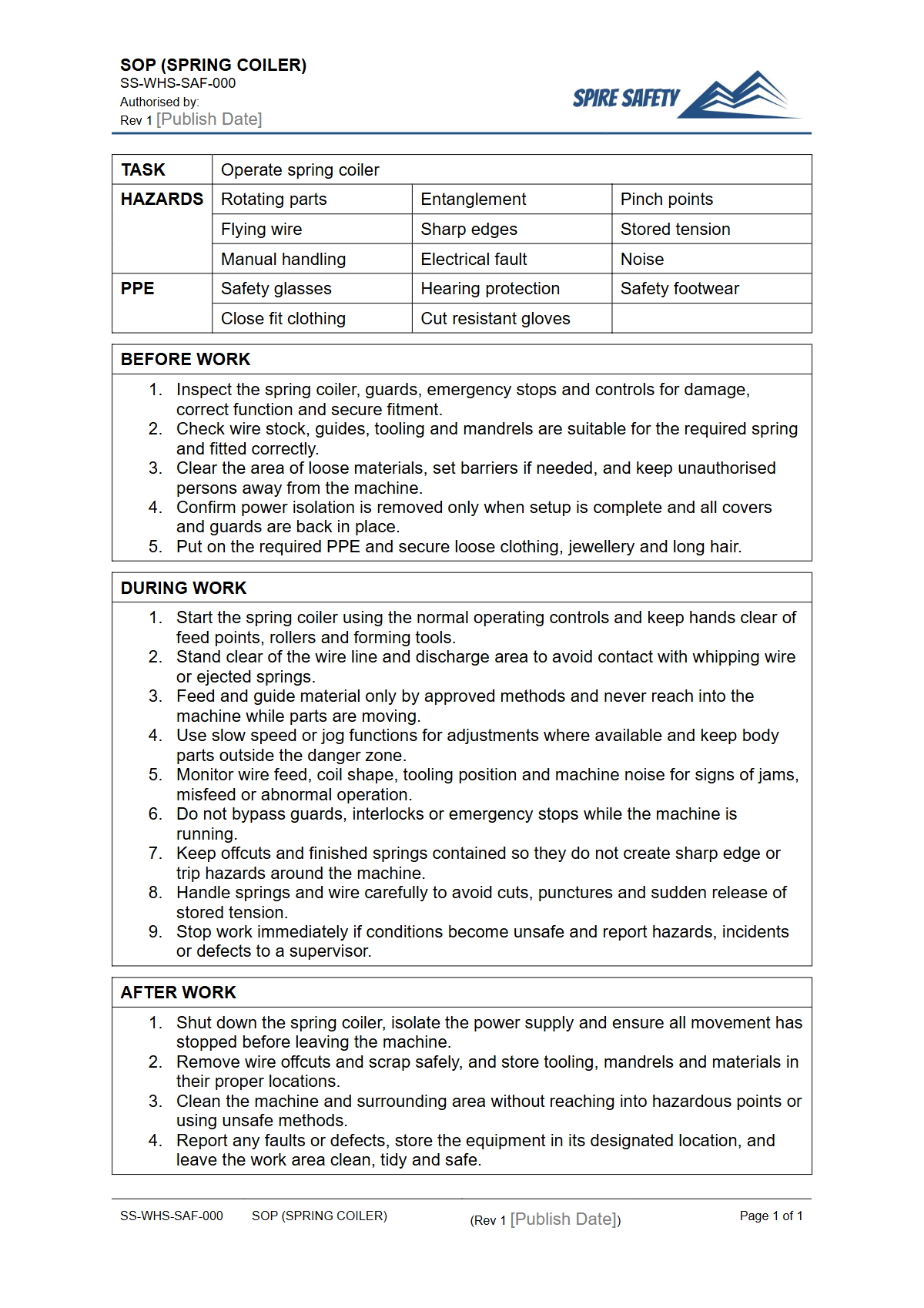
Purpose of the Free Safe Operating Procedure (Spring Coiler) Template
Operating spring coiling machinery presents significant risks, including entanglement, crushing, and cutting hazards. This Free Safe Operating Procedure (Spring Coiler) Template provides a structured framework for documenting the required steps to operate this equipment safely.
It helps organisations standardise their processes, train workers effectively, and demonstrate a commitment to managing workplace hazards. Using a clear SOP is a fundamental part of a proactive safety culture, ensuring every operator understands the approved method for completing tasks, from setup to shutdown.
The template is designed as a starting point, aligned with Australian WHS principles, to help you outline key safety controls. It forms a crucial part of broader WHS management systems by providing clear, actionable guidance for high-risk tasks.
Formalising your procedures reduces the chance of incidents caused by inconsistent practices or lack of knowledge.
Video walkthrough
How to use the Free Safe Operating Procedure (Spring Coiler) Template
This document is a fully editable Word (DOCX) file, allowing for complete customisation. To use this Free Safe Operating Procedure (Spring Coiler) Template effectively, you must consult with the people who actually operate and maintain the equipment.
Their direct experience is invaluable for identifying specific hazards and effective control measures related to your particular machine's make and model. The template prompts for information on pre-start checks, operational steps, emergency procedures, and required Personal Protective Equipment (PPE).
Important: This is a template only. It is not a complete, ready-to-use document.
You must adapt it to the specific machinery, materials, and environment in your workplace. We recommend a thorough risk assessment is conducted before finalising the procedure. While this template is a great start, you may find that other specific plant requires its own documentation, such as our free Air Compressor SOP template.
When to use a Spring Coiler SOP
A Safe Operating Procedure for a spring coiler should be used whenever the equipment is in operation. It is most critical during worker induction and training, ensuring new operators learn the correct, safe method from the beginning.
The SOP should also be readily available at or near the machine as a constant reference for all operators. It's also a key document to review during incident investigations or when changes are made to the machinery, process, or materials used.
Regular reviews of the SOP are essential to keep it relevant. This process can be supported by WHS compliance auditing to verify that documented procedures match actual work practices.
If your operations involve other fabrication equipment, consider developing similar documents, like an Oxy Acetylene SOP, to ensure consistency in your safety documentation.
Who should use this Safe Operating Procedure
This SOP should be used by several key groups within an organisation. Machine operators are the primary users, relying on it for step-by-step guidance to perform their work safely.
Supervisors and managers use it to enforce safe work practices, conduct training, and perform competency assessments. WHS personnel and management use it as evidence of risk management and as a foundational document within the overall safety system.
Involving a team in the development of the SOP—including operators, supervisors, and safety representatives—ensures the final document is practical and comprehensive. If you need to document procedures for different types of machinery or tasks, our general Safe Operating Procedure (SOP) template offers a versatile starting point.
For equipment that is often part of a larger production line, a Conveyer System SOP may also be a relevant document to create.
Common mistakes
Common mistakes to avoid
- Failing to include specific machine make and model details.
- Neglecting to specify lockout/tagout procedures for cleaning and maintenance.
- Using generic language instead of clear, step-by-step instructions.
- Not involving experienced operators in the drafting and review process.
Legal references
Legal considerations
The following legal requirements may be relevant to this type of work.
- Work Health and Safety Act (Harmonised) — Provides the primary duties for protecting workers and other people from work health and safety risks.
- Work Health and Safety Regulations (Harmonised) — Sets out requirements supporting the management of workplace hazards and risks.
The following codes may be relevant to this type of work.
- Managing WHS Risks Code of Practice — Provides practical guidance on identifying hazards, assessing risks and applying effective controls.
- Work Health and Safety Consultation, Cooperation and Coordination Code of Practice — Provides practical guidance on consulting workers and coordinating with other duty holders.
- Managing the Work Environment and Facilities Code of Practice — Provides practical guidance on safe work environments, workplace facilities and related controls.
Did you know
High-Speed Hazard
Modern CNC spring coilers can process wire at extremely high speeds, making effective machine guarding and lockout/tagout procedures non-negotiable. Any interaction with the machine while it is operational can lead to severe injury.
FAQ
Frequently asked questions
01What are the main hazards of a spring coiling machine?
02Does this SOP template cover maintenance procedures?
03How often should an SOP for a spring coiler be reviewed?
04Can a generic SOP be used for a spring coiler?
Share this resource
Free Safe Operating Procedure (Spring Coiler) Template
Browse Categories
How To Use It
- 1Download and open in Word or PDF.
- 2Replace the placeholders with your business details.
- 3Get it reviewed by a WHS specialist before rollout.
Need it customised?
Our WHS consultants can adapt this template to your site, run a gap analysis, or audit what you already have in place.
Book a Free Consultation WHS consulting servicesor call 1300 156 382
Related templates
- Free Safe Operating Procedure (Spring Compressor) Template
- Free Safe Operating Procedure (Sprinkler Head Change) Template
- Free Safe Operating Procedure (Sprinkler Head Cleaning) Template
- Free Safe Operating Procedure (Sprinkler Pump Test) Template
- Free Safe Operating Procedure (Sprinkler Valve Test) Template
- Free Safe Operating Procedure (Stable Bedding Change) Template