
Free Safe Operating Procedure (Spray Painting) Template
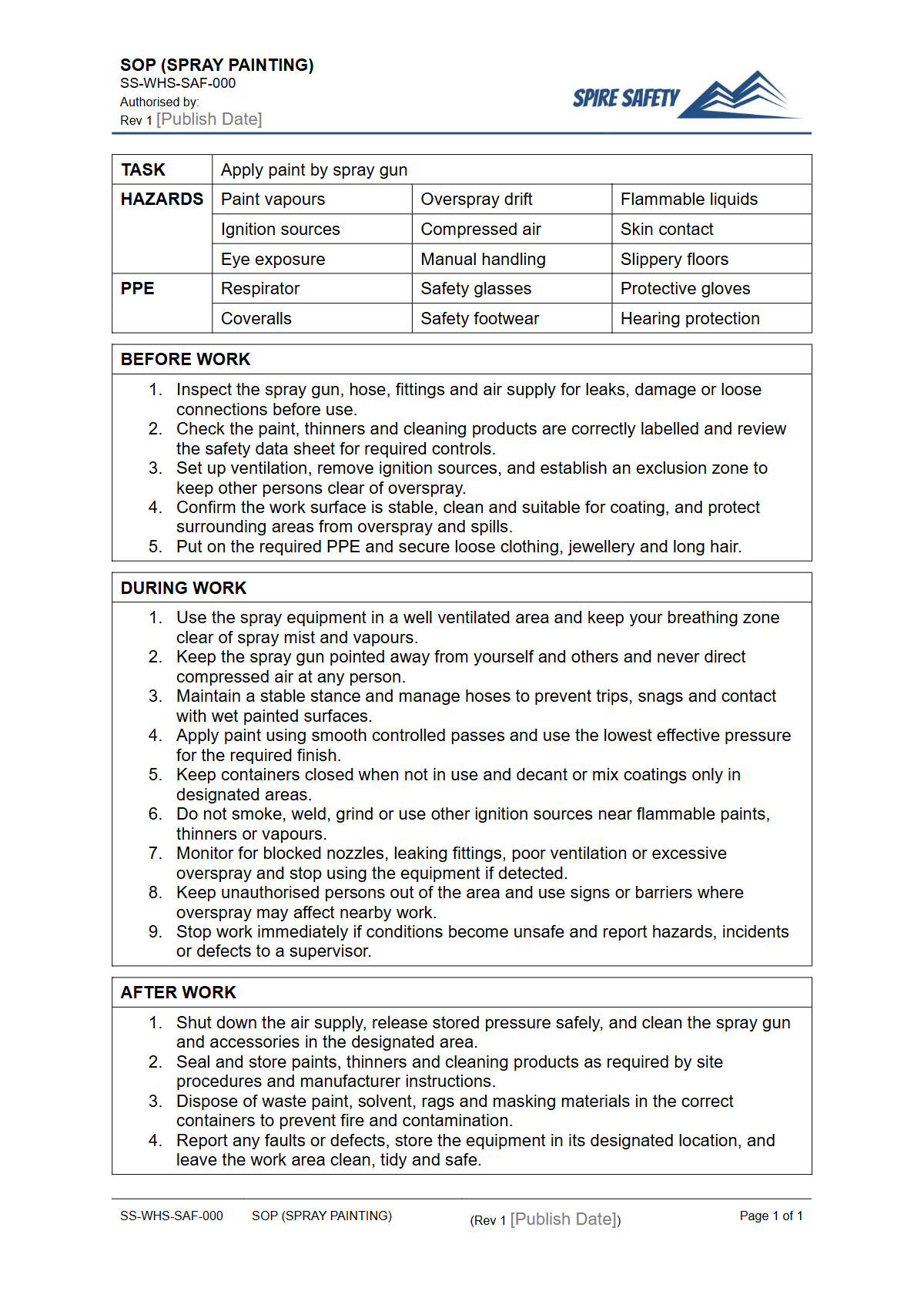
Download our free Safe Operating Procedure (Spray Painting) Template to manage risks associated with isocyanates, solvents, and flammability.
Free Safe Operating Procedure (Spray Painting) Template
DOCX • 126 KB + PDF
Updated Oct 2026
No signup required
Purpose of the Free Safe Operating Procedure (Spray Painting) Template
Spray painting is a high-risk activity that involves exposure to hazardous chemicals, flammable substances, and potential fire or explosion hazards. This free Safe Operating Procedure (Spray Painting) Template provides a structured framework for documenting the required steps to perform spray painting tasks safely.
Using a documented procedure helps your organisation manage significant risks such as respiratory sensitisation from isocyanates, acute poisoning from solvent inhalation, and ignition of flammable vapours. The template is designed to help you implement effective control measures in line with the hierarchy of controls, prioritising elimination, substitution, and engineering solutions over reliance on personal protective equipment (PPE) alone.
A well-defined SOP is a critical component of a robust safety management system. It serves as a vital training tool for workers, a reference for supervisors, and evidence of your organisation's commitment to providing a safe work environment.
This document forms part of your broader strategy to manage hazardous chemicals and should be integrated with your chemical register and Safety Data Sheets (SDS). For businesses that handle numerous hazardous materials, a comprehensive approach to WHS management systems can ensure all safety elements are connected and effective.
Video walkthrough
How to use the Free Safe Operating Procedure (Spray Painting) Template
This document is an editable template that must be customised to suit your specific workplace. Before use, a competent person must conduct a thorough risk assessment of the spray painting tasks, equipment, chemicals, and work area.
The information from this assessment should be used to populate and modify the template. For complex industrial processes, an Air Compressor SOP may also be necessary to cover the safe use of associated plant.
Important Customisation Note
This document has been developed as a starting point. As a PCBU (Person Conducting a Business or Undertaking), you have a duty to ensure the safety of your workers.
To do this, we recommend you consult with your team to ensure the procedure reflects the practical realities of the task. You must adapt this Safe Operating Procedure to align with the specific paints and solvents used, the type of spray equipment, the design of your spray booth or designated area, and the control measures you have implemented.
Generic procedures that do not reflect site-specific conditions are insufficient for managing WHS obligations.
When to use it
A Safe Operating Procedure for spray painting should be developed and implemented before any worker undertakes the task. It is a foundational document that should be used for:
- Inducting and training new workers or those unfamiliar with the task.
- Providing refresher training for existing workers.
- Supervising work to ensure the agreed-upon procedures are being followed.
- Investigating incidents or near misses to identify procedural gaps.
- Reviewing and improving safety processes regularly or when changes occur.
Regular reviews ensure the SOP remains relevant, especially when new equipment is introduced, different chemical products are used, or regulations are updated. Conducting periodic WHS compliance auditing can help verify that your documented procedures are being implemented correctly on the ground.
Who should use it
This Safe Operating Procedure is intended for use by all personnel involved in spray painting activities and their management. This includes:
- Workers: To understand and follow the step-by-step process for safely performing their tasks, including pre-start checks, operation, and shutdown procedures.
- Supervisors and Managers: To train workers, monitor compliance, and enforce safe work practices.
- WHS Managers and Advisors: To develop, review, and integrate the SOP into the organisation's overall WHS management system. For other workshop activities, our Oxy Acetylene SOP provides a useful reference for managing different high-risk tasks.
- PCBUs: To meet their primary duty of care under WHS legislation by providing and maintaining a safe system of work.
By defining and communicating these safe work methods, your organisation can systematically reduce risks. If your processes are unique, you can adapt our more general Safe Operating Procedure (SOP) Template for other specific tasks.
Explore our complete free WHS resources library for more templates to support your safety goals.
Common mistakes
Common mistakes to avoid
- Using the template without customising it for site-specific chemicals, equipment, and controls.
- Relying solely on PPE without implementing higher-level controls like ventilation and extraction.
- Failing to ensure respirators are correctly selected, fit-tested, and maintained.
- Neglecting to control all potential ignition sources in and around the spray painting area.
Legal references
Legal considerations
The following legal requirements may be relevant to this type of work.
- Work Health and Safety Act (Harmonised) — Provides the primary duties for protecting workers and other people from work health and safety risks.
- Work Health and Safety Regulations (Harmonised) — Sets out requirements supporting the management of workplace hazards and risks.
The following codes may be relevant to this type of work.
- Managing WHS Risks Code of Practice — Provides practical guidance on identifying hazards, assessing risks and applying effective controls.
- Work Health and Safety Consultation, Cooperation and Coordination Code of Practice — Provides practical guidance on consulting workers and coordinating with other duty holders.
- Managing the Work Environment and Facilities Code of Practice — Provides practical guidance on safe work environments, workplace facilities and related controls.
Did you know
Occupational Asthma Risk
Isocyanates, commonly found in two-pack polyurethane paints, are a leading cause of occupational asthma in Australia. The effects of sensitisation can be permanent and debilitating.
Explosive Potential
The vapour from just one litre of flammable solvent can create an explosive atmosphere in a space the size of a small car. Proper ventilation and control of ignition sources are critical.
FAQ
Frequently asked questions
01What are the main hazards associated with spray painting?
02Is a Safe Operating Procedure for spray painting mandatory in Australia?
03What kind of PPE is needed for spray painting?
04How often should a spray painting SOP be reviewed?
Share this resource
Free Safe Operating Procedure (Spray Painting) Template
Browse Categories
How To Use It
- 1Download and open in Word or PDF.
- 2Replace the placeholders with your business details.
- 3Get it reviewed by a WHS specialist before rollout.
Need it customised?
Our WHS consultants can adapt this template to your site, run a gap analysis, or audit what you already have in place.
Book a Free Consultation WHS consulting servicesor call 1300 156 382
Related templates
- Free Safe Operating Procedure (Spreader Beam) Template
- Free Safe Operating Procedure (Spring Coiler) Template
- Free Safe Operating Procedure (Spring Compressor) Template
- Free Safe Operating Procedure (Sprinkler Head Change) Template
- Free Safe Operating Procedure (Sprinkler Head Cleaning) Template
- Free Safe Operating Procedure (Sprinkler Pump Test) Template