
Free Safe Operating Procedure (Spot Welder) Template
Formalise your spot welding safety protocols with our structured Safe Operating Procedure template. Download this free, customisable document to get started.
Free Safe Operating Procedure (Spot Welder) Template
DOCX • 126 KB + PDF
Updated Oct 2026
No signup required
Purpose of the Free Safe Operating Procedure (Spot Welder) Template
Operating a spot welder presents significant workplace hazards, including severe burns, electric shock, and fire. A formalised Safe Operating Procedure (SOP) is a critical tool for managing these risks.
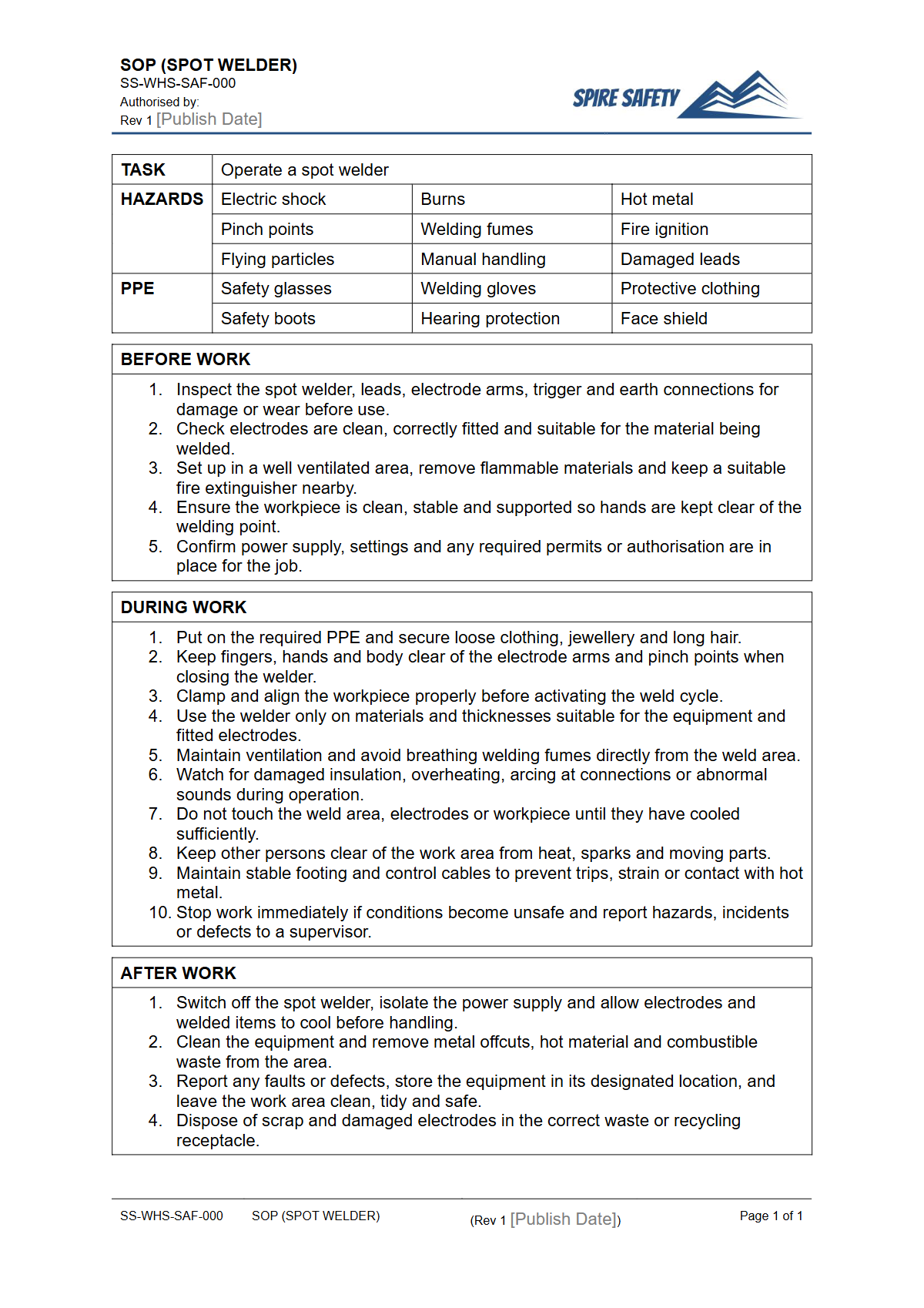
This free Safe Operating Procedure (Spot Welder) Template provides a structured framework to help your organisation document the required steps for safe use, from pre-operational checks to shutdown procedures.
The primary purpose of this SOP is to establish a clear, consistent, and safe method for operating spot welding equipment. A well-developed SOP helps to standardise work practices, ensuring every operator follows the same safety-critical steps.
It serves as an essential training document for new employees and a reference for experienced workers. By documenting procedures, you create an auditable record of your commitment to safety, which is a core component of effective WHS management systems. This systematic approach helps minimise the risk of injury and equipment damage, promoting a safer work environment for everyone.
Video walkthrough
How to use the Free Safe Operating Procedure (Spot Welder) Template
To get started, download the free Safe Operating Procedure (Spot Welder) Template in your preferred format (DOCX for easy editing or PDF). The document is logically structured to cover key areas such as required Personal Protective Equipment (PPE), pre-start safety checks, step-by-step operational instructions, and emergency shutdown protocols.
Important: Customise to Your Workplace
While this template is aligned with Australian WHS principles, it is vital to remember it is a starting point. To ensure this document is effective and supports your safety obligations, you must customise it.
You need to incorporate details specific to your site, including the make and model of your spot welders, the specific materials being worked on, and your workplace's unique environmental conditions and control measures. We are not liable for incidents arising from the use of an uncustomised or improperly implemented template.
Similar to our Oxy-Acetylene SOP template, site-specific details are what make the document truly effective.
When to use it
An SOP for spot welding should be an active document, not one that gathers dust on a shelf. It is used in several key situations:
- Worker Training and Induction: As the primary training document for new operators learning to use the equipment safely.
- Refresher Training: For periodic retraining of existing staff to prevent complacency and reinforce safe behaviour.
- Risk Management: As part of your overall risk assessment process, demonstrating a control measure for identified hazards.
- Incident Investigation: As a benchmark to determine if procedures were followed correctly when an accident or near-miss occurs.
- Audits and Inspections: During internal or external safety audits to verify that documented procedures are in place and being followed. Regular WHS compliance auditing can help identify gaps between your documented procedures and actual work practices.
Who should use it
This template is designed for anyone responsible for workplace safety in environments where spot welding occurs. This includes:
- WHS/HSE Managers: Who are tasked with developing and implementing safety systems and documentation.
- Workshop and Production Managers: Who oversee daily operations and are responsible for the safety of their teams.
- Supervisors and Team Leaders: Who directly manage and train equipment operators.
- Business Owners: In smaller operations, who hold the primary duty of care for ensuring a safe workplace.
The finalised SOP is then used by all operators of the spot welding equipment. For other common workshop tools, you might also find our Circular Saw SOP or free Air Compressor SOP useful.
You can browse our entire free WHS resources library for more templates to support your safety program.
Common mistakes
Common mistakes to avoid
- Using a generic template without customising it for specific equipment and workplace hazards.
- Failing to ensure operators have read, understood, and been trained on the finalised SOP.
- Neglecting to regularly inspect and maintain the spot welder's electrodes and cooling system.
- Storing flammable materials too close to the welding area, ignoring spark travel distance.
Legal references
Legal considerations
The following legal requirements may be relevant to this type of work.
- Work Health and Safety Act (Harmonised) — Provides the primary duties for protecting workers and other people from work health and safety risks.
- Work Health and Safety Regulations (Harmonised) — Sets out requirements supporting the management of workplace hazards and risks.
The following codes may be relevant to this type of work.
- Managing WHS Risks Code of Practice — Provides practical guidance on identifying hazards, assessing risks and applying effective controls.
- Work Health and Safety Consultation, Cooperation and Coordination Code of Practice — Provides practical guidance on consulting workers and coordinating with other duty holders.
- Managing the Work Environment and Facilities Code of Practice — Provides practical guidance on safe work environments, workplace facilities and related controls.
Did you know
Resistance is Key
Spot welding, or Resistance Spot Welding (RSW), doesn't use filler material. It works by passing a strong electrical current through the metal sheets, generating heat from electrical resistance to fuse them together at a single point.
Fire Watch
Sparks from spot welding can travel several metres and lodge in cracks or combustible materials. A designated 'fire watch' is often required for at least 30 minutes after welding stops to ensure no smouldering fires have started.
FAQ
Frequently asked questions
01What are the main hazards of using a spot welder?
02Is a Safe Operating Procedure a legal requirement in Australia?
03How often should a spot welder SOP be reviewed?
04What PPE is required for spot welding?
Share this resource
Free Safe Operating Procedure (Spot Welder) Template
Browse Categories
How To Use It
- 1Download and open in Word or PDF.
- 2Replace the placeholders with your business details.
- 3Get it reviewed by a WHS specialist before rollout.
Need it customised?
Our WHS consultants can adapt this template to your site, run a gap analysis, or audit what you already have in place.
Book a Free Consultation WHS consulting servicesor call 1300 156 382
Related templates
- Free Safe Operating Procedure (Spray Adhesive) Template
- Free Safe Operating Procedure (Spray Booth Cleaning) Template
- Free Safe Operating Procedure (Spray Painting) Template
- Free Safe Operating Procedure (Spreader Beam) Template
- Free Safe Operating Procedure (Spring Coiler) Template
- Free Safe Operating Procedure (Spring Compressor) Template