
Free Safe Operating Procedure (Spray Adhesive) Template
Manage the risks of using spray adhesives with our structured Safe Operating Procedure template.
Free Safe Operating Procedure (Spray Adhesive) Template
DOCX • 126 KB + PDF
Updated Oct 2026
No signup required
Purpose of the Free Safe Operating Procedure (Spray Adhesive) Template
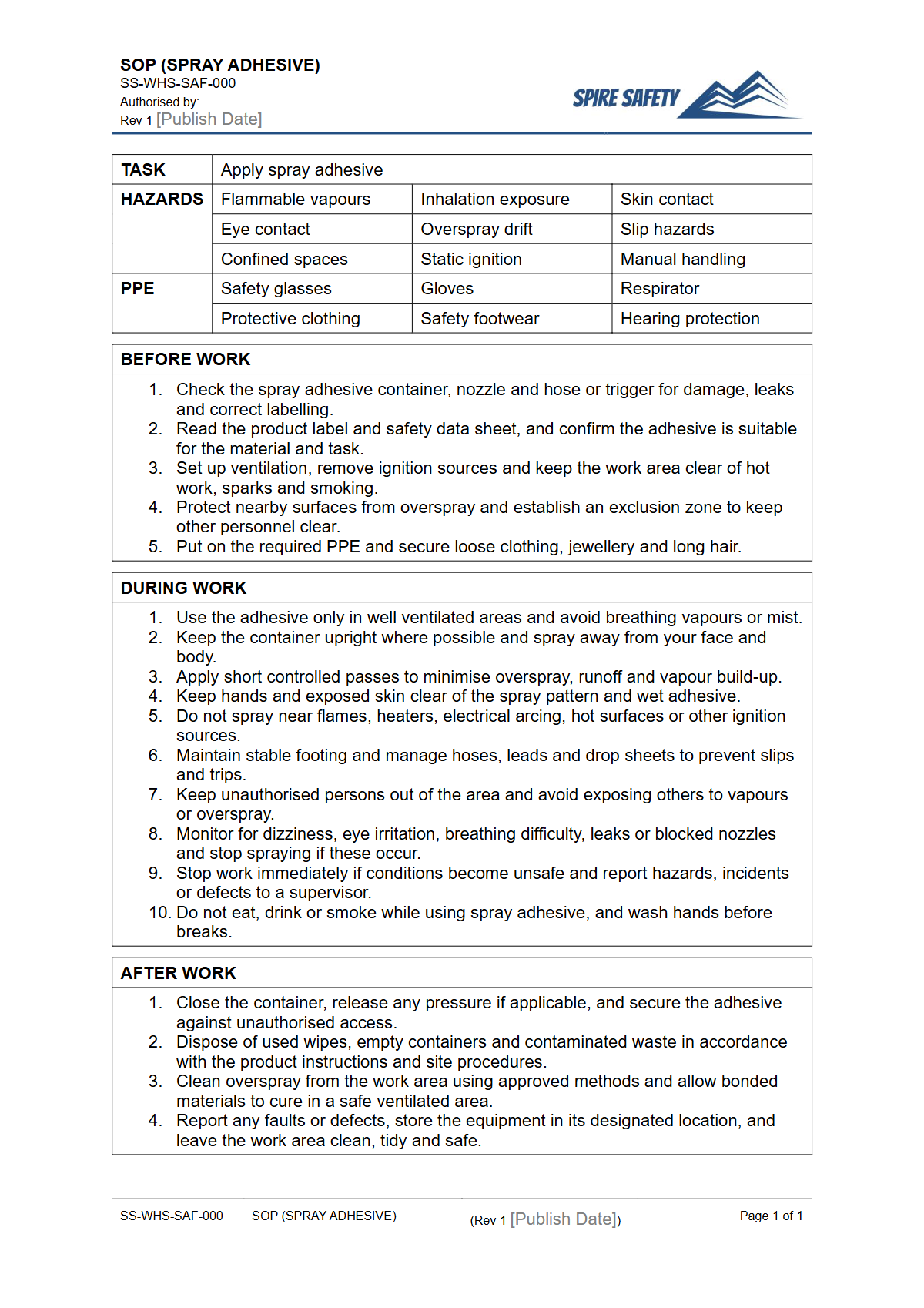
Using spray adhesives introduces significant workplace hazards, including exposure to harmful volatile organic compounds (VOCs), fire and explosion risks from flammable propellants, and potential skin and eye irritation. This Free Safe Operating Procedure (Spray Adhesive) Template provides a structured framework for documenting the essential safety measures required to control these risks.
It helps your organisation establish and communicate a clear, step-by-step process for the safe handling, application, and storage of these chemical products. By formalising your process, you create a reliable reference for worker training, supervision, and operational consistency.
An effective SOP is a critical administrative control measure that forms part of a comprehensive WHS management system. It demonstrates a proactive approach to risk management by identifying hazards, assessing risks, and implementing specific controls such as correct ventilation, appropriate Personal Protective Equipment (PPE), and emergency response actions. This document helps ensure that all personnel understand their responsibilities and follow a standardised, safe method for every task involving spray adhesives.
Video walkthrough
How to use the Free Safe Operating Procedure (Spray Adhesive) Template
This document is designed as a customisable starting point, aligned with Australian WHS principles. To make it effective, you must adapt it to your specific operational context.
Start by downloading the DOCX version and gathering the Safety Data Sheets (SDS) for all spray adhesive products used in your workplace. The SDS contains crucial information on hazards, first aid, and required controls that must be incorporated into your final SOP.
Work through each section of the template, replacing the placeholder text with details relevant to your site. This includes specifying the exact make and model of any application equipment, the types of PPE required (e.g., specific respirator cartridges, glove materials), and site-specific emergency procedures.
Consultation is key; involve the workers who actually perform the task to ensure the procedure is practical and reflects how the work is done. Once completed, the SOP should be used as a primary training tool for new and existing employees.
Regular reviews and updates are essential, especially when new products are introduced or processes change.
Please note: this is a template, not a finished document. We have drafted it as a starting point, but you must customise it to reflect the specific spray adhesive products, equipment, environment, and personnel in your workplace.
The final document should be reviewed and approved by a competent person before implementation. The effectiveness of this procedure relies on its accurate customisation and diligent application, which can be verified through periodic WHS compliance audits.
When to use this Safe Operating Procedure
A Safe Operating Procedure for spray adhesive should be developed and implemented before any worker is permitted to use the product. It serves as a foundational document for task-specific training and competency assessments.
The SOP should be readily accessible in the work area for quick reference during operations. It is particularly important to review the SOP during toolbox talks before starting a non-routine job involving adhesives.
Furthermore, the document is a critical reference tool during incident investigations or when conducting risk assessments for new projects or materials.
Who should use this Safe Operating Procedure
This SOP is intended for multiple roles within an organisation. Workers and operators are the primary users, as it directs their actions to ensure their own safety and the safety of others.
They must be trained on the SOP's contents and follow its steps precisely. Supervisors and team leaders use the SOP to induct new team members, monitor compliance, enforce safe work practices, and lead pre-start discussions.
WHS Managers and officers use the SOP as part of the broader risk management framework, ensuring it is properly developed, reviewed, and integrated with other safety documentation, such as a Oxy Acetylene SOP for tasks in adjacent fabrication areas. For tasks involving other aerosolised or pressurised equipment, you might also require a free Air Compressor SOP.
For activities not covered by a specific template like this one, our general Safe Operating Procedure template provides a blank slate for you to build upon. This ensures you can document safe systems of work for any hazardous task in your workplace.
All of these documents and more can be found in our free WHS resources library, which we update regularly with new templates and guides.
Common mistakes
Common mistakes to avoid
- Using the template without consulting the specific product's Safety Data Sheet (SDS).
- Failing to ensure adequate mechanical ventilation or working in a confined space.
- Neglecting to wear, inspect, or maintain the correct Personal Protective Equipment (PPE).
- Not cleaning up overspray promptly, leading to slip hazards and flammable residue buildup.
Legal references
Legal considerations
The following legal requirements may be relevant to this type of work.
- Work Health and Safety Act (Harmonised) — Provides the primary duties for protecting workers and other people from work health and safety risks.
- Work Health and Safety Regulations (Harmonised) — Sets out requirements supporting the management of workplace hazards and risks.
The following codes may be relevant to this type of work.
- Managing WHS Risks Code of Practice — Provides practical guidance on identifying hazards, assessing risks and applying effective controls.
- Work Health and Safety Consultation, Cooperation and Coordination Code of Practice — Provides practical guidance on consulting workers and coordinating with other duty holders.
- Managing the Work Environment and Facilities Code of Practice — Provides practical guidance on safe work environments, workplace facilities and related controls.
Did you know
Invisible Danger
Many adhesives contain Volatile Organic Compounds (VOCs) that can cause short-term health effects like headaches and dizziness, and long-term organ damage with repeated, unprotected exposure.
High Fire Risk
The propellants and solvents in most aerosol adhesives are extremely flammable. A single spark from static electricity or nearby equipment can be enough to ignite vapours in a poorly ventilated space.
FAQ
Frequently asked questions
01What are the main hazards when using spray adhesive?
02Is an SOP a legal requirement for spray adhesives in Australia?
03What PPE is required for applying spray adhesive?
04How often should a Safe Operating Procedure for spray adhesive be reviewed?
Share this resource
Free Safe Operating Procedure (Spray Adhesive) Template
Browse Categories
How To Use It
- 1Download and open in Word or PDF.
- 2Replace the placeholders with your business details.
- 3Get it reviewed by a WHS specialist before rollout.
Need it customised?
Our WHS consultants can adapt this template to your site, run a gap analysis, or audit what you already have in place.
Book a Free Consultation WHS consulting servicesor call 1300 156 382
Related templates
- Free Safe Operating Procedure (Spray Booth Cleaning) Template
- Free Safe Operating Procedure (Spray Painting) Template
- Free Safe Operating Procedure (Spreader Beam) Template
- Free Safe Operating Procedure (Spring Coiler) Template
- Free Safe Operating Procedure (Spring Compressor) Template
- Free Safe Operating Procedure (Sprinkler Head Change) Template