
Free Safe Operating Procedure (Sports Net Inspection) Template
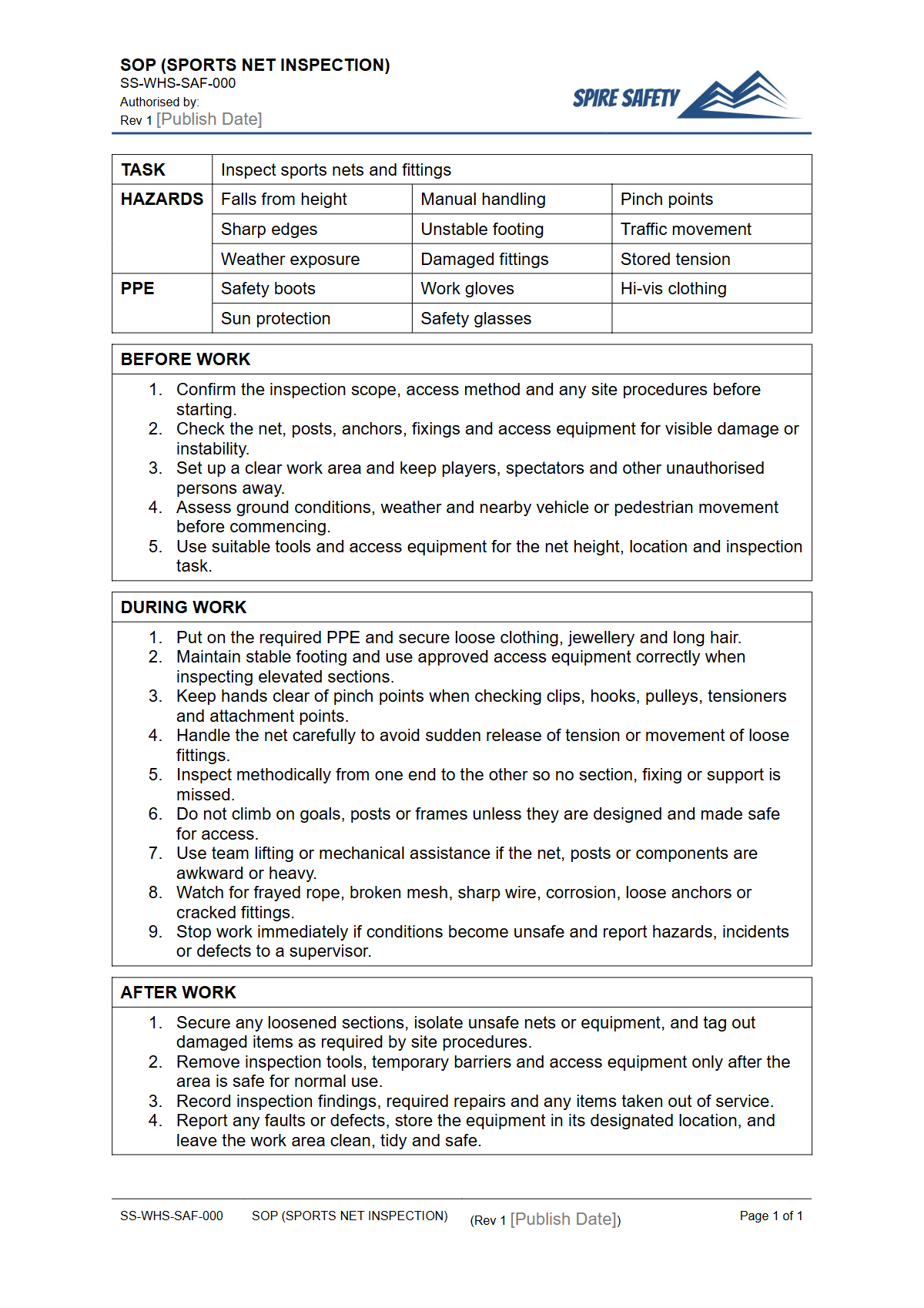
Ensure the safety of your sports facilities with our comprehensive sports net inspection SOP. Download this customisable template to get started today.
Free Safe Operating Procedure (Sports Net Inspection) Template
DOCX • 126 KB + PDF
Updated Oct 2026
No signup required
Purpose of the Free Safe Operating Procedure (Sports Net Inspection) Template
Regularly inspecting sports netting is a critical task for maintaining a safe environment in schools, clubs, and public venues. This Free Safe Operating Procedure (Sports Net Inspection) Template provides a structured framework for documenting the process, helping to ensure inspections are conducted consistently and thoroughly.
By using a standardised procedure, your organisation can systematically identify hazards such as frayed ropes, corroded posts, loose anchors, or damaged tensioning systems before they lead to equipment failure or injury. This SOP serves as an administrative control measure, supporting your duty of care as a PCBU (Person Conducting a Business or Undertaking) to provide and maintain a work environment that is without risks to health and safety.
Implementing a formal SOP demonstrates a commitment to proactive risk management. It establishes clear steps for workers to follow, outlines necessary personal protective equipment (PPE), and defines actions to take when defects are found.
A well-defined inspection protocol is a key component of any effective WHS management system, helping to minimise liability and ensure the ongoing safety of players, staff, and the public.
Video walkthrough
How to use the Free Safe Operating Procedure (Sports Net Inspection) Template
This Safe Operating Procedure is provided as a fully editable DOCX file and a print-ready PDF. To use it effectively, download the document and integrate it into your organisation's safety management system.
It is designed as a comprehensive starting point, aligned with Australian WHS principles, but it requires site-specific information to be effective.
Important: This is a template only. You must customise this document to reflect the specific hazards, equipment (e.g., soccer goals, tennis nets, safety barriers), and environmental conditions of your workplace.
We are not liable for any incidents that may occur from the use of this document. Thoroughly review and adapt all sections to ensure they are relevant and sufficient for your operational context.
If you require assistance in developing or reviewing safety documentation, our WHS consulting services can provide expert guidance.
Key Sections to Customise
- Hazard Identification: Add any site-specific hazards, such as proximity to traffic, underground services near anchors, or public access issues.
- PPE Requirements: Specify the exact type of gloves, footwear, or other PPE required for the task.
- Inspection Steps: Detail the sequence for checking your specific net systems. This includes checking net integrity, post stability, anchor security, winch and tensioning mechanisms, and the surrounding area for trip hazards. The process for inspecting a cricket net will differ greatly from that for a large perimeter fence.
- Corrective Actions: Clearly define the procedure for when a fault is identified. This should include who to report it to, how to isolate or remove the hazardous equipment, and the process for documenting the action taken.
The principle of customising procedures for specific tasks applies to all workplace equipment. You can explore our free WHS resources library to find other templates that can be adapted for your needs.
When to perform a sports net inspection
The frequency of inspection depends on several factors, including the level of use, the type of equipment, environmental conditions (e.g., coastal or high-wind areas), and manufacturer recommendations. A robust inspection schedule typically includes:
- Pre-use visual checks: A quick check before each game or session to spot obvious damage.
- Routine detailed inspections: Weekly or monthly documented inspections that follow the full SOP.
- Annual comprehensive inspections: A thorough annual check, potentially conducted by a specialist technician.
- Post-event inspections: After severe weather, vandalism, or impact to ensure the structure remains safe.
Consistent documentation from these inspections provides valuable evidence of due diligence during formal WHS compliance audits and helps track the condition of assets over time.
Who should use this Safe Operating Procedure
This SOP should be used by any person responsible for the maintenance and safety of sports facilities. This includes, but is not limited to:
- Groundskeepers and maintenance staff
- Facility or venue managers
- School principals and administration staff
- Designated safety officers
- Committee members or volunteers at community sports clubs
It is crucial that anyone performing the inspection is deemed competent to do so. This means they have received the necessary training and instruction to understand the procedure, identify hazards accurately, and take appropriate action.
This SOP forms an excellent basis for that training. It is a specific application of a procedural framework, and for other tasks, you might use a more general Safe Operating Procedure (SOP) template as your starting point.
Common mistakes
Common mistakes to avoid
- Only checking the net and ignoring the posts, tensioning systems, and ground anchors.
- Failing to document every inspection, leaving no official record of due diligence.
- Using a generic checklist that doesn't account for the specific type of net system.
- Not immediately removing damaged equipment from service, assuming a minor fault isn't a major risk.
Legal references
Legal considerations
The following legal requirements may be relevant to this type of work.
- Work Health and Safety Act (Harmonised) — Provides the primary duties for protecting workers and other people from work health and safety risks.
- Work Health and Safety Regulations (Harmonised) — Sets out requirements supporting the management of workplace hazards and risks.
The following codes may be relevant to this type of work.
- Managing WHS Risks Code of Practice — Provides practical guidance on identifying hazards, assessing risks and applying effective controls.
- Work Health and Safety Consultation, Cooperation and Coordination Code of Practice — Provides practical guidance on consulting workers and coordinating with other duty holders.
- Managing the Work Environment and Facilities Code of Practice — Provides practical guidance on safe work environments, workplace facilities and related controls.
Did you know
Hidden Hazards
Frayed nets or corroded posts can fail unexpectedly under load from players or ball impacts, posing serious injury risks not just to participants but also to nearby spectators.
Weather's Toll
UV radiation, high winds, and moisture significantly accelerate the degradation of netting and metal components, making frequent inspections especially critical for all outdoor facilities.
FAQ
Frequently asked questions
01What should be included in a sports net inspection?
02How often should sports nets be inspected?
03Who is responsible for inspecting sports nets?
04Is an SOP a legal requirement for sports net inspections in Australia?
Share this resource
Free Safe Operating Procedure (Sports Net Inspection) Template
Browse Categories
How To Use It
- 1Download and open in Word or PDF.
- 2Replace the placeholders with your business details.
- 3Get it reviewed by a WHS specialist before rollout.
Need it customised?
Our WHS consultants can adapt this template to your site, run a gap analysis, or audit what you already have in place.
Book a Free Consultation WHS consulting servicesor call 1300 156 382
Related templates
- Free Safe Operating Procedure (Spot Welder) Template
- Free Safe Operating Procedure (Spray Adhesive) Template
- Free Safe Operating Procedure (Spray Booth Cleaning) Template
- Free Safe Operating Procedure (Spray Painting) Template
- Free Safe Operating Procedure (Spreader Beam) Template
- Free Safe Operating Procedure (Spring Coiler) Template