
Free Safe Operating Procedure (Sports Field Fertilise) Template
Manage risks associated with turf maintenance with our Safe Operating Procedure for sports field fertilising.
Free Safe Operating Procedure (Sports Field Fertilise) Template
DOCX • 126 KB + PDF
Updated Oct 2026
No signup required
Purpose of the Free Safe Operating Procedure (Sports Field Fertilise) Template
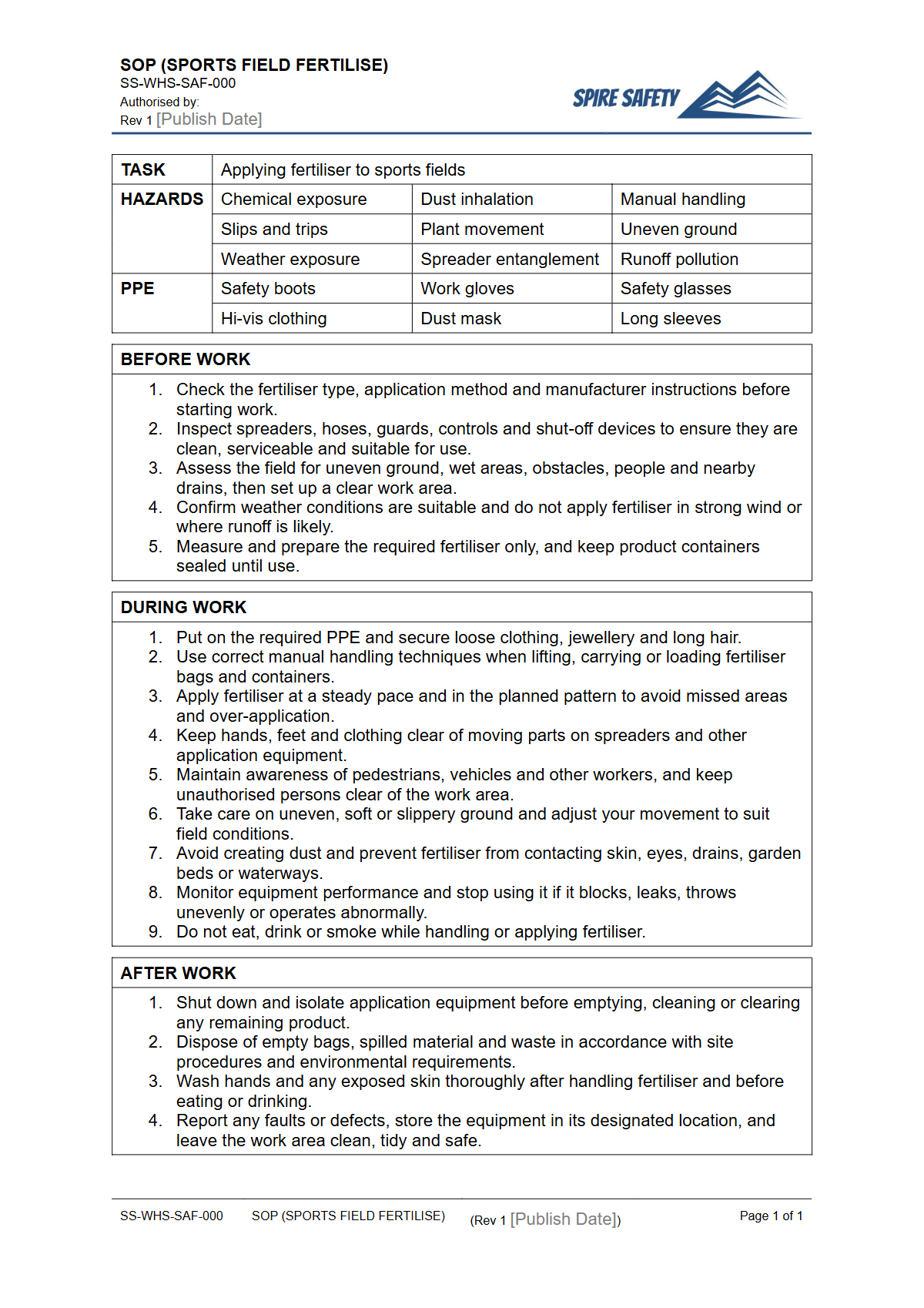
This Free Safe Operating Procedure (Sports Field Fertilise) Template provides a structured framework for documenting the safe steps involved in applying fertilisers to sports fields and large turf areas. Fertilising operations present several key hazards, including chemical exposure from fertilisers, manual handling risks when moving heavy bags, and operational dangers associated with machinery like spreaders and tractors.
A clear, documented procedure is an essential tool for any organisation to manage these risks, ensuring workers understand the expected safe work practices. Implementing robust procedures like this one is a fundamental part of effective WHS management systems, helping to fulfil your duty of care under Australian WHS legislation.
Video walkthrough
How to use the Free Safe Operating Procedure (Sports Field Fertilise) Template
Our template is designed for ease of use and is available in both DOCX and PDF formats. It outlines the key stages of the task, including pre-operational checks on equipment, step-by-step instructions for the fertilising process itself, and post-operational clean-up and storage procedures.
It includes sections for detailing required Personal Protective Equipment (PPE), potential hazards, and associated control measures. This document provides a strong foundation, but it is not a complete, ready-to-use document.
Important: You must customise this template to reflect the specific circumstances of your workplace. We have provided a solid framework, but you must adapt it to your specific machinery (e.g., brand and model of spreader), the exact chemical fertilisers used (referencing their Safety Data Sheets), site conditions, and your organisation's unique policies.
For a broader look at structuring these documents, you might also find our general Safe Operating Procedure (SOP) template helpful.
When to use it
A Safe Operating Procedure for sports field fertilising should be used consistently to guide behaviour and reinforce safety standards. It is a critical document for worker training and induction, ensuring new team members understand the correct, safe method from the outset.
The SOP should also be referenced during pre-start or toolbox talks before a fertilising job commences. It serves as a benchmark for competency assessments and refresher training and is an invaluable reference tool during incident investigations to identify any deviation from established safe work practices. For specific equipment used in the task, you may need a separate procedure, such as an SOP for spreaders.
Who should use it
This SOP is intended for all personnel involved in turf management and maintenance. This includes groundskeepers, greenkeepers, landscapers, and any other workers tasked with applying fertiliser.
Supervisors and managers should use the SOP to oversee work, conduct safety observations, and ensure that procedures are being followed correctly. WHS managers and personnel can integrate this procedure into the broader safety management system, using it as part of risk assessments and training program development.
For businesses needing hands-on support with implementation, our specialist WHS consulting services can provide tailored guidance.
Key Hazards in Sports Field Fertilising
Beyond the procedure itself, it's vital to recognise the specific hazards involved. These include:
- Chemical Hazards: Skin or eye contact, or inhalation of dust from granular or powdered fertilisers. Always have the Safety Data Sheet (SDS) for each product available.
- Manual Tasks: Lifting and carrying heavy bags of fertiliser can lead to musculoskeletal injuries. Assess the load and use mechanical aids where possible.
- Equipment Hazards: Entanglement in moving parts of spreaders, tractors, or other machinery. Ensure all guards are in place and conduct pre-start checks. The principles for managing equipment safely are similar across different groundskeeping tasks, such as those covered in SOPs for planters.
- Environmental Factors: Working in heat, sun exposure, or adverse weather like high wind, which can cause fertiliser drift.
Integrating SOPs into Your WHS Framework
A single SOP is most effective when it is part of a comprehensive safety system. Ensure this procedure is referenced in your overarching risk register and training matrix.
Regularly review the SOP (e.g., annually, or after an incident) to ensure it remains current and effective. Conducting periodic WHS compliance audits can help verify that this and other procedures are being correctly implemented in practice. This document is one of many tools available to help you build a safer workplace, and you can explore more templates in our free WHS resources library.
Common mistakes
Common mistakes to avoid
- Failing to read and understand the Safety Data Sheet (SDS) for the specific fertiliser before use.
- Applying fertiliser in unsuitable weather, such as high winds that cause drift or heavy rain that leads to runoff.
- Using poorly maintained or incorrectly calibrated spreading equipment, leading to uneven and inefficient application.
- Inadequate record-keeping of application dates, products used, and rates applied, which is vital for both agronomic and compliance purposes.
Legal references
Legal considerations
The following legal requirements may be relevant to this type of work.
- Work Health and Safety Act (Harmonised) — Provides the primary duties for protecting workers and other people from work health and safety risks.
- Work Health and Safety Regulations (Harmonised) — Sets out requirements supporting the management of workplace hazards and risks.
The following codes may be relevant to this type of work.
- Managing WHS Risks Code of Practice — Provides practical guidance on identifying hazards, assessing risks and applying effective controls.
- Work Health and Safety Consultation, Cooperation and Coordination Code of Practice — Provides practical guidance on consulting workers and coordinating with other duty holders.
- Managing the Work Environment and Facilities Code of Practice — Provides practical guidance on safe work environments, workplace facilities and related controls.
Did you know
Nutrient Runoff
Excess fertiliser that washes off turf into storm drains can enter waterways, causing environmental harm like algal blooms. Calibrating spreaders correctly and avoiding application before heavy rain are key environmental controls.
Soil Compaction
The heavy machinery used for fertilising, like tractors and utility vehicles, can contribute to soil compaction. Compacted soil restricts root growth and water absorption, ultimately impacting the health and resilience of the turf.
FAQ
Frequently asked questions
01What PPE is required when fertilising a sports field?
02How should I store fertilisers safely?
03Is an SOP a legal requirement for fertilising in Australia?
04What is the difference between an SOP and a SWMS?
Share this resource
Free Safe Operating Procedure (Sports Field Fertilise) Template
Browse Categories
How To Use It
- 1Download and open in Word or PDF.
- 2Replace the placeholders with your business details.
- 3Get it reviewed by a WHS specialist before rollout.
Need it customised?
Our WHS consultants can adapt this template to your site, run a gap analysis, or audit what you already have in place.
Book a Free Consultation WHS consulting servicesor call 1300 156 382
Related templates
- Free Safe Operating Procedure (Sports Field Line Prep) Template
- Free Safe Operating Procedure (Sports Field Overseed) Template
- Free Safe Operating Procedure (Sports Field Topdress) Template
- Free Safe Operating Procedure (Sports Net Inspection) Template
- Free Safe Operating Procedure (Spot Welder) Template
- Free Safe Operating Procedure (Spray Adhesive) Template