
Free Safe Operating Procedure (Spinning Machine) Template
Download our free Safe Operating Procedure (Spinning Machine) Template to establish clear, safe work instructions for your team. Get your DOCX and PDF now.
Free Safe Operating Procedure (Spinning Machine) Template
DOCX • 126 KB + PDF
Updated Oct 2026
No signup required
Purpose of the Free Safe Operating Procedure (Spinning Machine) Template
Operating industrial spinning machines presents significant risks, including entanglement, impact from moving parts, and noise exposure. This free Safe Operating Procedure (Spinning Machine) Template provides a structured framework for documenting the safest method to perform tasks involving this equipment.
It helps your organisation standardise its processes, ensuring every operator follows a consistent, pre-approved procedure designed to minimise hazards. By clearly outlining steps for pre-operational checks, operation, and shutdown, the SOP becomes a vital tool for training new employees and reinforcing safe behaviour for experienced workers.
A well-drafted SOP is a fundamental component of managing workplace risks associated with plant and machinery. It translates the findings of your risk assessment into practical, actionable instructions that workers can easily follow. While this document is specific to spinning machines, the principles apply across various equipment, as shown in our general Safe Operating Procedure (SOP) template.
Video walkthrough
How to use the Free Safe Operating Procedure (Spinning Machine) Template
This downloadable document serves as a comprehensive starting point. To make it effective, you must adapt it to the specific context of your workplace.
Download the DOCX file and populate the sections with details relevant to your particular make and model of spinning machine, the materials being processed, and the environment in which it operates. A generic document is not sufficient for ensuring safety or meeting regulatory duties.
Important: This is a template and not a finished document. We are not familiar with your specific machinery, processes, or workplace hazards.
You must customise this document by incorporating details from the manufacturer's guidelines, conducting a site-specific risk assessment, and consulting with operators who use the equipment daily. If you require assistance with this process, engaging specialist WHS consulting can provide expert guidance.
When to use this Safe Operating Procedure
A Safe Operating Procedure for a spinning machine should be a readily accessible document used in several key situations. It is essential for the induction and training of new operators, providing them with a clear guide to follow under supervision.
It also serves as a critical reference for all workers before commencing work, especially for tasks that are not performed frequently. Supervisors should use the SOP as a benchmark for observing work practices and ensuring adherence to safety standards.
Furthermore, the SOP is an invaluable resource during incident investigations, helping to identify deviations from established safe processes.
These procedures are often part of a sequence of operations in a larger production line. Integrating them with procedures for connected equipment, such as an SOP for conveyer systems, ensures a holistic approach to safety.
Who should use it
The primary users of this SOP are the machine operators themselves. The document should be written in clear, simple language that is easy for them to understand and apply.
Supervisors and team leaders also have a responsibility to use the SOP to enforce safe work practices, conduct competency assessments, and deliver toolbox talks or refresher training. WHS managers and personnel will use the SOP as part of the broader safety management system, linking it to risk registers, training records, and incident reports.
This integration is crucial for building and maintaining comprehensive WHS management systems that effectively control risks.
Key Elements Included in the Template
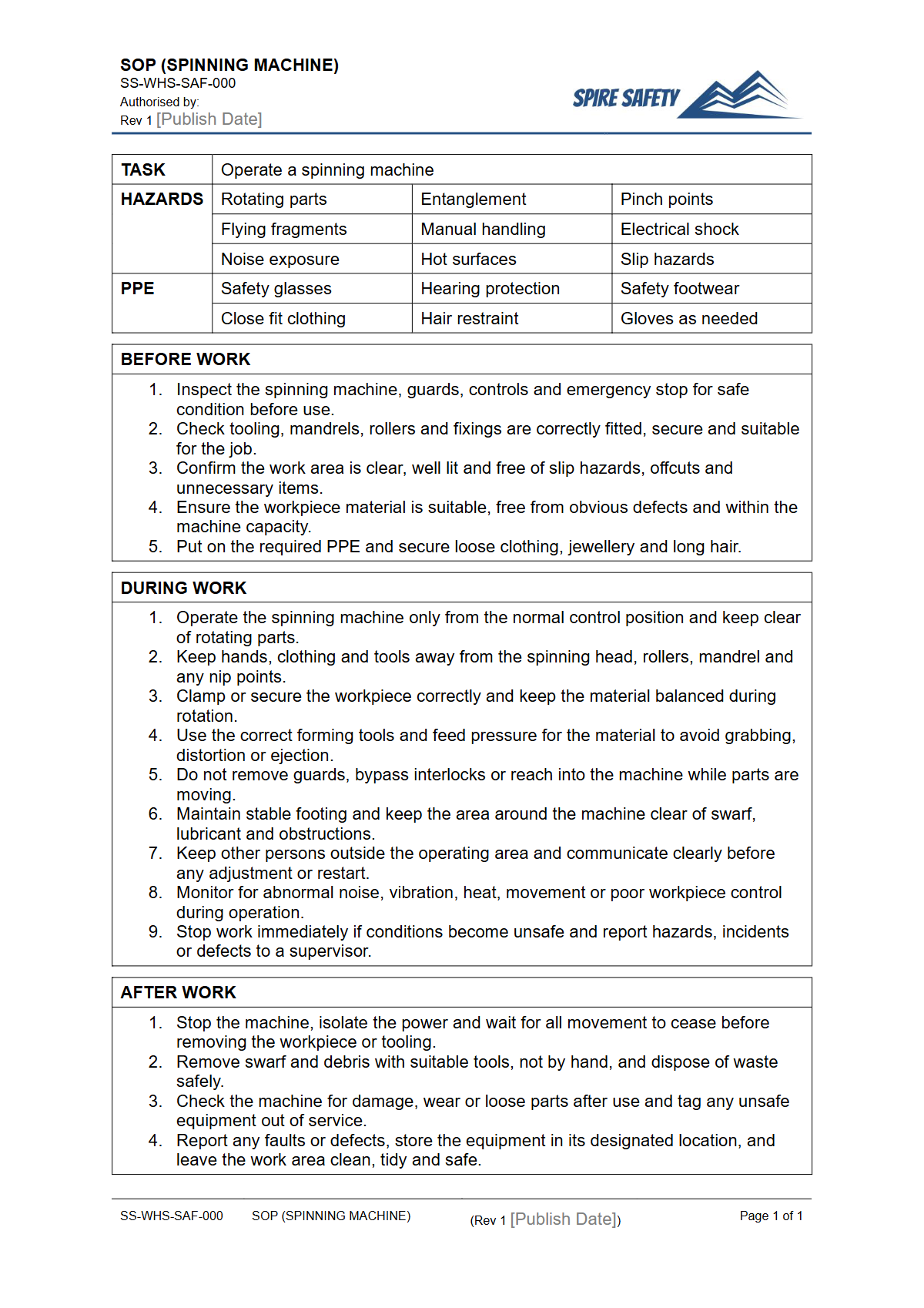
Our template prompts you to detail the critical stages of safely operating a spinning machine. Key sections you will need to customise include:
- Required Personal Protective Equipment (PPE): Specify mandatory PPE such as safety glasses, hearing protection, and appropriate footwear. Prohibit loose clothing, jewellery, or untied long hair that could cause entanglement.
- Pre-Operational Checks: Outline a checklist for inspecting the machine before use. This includes checking that machine guards are in place and functional, emergency stops are accessible and working, and the work area is clear of obstructions. This may also involve checking systems connected to other plant, like an SOP for an air compressor that powers pneumatic components.
- Step-by-Step Operating Instructions: Document the sequence for starting, loading, operating, and monitoring the machine. Detail correct operator posture and positioning to avoid ergonomic strains and maintain a safe distance from moving parts.
- Shutdown and Cleaning Procedures: Provide clear instructions for powering down the machine, including lockout/tagout procedures for maintenance or cleaning to prevent accidental start-up.
- Emergency Procedures: Describe the steps to take in an emergency, such as locating and activating the emergency stop, procedures for entanglement, and reporting incidents.
Integrating the SOP into Your WHS System
An SOP is most effective when it is a living document within a proactive safety culture, not just a file on a shelf. It must be directly linked to your workplace's risk assessments.
Any hazard identified in a risk assessment for the spinning machine should be controlled by a step in the SOP. The procedure should be formally reviewed on a regular basis, and always after an incident, a near miss, or when a change is made to the machinery or process.
Regular reviews and updates can be verified through internal or external WHS compliance audits to ensure ongoing effectiveness and alignment with best practice.
Common mistakes
Common mistakes to avoid
- Using a generic template without customising it for the specific machine and workplace.
- Failing to adequately train all operators on the SOP's contents and verify their competency.
- Omitting critical details about emergency stop and lockout/tagout (LOTO) procedures.
- Neglecting to review and update the SOP after an incident, near miss, or process change.
Legal references
Legal considerations
The following legal requirements may be relevant to this type of work.
- Work Health and Safety Act (Harmonised) — Provides the primary duties for protecting workers and other people from work health and safety risks.
- Work Health and Safety Regulations (Harmonised) — Sets out requirements supporting the management of workplace hazards and risks.
The following codes may be relevant to this type of work.
- Managing WHS Risks Code of Practice — Provides practical guidance on identifying hazards, assessing risks and applying effective controls.
- Work Health and Safety Consultation, Cooperation and Coordination Code of Practice — Provides practical guidance on consulting workers and coordinating with other duty holders.
- Managing the Work Environment and Facilities Code of Practice — Provides practical guidance on safe work environments, workplace facilities and related controls.
Did you know
Entanglement Hazard
Entanglement in moving machinery is a leading cause of serious and fatal injuries in manufacturing. The high speed and torque of spinning machines mean that even a small snag of loose clothing or hair can result in a catastrophic incident in seconds.
Noise-Induced Hearing Loss
Many industrial spinning machines operate above 85 decibels (dB). Under Australian WHS regulations, prolonged exposure to noise at this level without hearing protection can cause permanent hearing loss.
FAQ
Frequently asked questions
01What is a Safe Operating Procedure for a spinning machine?
02Is a generic SOP template enough to be compliant?
03Who is responsible for writing the SOP for a spinning machine?
04How often should a spinning machine SOP be reviewed?
Share this resource
Free Safe Operating Procedure (Spinning Machine) Template
Browse Categories
How To Use It
- 1Download and open in Word or PDF.
- 2Replace the placeholders with your business details.
- 3Get it reviewed by a WHS specialist before rollout.
Need it customised?
Our WHS consultants can adapt this template to your site, run a gap analysis, or audit what you already have in place.
Book a Free Consultation WHS consulting servicesor call 1300 156 382
Related templates
- Free Safe Operating Procedure (Sports Field Aeration) Template
- Free Safe Operating Procedure (Sports Field Divoting) Template
- Free Safe Operating Procedure (Sports Field Fertilise) Template
- Free Safe Operating Procedure (Sports Field Line Prep) Template
- Free Safe Operating Procedure (Sports Field Overseed) Template
- Free Safe Operating Procedure (Sports Field Topdress) Template