
Free Safe Operating Procedure (Spill Berm Setup) Template
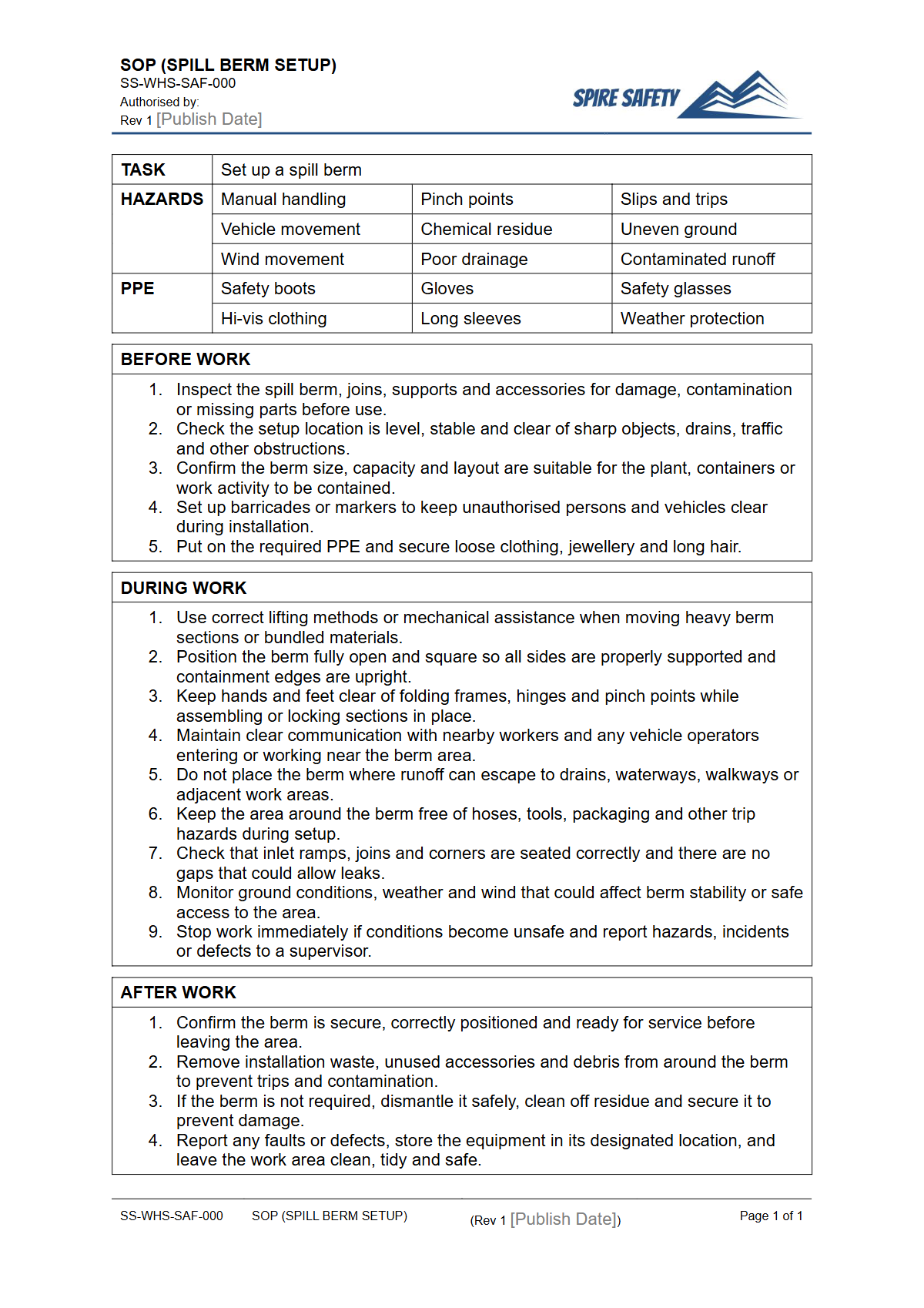
Download our free Safe Operating Procedure for Spill Berm Setup to document the step-by-step process for safely deploying temporary spill containment.
Free Safe Operating Procedure (Spill Berm Setup) Template
DOCX • 126 KB + PDF
Updated Oct 2026
No signup required
Purpose of the Free Safe Operating Procedure (Spill Berm Setup) Template
Effectively managing hazardous liquid spills is critical for environmental protection and worker safety. This Free Safe Operating Procedure (Spill Berm Setup) Template provides a structured format for documenting the specific, step-by-step actions required to correctly and safely deploy temporary spill berms.
A clear, documented procedure helps prevent ground and water contamination, minimises worker exposure to harmful substances, and reduces the risk of costly clean-up operations and regulatory fines. Using a standardised Safe Operating Procedure (SOP) ensures that all personnel perform the task consistently and safely, every time.
A well-written SOP is a fundamental training tool, a reference for competent operators, and a key document within your broader WHS management systems. It formalises your organisation's commitment to controlling risks and demonstrates due diligence in managing foreseeable hazards associated with liquid storage and handling. This template is designed as a practical starting point, aligned with Australian WHS best practices for risk management.
Video walkthrough
How to use the Free Safe Operating Procedure (Spill Berm Setup) Template
This resource is available for download as a DOCX file for easy editing and a PDF for immediate use. The primary purpose of the template is to be adapted to the unique context of your workplace.
You should review and modify every section to ensure it accurately reflects your specific equipment, materials, and operational environment. While this document is a comprehensive starting point, compliance is dependent on its correct customisation and implementation.
Important: It is crucial to remember that this is a template. We have designed it as a starting point, and you must customise it to reflect the specific types of spill berms, hazardous materials, and unique environmental conditions present in your workplace.
A Person Conducting a Business or Undertaking (PCBU) has a primary duty of care, which includes consulting with workers when developing and reviewing procedures that affect their health and safety.
Key sections to customise include:
- Hazard Identification: Add any site-specific hazards related to the location, the substances being contained, or the equipment used.
- Personal Protective Equipment (PPE): Specify the exact PPE required, such as chemical-resistant gloves, safety glasses, and appropriate footwear, based on your risk assessment and the Safety Data Sheet (SDS) for the substance.
- Pre-use Inspection: Detail the checklist your workers must follow to inspect the spill berm for tears, punctures, or defects before deployment.
- Step-by-Step Procedure: Modify the steps to match the exact type of spill berm you use (e.g., collapsible wall, inflatable, foam edge) and the typical scenarios in which it is deployed.
- Post-use Procedure: Outline your specific process for cleaning, decontaminating, inspecting, and storing the berm.
For tasks not covered by our specific templates, our generic Free Safe Operating Procedure (SOP) Template provides a versatile foundation for a wide range of activities.
When to use a Spill Berm
A spill berm is a form of secondary containment used to control and capture spills and leaks from containers or equipment. This Safe Operating Procedure should be followed whenever a temporary berm is set up. Common scenarios include:
- During refuelling of vehicles, mobile plant, or generators, especially in environmentally sensitive areas.
- When performing maintenance on equipment where fluid leaks (e.g., oil, hydraulic fluid, coolant) are possible. Procedures for specific equipment can be detailed in documents like our Free Air Compressor SOP (Safe Operating Procedure) Template.
- While transferring liquids between containers, such as decanting chemicals from a 200L drum to a smaller vessel.
- To create a temporary bunded area for leaking drums, tanks, or machinery until they can be properly repaired or removed.
- When moving large containers of hazardous materials using equipment such as forklifts or telehandlers. Operators of such machinery must also follow specific procedures, as outlined in resources like our FREE Telehandler SOP (Safe Operating Procedure) Template.
Who should use this Safe Operating Procedure
This SOP is intended for all personnel who may be required to handle, deploy, or manage temporary spill berms. Specific roles include:
- Site Supervisors and Managers: They are responsible for ensuring the SOP is implemented correctly, workers are trained on the procedure, and its use is enforced. The effectiveness of these procedures can be verified through regular WHS compliance auditing.
- Maintenance Personnel: Any workers involved in servicing plant and equipment that contain significant volumes of fuel, oil, or other potentially hazardous fluids.
- Warehouse and Logistics Staff: Personnel responsible for storing, moving, and decanting liquid chemicals.
- Emergency Response Team Members: As part of the initial response to a spill incident, the deployment of a berm may be a critical first step.
- Environmental, Health, and Safety (EHS) Officers: For use in training, risk assessments, and incident planning.
After customising this document, explore our entire free WHS resources library for more templates to support your safety management system.
Common mistakes
Common mistakes to avoid
- Using a berm that is too small for the potential spill volume (a common rule is 110% of the largest container).
- Deploying the berm on uneven, sharp, or debris-covered ground, which can compromise its seal or cause punctures.
- Failing to conduct a pre-use inspection for rips, tears, or defects, leading to failure during a spill event.
- Not having a spill kit and other response materials readily available near the setup area.
Legal references
Legal considerations
The following legal requirements may be relevant to this type of work.
- Work Health and Safety Act (Harmonised) — Provides the primary duties for protecting workers and other people from work health and safety risks.
- Work Health and Safety Regulations (Harmonised) — Sets out requirements supporting the management of workplace hazards and risks.
The following codes may be relevant to this type of work.
- Managing WHS Risks Code of Practice — Provides practical guidance on identifying hazards, assessing risks and applying effective controls.
- Work Health and Safety Consultation, Cooperation and Coordination Code of Practice — Provides practical guidance on consulting workers and coordinating with other duty holders.
- Managing the Work Environment and Facilities Code of Practice — Provides practical guidance on safe work environments, workplace facilities and related controls.
Did you know
Cost of Contamination
According to regulatory bodies, clean-up costs for even a minor spill can run into thousands of dollars, while significant contamination events can cost businesses hundreds of thousands or even millions, not including fines and legal fees.
Material Matters
Not all spill berms are created equal. The material must be chemically compatible with the substance being contained. Using a standard PVC berm for an aggressive solvent could cause it to degrade and fail, leading to a larger incident.
FAQ
Frequently asked questions
01What is a spill berm?
02Why is a documented SOP important for spill berm setup?
03How often should we review our Spill Berm Setup SOP?
04Can this template be used for permanent spill containment?
Share this resource
Free Safe Operating Procedure (Spill Berm Setup) Template
Browse Categories
How To Use It
- 1Download and open in Word or PDF.
- 2Replace the placeholders with your business details.
- 3Get it reviewed by a WHS specialist before rollout.
Need it customised?
Our WHS consultants can adapt this template to your site, run a gap analysis, or audit what you already have in place.
Book a Free Consultation WHS consulting servicesor call 1300 156 382
Related templates
- Free Safe Operating Procedure (Spill Kit Use) Template
- Free Safe Operating Procedure (Spindle Moulder) Template
- Free Safe Operating Procedure (Spinning Machine) Template
- Free Safe Operating Procedure (Sports Field Aeration) Template
- Free Safe Operating Procedure (Sports Field Divoting) Template
- Free Safe Operating Procedure (Sports Field Fertilise) Template