
Free Safe Operating Procedure (Spill Kit Use) Template
Download our free Safe Operating Procedure (Spill Kit Use) template to manage spills effectively. This document provides a clear framework for your team.
Free Safe Operating Procedure (Spill Kit Use) Template
DOCX • 126 KB + PDF
Updated Oct 2026
No signup required
Purpose of the Free Safe Operating Procedure (Spill Kit Use) Template
Effectively managing chemical, oil, and other hazardous liquid spills is a critical component of workplace health and safety. A swift and correct response can prevent serious injuries, environmental damage, and costly clean-ups.
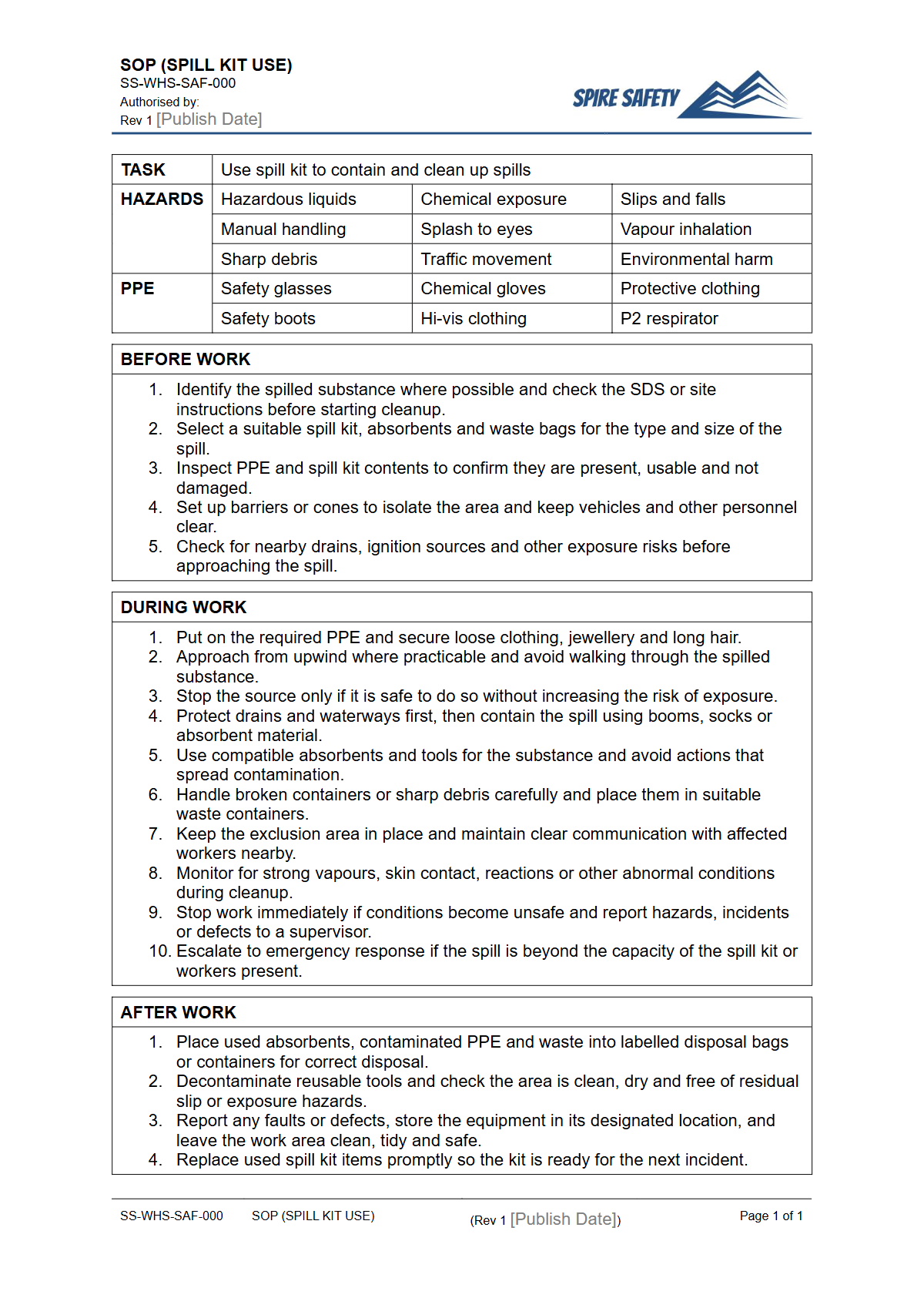
This Free Safe Operating Procedure (Spill Kit Use) Template provides a structured starting point for organisations to develop their own site-specific procedures. It is designed to guide workers through the process of safely containing, cleaning, and disposing of spilled materials using a standard spill kit.
The primary purpose of this SOP is to establish a clear, repeatable process that minimises risks to personnel and the environment. By documenting the required steps, personal protective equipment (PPE), and emergency contacts, you create a reliable guide for employees to follow under pressure.
Integrating this procedure into your broader safety framework is essential for maintaining a safe workplace. A well-defined SOP for spill response is a key part of all comprehensive WHS management systems, demonstrating due diligence in managing foreseeable hazards.
Video walkthrough
How to use the Free Safe Operating Procedure (Spill Kit Use) Template
This resource is available for download in both DOCX and PDF formats. The DOCX version is fully editable, allowing you to tailor the content to the specific hazards, equipment, and protocols of your workplace.
While this template is aligned with Australian WHS principles, it serves as a foundation, not a finished document.
Important: You must customise this Safe Operating Procedure to reflect the unique conditions and chemical inventories of your site. We have provided a general structure, but it is your responsibility to conduct a risk assessment and add specific details about the types of spills you might encounter, the exact contents of your spill kits, site-specific disposal methods, and emergency contact information.
This template can be used alongside a more general Safe Operating Procedure (SOP) Template for other tasks in your organisation.
What to Include in Your Spill Kit Use SOP
When customising your SOP, ensure it covers all phases of spill response. A robust procedure should include several key sections to guide workers effectively.
Key Sections to Customise:
- Hazard Identification: List the types of hazardous substances present at your workplace and the specific risks they pose (e.g., corrosive, flammable, toxic).
- PPE Requirements: Specify the exact PPE required for responding to a spill, such as chemical-resistant gloves, safety glasses or goggles, coveralls, and respiratory protection if needed.
- Spill Kit Location and Contents: Clearly state where spill kits are located and provide an inventory of their contents (e.g., absorbent pads, booms, granular absorbent, disposal bags, warning signs).
- Step-by-Step Response Procedure: Detail the sequence of actions: 1. Alert others and secure the area. 2. Assess the spill and identify the substance. 3. Contain the spill to prevent it from spreading. 4. Absorb the spilled material. 5. Collect and package the contaminated waste. 6. Decontaminate the area, tools, and personnel.
- Disposal Procedures: Provide clear instructions on how to label, store, and dispose of contaminated waste in accordance with local environmental regulations.
- Reporting and Restocking: Outline the process for reporting the incident to a supervisor and ensuring the spill kit is immediately cleaned and restocked for the next use. Regular checks of these procedures are often verified during WHS compliance audits.
When to Use a Spill Response SOP
This Safe Operating Procedure should be activated immediately upon the discovery of any uncontrolled release of a liquid that poses a risk to health, safety, or the environment. This includes spills of oils, fuels, solvents, acids, caustics, and other hazardous chemicals.
The procedure applies whether the spill is minor (a few litres) or more significant, though the scale of the response will differ. For large or highly dangerous spills, the procedure should clearly define the point at which an internal response is insufficient and external emergency services must be called.
The SOP is a proactive control measure. Its development should be part of the initial risk assessment process when introducing new chemicals or machinery.
Preventing spills is the first priority, whether it's managing hydraulic fluids from machinery or potential leaks from gas cylinders, which may be covered in a specific Oxy Acetylene SOP. However, when prevention fails, this procedure provides the critical reactive framework.
Who Should Use This Procedure
This SOP is intended for all personnel who are trained and authorised to respond to spills in the workplace. This typically includes maintenance staff, laboratory technicians, machine operators, first responders, and supervisors.
It is crucial that no worker attempts to clean up a spill without receiving proper training on the procedures and the correct use of the spill kit and associated PPE.
Management holds the responsibility for ensuring that an adequate number of staff are trained and that training is refreshed regularly. For businesses dealing with particularly complex or high-risk substances, seeking external guidance can be beneficial. Engaging with professional WHS consulting services can help ensure your procedures are robust and fit for purpose. You can find many more helpful documents in our free WHS resources library to support your safety management system.
Common mistakes
Common mistakes to avoid
- Using the wrong type of absorbent material for the specific chemical spilled.
- Failing to wear the correct Personal Protective Equipment (PPE), leading to exposure.
- Neglecting to contain the spill first, allowing it to spread and create a larger hazard.
- Forgetting to restock the spill kit after use, leaving the workplace unprepared for the next incident.
- Improper disposal of used absorbent materials and contaminated PPE.
Legal references
Legal considerations
The following legal requirements may be relevant to this type of work.
- Work Health and Safety Act (Harmonised) — Provides the primary duties for protecting workers and other people from work health and safety risks.
- Work Health and Safety Regulations (Harmonised) — Sets out requirements supporting the management of workplace hazards and risks.
The following codes may be relevant to this type of work.
- Managing WHS Risks Code of Practice — Provides practical guidance on identifying hazards, assessing risks and applying effective controls.
- Work Health and Safety Consultation, Cooperation and Coordination Code of Practice — Provides practical guidance on consulting workers and coordinating with other duty holders.
- Managing the Work Environment and Facilities Code of Practice — Provides practical guidance on safe work environments, workplace facilities and related controls.
Did you know
Colour Coding Absorbents
Spill kit absorbents are often colour-coded to help workers quickly choose the right material. Grey or black is typically for universal use (oils, coolants, water), yellow for hazardous chemicals, and white for oil and fuel only.
Serious Injury Claims
According to Safe Work Australia, contact with chemical and other substances accounts for thousands of serious workers' compensation claims each year, highlighting the importance of proper handling and spill response procedures.
FAQ
Frequently asked questions
01What items should be included in a standard spill kit?
02How often should spill kits be inspected?
03Who is responsible for cleaning up a chemical spill in the workplace?
04Does this SOP template cover all types of chemical spills?
Share this resource
Free Safe Operating Procedure (Spill Kit Use) Template
Browse Categories
How To Use It
- 1Download and open in Word or PDF.
- 2Replace the placeholders with your business details.
- 3Get it reviewed by a WHS specialist before rollout.
Need it customised?
Our WHS consultants can adapt this template to your site, run a gap analysis, or audit what you already have in place.
Book a Free Consultation WHS consulting servicesor call 1300 156 382
Related templates
- Free Safe Operating Procedure (Spindle Moulder) Template
- Free Safe Operating Procedure (Spinning Machine) Template
- Free Safe Operating Procedure (Sports Field Aeration) Template
- Free Safe Operating Procedure (Sports Field Divoting) Template
- Free Safe Operating Procedure (Sports Field Fertilise) Template
- Free Safe Operating Procedure (Sports Field Line Prep) Template