
Free Safe Operating Procedure (Specimen Transport) Template
Download our free Safe Operating Procedure (Specimen Transport) Template to manage biological hazards. Get your customisable DOCX and PDF template today.
Free Safe Operating Procedure (Specimen Transport) Template
DOCX • 126 KB + PDF
Updated Oct 2026
No signup required
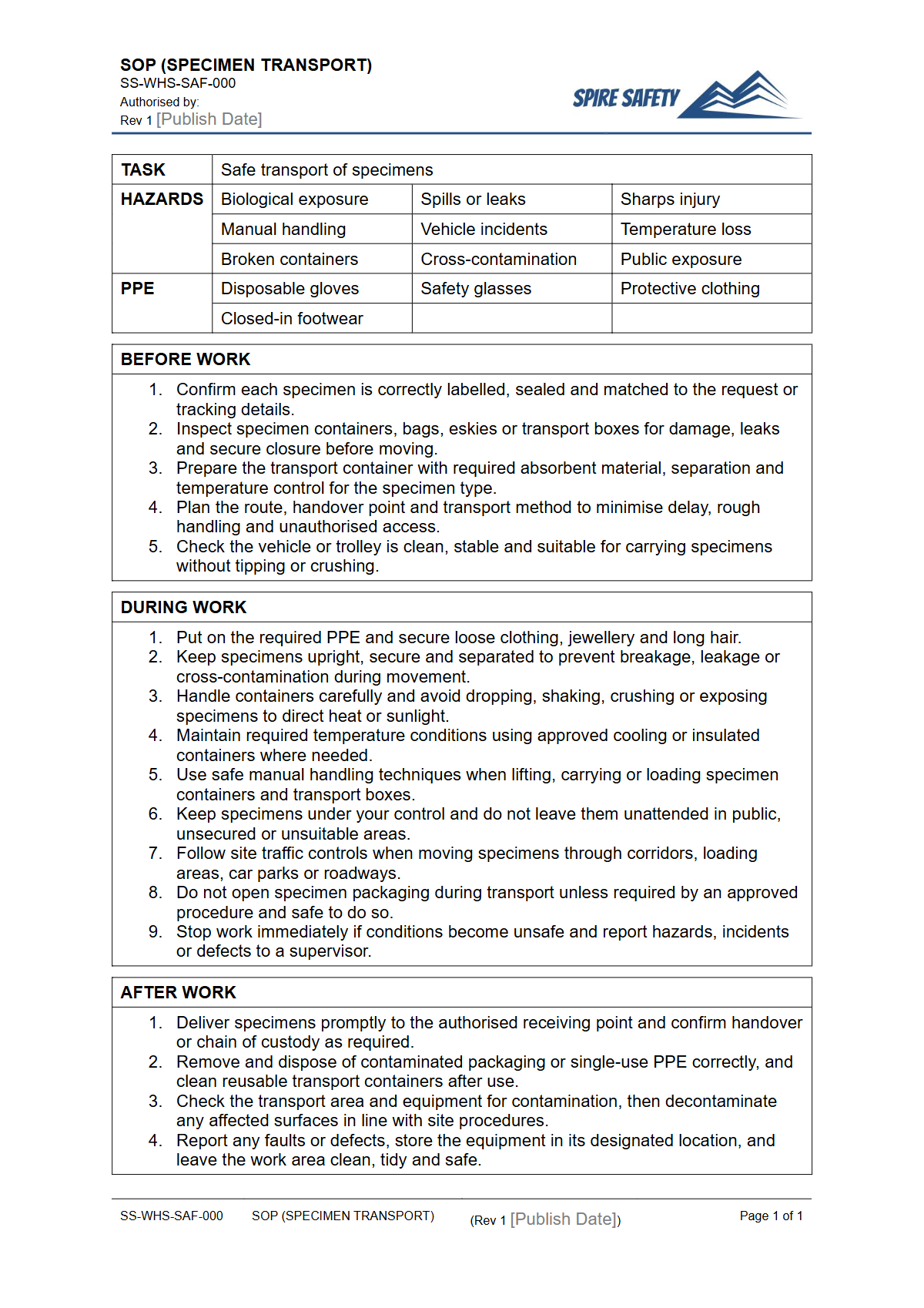
Purpose of the Free Safe Operating Procedure (Specimen Transport) Template
This free Safe Operating Procedure (Specimen Transport) Template provides a structured starting point for organisations that handle and transport biological specimens. Whether in a clinical, research, or veterinary setting, moving samples from the point of collection to the laboratory involves significant risks.
These include potential exposure to infectious agents, specimen degradation affecting diagnostic accuracy, and breaches of patient confidentiality. A documented SOP is crucial for ensuring the safety of personnel, the public, and for maintaining sample integrity.
It outlines the required steps for packaging, labelling, handling, and documentation, ensuring a consistent and safe process is followed every time.
Implementing a robust SOP for specimen transport is a fundamental component of a comprehensive safety framework. It formalises risk control measures and provides a clear reference for training and daily operations.
Properly executed, this procedure helps your organisation meet its duty of care under Australian WHS laws. This SOP should integrate seamlessly into your overall WHS management systems, serving as a practical tool to mitigate specific biological hazards.
Video walkthrough
How to use the Free Safe Operating Procedure (Specimen Transport) Template
This document is a template, not a finished procedure. It must be customised to reflect the specific hazards, personnel, equipment, and transport routes relevant to your workplace.
To effectively use this Safe Operating Procedure for specimen transport, you should consult with workers, laboratory staff, and transport personnel involved in the process.
Follow these steps to adapt the template:
- Risk Assessment: Conduct a thorough risk assessment for your specific specimen transport activities. Identify hazards such as the types of biological agents, transport methods (e.g., internal, external courier, vehicle type), potential for spills, and security risks.
- Customisation: Fill in the blank sections with details specific to your organisation. This includes emergency contact numbers, required personal protective equipment (PPE), specific packaging materials (e.g., primary, secondary, and tertiary containers), and exact labelling requirements according to relevant standards like the ADG Code or NPAAC guidelines.
- Consultation: Share the draft procedure with your team for feedback. Those performing the task are best placed to identify practical challenges or gaps in the procedure.
- Training: Once finalised, use the SOP as a basis for training all relevant staff. Ensure everyone understands their responsibilities, from packaging at the source to reception at the lab. Keep detailed training records.
- Review: Schedule regular reviews of the SOP, especially after any incident, near miss, or change in regulations or processes. Regular checks of your safety documents are a key activity during a WHS compliance auditing process.
A Note on Customisation
IMPORTANT: This is a template we have developed to provide a starting point. You MUST customise this document to your specific workplace, equipment, and context.
Un-customised, it is not a valid control measure. Generic procedures are not effective in controlling hazards.
When to use it
A Safe Operating Procedure for specimen transport should be used for any activity involving the movement of biological samples outside of a primary containment environment. This applies to transport within a single facility (e.g., from a ward to an on-site lab), between different buildings on a campus, or to off-site laboratories via road or air.
Even automated systems in larger facilities, like those for which a FREE Conveyer System SOP would be used, require strict protocols when transporting hazardous materials.
It is particularly critical when transporting potentially infectious substances (Category A or B), patient diagnostic samples, research materials, and veterinary specimens. Use this SOP to standardise procedures, train new staff, and as a reference guide for incident response, such as managing a spill during transit.
For particularly complex logistics or high-consequence pathogens, engaging external experts through WHS consulting can provide an additional layer of assurance.
Who should use it
This SOP is designed for use by a range of personnel within an organisation. Primarily, it should be used by workers directly involved in the collection, packaging, and transport of specimens.
This includes nurses, doctors, phlebotomists, researchers, couriers, and laboratory technicians who receive the samples.
Additionally, WHS managers, laboratory managers, and supervisors should use this template to develop and implement the procedure. It serves as a tool for them to supports your compliance efforts, train their teams, and investigate incidents.
While this template addresses a specific task, you can find our generic Free Safe Operating Procedure (SOP) Template for documenting other workplace activities. Ultimately, anyone responsible for the safe and secure handling of biological materials will find this document essential for their operational toolkit. To explore more templates and safety documents, visit our free WHS resources library.
Common mistakes
Common mistakes to avoid
- Using incorrect or damaged packaging that fails to meet triple-layer requirements.
- Incomplete or illegible labelling, leading to sample rejection or mishandling.
- Failing to include sufficient absorbent material in the secondary container to contain a spill from the primary container.
- Not having a readily accessible spill kit in transport vehicles or along the transport route.
Legal references
Legal considerations
The following legal requirements may be relevant to this type of work.
- Work Health and Safety Act (Harmonised) — Provides the primary duties for protecting workers and other people from work health and safety risks.
- Work Health and Safety Regulations (Harmonised) — Sets out requirements supporting the management of workplace hazards and risks.
The following codes may be relevant to this type of work.
- Managing WHS Risks Code of Practice — Provides practical guidance on identifying hazards, assessing risks and applying effective controls.
- Work Health and Safety Consultation, Cooperation and Coordination Code of Practice — Provides practical guidance on consulting workers and coordinating with other duty holders.
- Managing the Work Environment and Facilities Code of Practice — Provides practical guidance on safe work environments, workplace facilities and related controls.
Did you know
Chain of Custody
For many specimens, particularly in legal or forensic cases, the SOP must also ensure a strict 'chain of custody'. This is a documented trail that accounts for the integrity and security of the sample from collection to reception.
The Triple-Layer System
The standard for shipping infectious substances, developed by the UN, is a triple-packaging system. It consists of a primary watertight container, a secondary watertight container with absorbent material, and a rigid outer layer to protect it during transit.
FAQ
Frequently asked questions
01What key information must be included in a specimen transport SOP?
02Who is responsible for training staff on specimen transport procedures?
03How often should a Safe Operating Procedure for specimen transport be reviewed?
04Does this SOP cover transport by external third-party couriers?
Share this resource
Free Safe Operating Procedure (Specimen Transport) Template
Browse Categories
How To Use It
- 1Download and open in Word or PDF.
- 2Replace the placeholders with your business details.
- 3Get it reviewed by a WHS specialist before rollout.
Need it customised?
Our WHS consultants can adapt this template to your site, run a gap analysis, or audit what you already have in place.
Book a Free Consultation WHS consulting servicesor call 1300 156 382
Related templates
- Free Safe Operating Procedure (Spill Berm Setup) Template
- Free Safe Operating Procedure (Spill Kit Use) Template
- Free Safe Operating Procedure (Spindle Moulder) Template
- Free Safe Operating Procedure (Spinning Machine) Template
- Free Safe Operating Procedure (Sports Field Aeration) Template
- Free Safe Operating Procedure (Sports Field Divoting) Template