
Free Safe Operating Procedure (Spa Room Cleaning) Template
Download our free Safe Operating Procedure for Spa Room Cleaning to outline hazards and controls for your business. Get your DOCX and PDF template now.
Free Safe Operating Procedure (Spa Room Cleaning) Template
DOCX • 126 KB + PDF
Updated Oct 2026
No signup required
Purpose of the Free Safe Operating Procedure (Spa Room Cleaning) Template
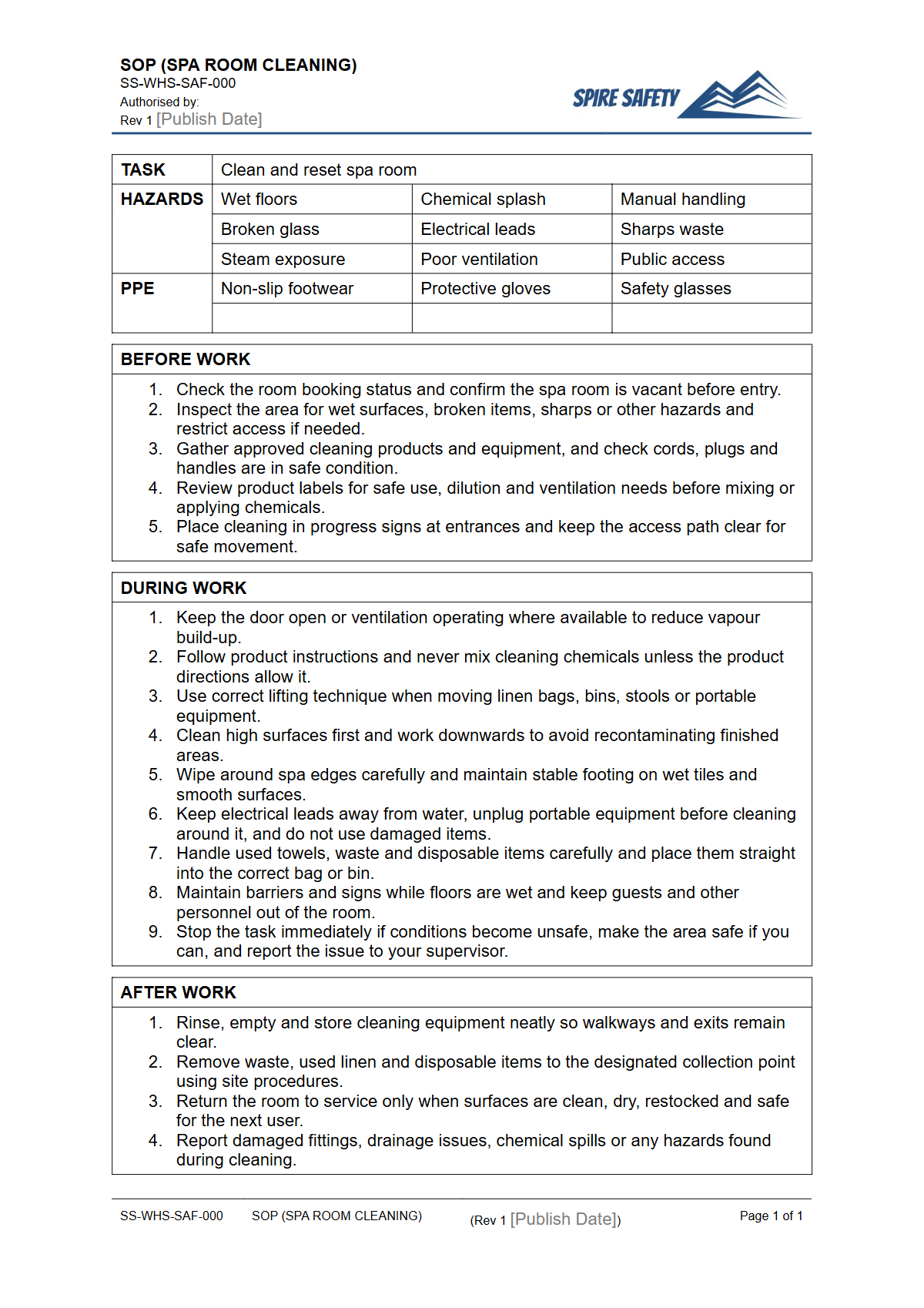
Maintaining hygiene and presentation in a spa environment is critical, but the cleaning process itself introduces significant workplace hazards. This free Safe Operating Procedure (Spa Room Cleaning) Template provides a structured framework for documenting the specific tasks, risks, and safety controls required.
Using a detailed SOP helps standardise your cleaning processes, ensuring every team member understands how to work safely and effectively. It formalises procedures for handling chemicals, mitigating slip hazards on wet floors, and performing manual tasks correctly, forming a key part of your overall safety management approach.
What is a Safe Operating Procedure?
A Safe Operating Procedure (SOP), sometimes called a Safe Work Procedure (SWP), is a written document that provides step-by-step instructions on how to perform a task safely. Unlike a Safe Work Method Statement (SWMS) which is required for high-risk construction work, an SOP is a practical tool used across all industries to manage risks associated with routine operational tasks.
It identifies potential hazards and outlines the control measures required to prevent injury or illness. This is a more detailed and specific document than our general Safe Operating Procedure (SOP) template, focusing exclusively on the spa environment.
Video walkthrough
How to use the Free Safe Operating Procedure (Spa Room Cleaning) Template
This template is provided in both DOCX and PDF formats for your convenience. The DOCX file is fully editable, allowing you to tailor the content to the unique aspects of your facility.
It is crucial to customise this document to reflect your specific cleaning chemicals, equipment, spa layout, and internal procedures. A generic SOP that doesn't match your reality offers little practical protection.
We strongly recommend a collaborative approach. Download the template and review it with the staff who perform the cleaning tasks.
Their direct experience is invaluable for identifying practical challenges and effective controls. Once customised, the SOP should be used as a primary training document for new employees and for regular refresher training with your existing team.
Ensuring easy access to the finalised SOP in the workplace is essential for it to be effective.
When to use this Safe Operating Procedure
The Spa Room Cleaning SOP should be an integral part of your daily operations. It serves as the primary reference for:
- Routine Cleaning: Guiding staff through the daily or shift-by-shift cleaning tasks for treatment rooms, wet areas, and change rooms.
- Periodic Deep Cleans: Providing detailed instructions for less frequent but more intensive cleaning schedules.
- Staff Training and Induction: Forming the basis of training for new cleaners, ensuring they understand the safety requirements from day one.
- Incident Investigation: Acting as a benchmark for expected procedure if a safety incident or near-miss occurs during cleaning activities.
Consistent use of the SOP reinforces safe work habits and demonstrates your organisation's commitment to a safe working environment.
Who should use this Safe Operating Procedure
This document is designed for use by multiple roles within a spa, wellness centre, or hotel facility:
- Cleaning Staff: As a direct, practical guide to performing their duties safely.
- Supervisors and Managers: To monitor compliance, conduct training, and ensure consistent standards are met across the team.
- WHS Representatives and Committees: As a tool for risk assessment and a document to review as part of broader safety initiatives.
Effectively implementing SOPs like this one is a cornerstone of a strong safety culture and a key component of a comprehensive WHS management system. It provides clear, documented evidence of the steps your business takes to manage foreseeable risks.
Integrating the SOP with Chemical Safety
A critical part of using this SOP involves hazardous chemicals. Your procedure must align with the information found in the Safety Data Sheets (SDS) for every cleaning product used.
The SOP should specify where SDS are located and instruct workers to consult them before using a chemical. If your team requires support with hazard identification and chemical management, engaging specialist WHS consulting can provide clarity and expert guidance.
Review and Continuous Improvement
A Safe Operating Procedure is not a 'set and forget' document. To remain effective, it must be reviewed regularly—typically on an annual basis, or whenever there is a change in equipment, chemicals, processes, or after an incident.
This process of review ensures the procedure stays relevant and continues to effectively control risks. Conducting regular WHS compliance audits can help formalise this review cycle and identify gaps in your safety systems. To find more templates and checklists, browse our complete free WHS resources library.
Common mistakes
Common mistakes to avoid
- Using a generic template without customising it for the specific chemicals, equipment, and layout of your spa.
- Failing to provide practical training to staff on how to follow the documented procedure.
- Not making Safety Data Sheets (SDS) for all cleaning chemicals readily accessible to workers.
- Forgetting to schedule regular reviews, rendering the SOP outdated and ineffective over time.
Legal references
Legal considerations
The following legal requirements may be relevant to this type of work.
- Work Health and Safety Act (Harmonised) — Provides the primary duties for protecting workers and other people from work health and safety risks.
- Work Health and Safety Regulations (Harmonised) — Sets out requirements supporting the management of workplace hazards and risks.
The following codes may be relevant to this type of work.
- Managing WHS Risks Code of Practice — Provides practical guidance on identifying hazards, assessing risks and applying effective controls.
- Work Health and Safety Consultation, Cooperation and Coordination Code of Practice — Provides practical guidance on consulting workers and coordinating with other duty holders.
- Managing the Work Environment and Facilities Code of Practice — Provides practical guidance on safe work environments, workplace facilities and related controls.
Did you know
Slips, Trips, and Falls
According to Safe Work Australia, slips, trips, and falls are a leading cause of serious workplace injuries, with wet or greasy floors being a primary contributor. Using correct signage and 'clean-as-you-go' methods are vital controls.
Chemical Exposure
Many common cleaning agents can cause occupational skin or respiratory diseases if used without proper ventilation and PPE. The risks are often underestimated because the products are used so frequently.
FAQ
Frequently asked questions
01What should be included in a Spa Room Cleaning SOP?
02How often should we review our Spa Room Cleaning SOP?
03Is a Safe Operating Procedure a legal requirement in Australia?
04What's the difference between an SOP and a SWMS?
Share this resource
Free Safe Operating Procedure (Spa Room Cleaning) Template
Browse Categories
How To Use It
- 1Download and open in Word or PDF.
- 2Replace the placeholders with your business details.
- 3Get it reviewed by a WHS specialist before rollout.
Need it customised?
Our WHS consultants can adapt this template to your site, run a gap analysis, or audit what you already have in place.
Book a Free Consultation WHS consulting servicesor call 1300 156 382
Related templates
- Free Safe Operating Procedure (Specimen Transport) Template
- Free Safe Operating Procedure (Spill Berm Setup) Template
- Free Safe Operating Procedure (Spill Kit Use) Template
- Free Safe Operating Procedure (Spindle Moulder) Template
- Free Safe Operating Procedure (Spinning Machine) Template
- Free Safe Operating Procedure (Sports Field Aeration) Template