
Free Safe Operating Procedure (Spa Equipment Cleaning) Template
Standardise your spa and salon hygiene protocols with our professional template. Download our free Safe Operating Procedure for spa equipment cleaning today.
Free Safe Operating Procedure (Spa Equipment Cleaning) Template
DOCX • 126 KB + PDF
Updated Oct 2026
No signup required
Purpose of the Free Safe Operating Procedure (Spa Equipment Cleaning) Template
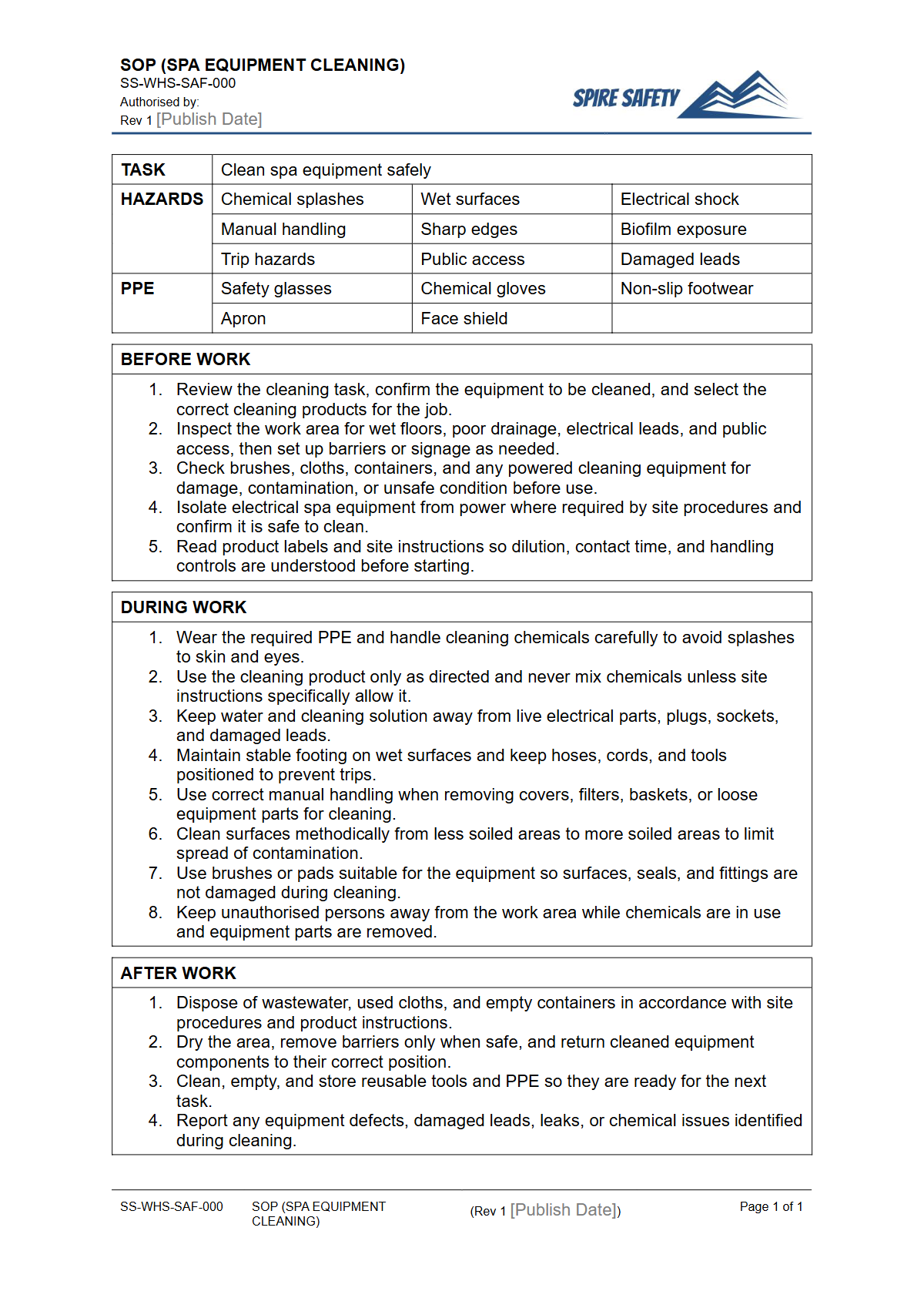
Maintaining impeccable hygiene in a spa, salon, or wellness centre is not just about aesthetics—it's a critical work health and safety requirement. This Free Safe Operating Procedure (Spa Equipment Cleaning) Template provides a structured framework for documenting the safe and effective cleaning of spa equipment.
Using this SOP helps your organisation standardise cleaning processes, manage risks associated with hazardous chemicals and biological contaminants, and protect both your staff and clients. It serves as a practical tool to ensure tasks are performed consistently and safely every time.
A documented SOP is a fundamental component of effective WHS management systems. It demonstrates a commitment to safety, provides clear instructions for workers, and simplifies training for new employees. This template helps you outline pre-operational checks, the step-by-step cleaning process, and post-cleaning actions, ensuring all safety measures, including the use of Personal Protective Equipment (PPE), are clearly defined and followed.
Video walkthrough
How to use the Free Safe Operating Procedure (Spa Equipment Cleaning) Template
Using this Safe Operating Procedure for spa equipment cleaning is straightforward. First, download the template in your preferred format, either DOCX for easy editing or PDF.
The document is designed as a comprehensive starting point, aligned with Australian WHS principles, that you can adapt to your specific operational needs.
It is essential to tailor the content to your workplace. This includes adding your company name, specific site details, and the names of the managers responsible for its implementation and review.
Most importantly, the procedural steps must be modified to reflect the exact types of equipment you use (e.g., hydrotherapy tubs, massage tables, pedicure stations), the specific cleaning chemicals approved for your site, and the unique hazards present in your environment.
Important Note: This is a template, not a finished document. We have provided a solid foundation, but you must customise it to reflect the unique risks and processes of your business.
A generic procedure cannot cover every specific scenario. If you require assistance in developing site-specific documentation, consider engaging professional WHS consulting services.
When to use it
A Safe Operating Procedure for cleaning spa equipment should be integrated into your daily and periodic cleaning schedules. It is a live document that workers should reference before and during the cleaning process to ensure they are following the correct, safe method.
It is particularly important for tasks that are performed daily, such as end-of-day wipe-downs, as well as for less frequent but more intensive deep cleaning procedures.
This SOP should be used to guide the cleaning of all client-facing and back-of-house equipment where hygiene is paramount. This includes pedicure chairs, facial steamers, massage tables, hot stone warmers, and any other tools or surfaces that come into contact with clients or are exposed to moisture and potential contamination.
While it has a different context, a similar structured approach can be seen in our Free Safe Operating Procedure (Deep Fryer - Standard Operation) Template, which also focuses on hygiene and safety in a specific operational environment.
Who should use it
This SOP is intended for a range of personnel within a spa or wellness business. Managers and business owners should use it to establish and enforce a consistent standard of safety and cleanliness across their operations.
Supervisors are responsible for using the SOP as a primary tool for training staff, conducting competency assessments, and monitoring adherence to the procedure. They ensure that all team members understand the risks and the control measures outlined in the document.
The primary users, however, are the spa therapists, aestheticians, and cleaning staff who perform the cleaning tasks. For these workers, the SOP is a vital step-by-step guide to doing their job safely and effectively, minimising risks such as chemical burns, slips, or exposure to pathogens.
Regular reviews of SOPs and their practical application are a key activity during WHS compliance auditing to verify that safe work practices are truly embedded in the organisation’s culture. For more templates and safety documents, browse our complete free WHS resources library.
Common mistakes
Common mistakes to avoid
- Using the wrong cleaning chemicals for a specific surface, leading to equipment damage.
- Failing to wear appropriate PPE, especially gloves and eye protection, when handling concentrates.
- Neglecting to unplug electrical equipment before cleaning with liquids, creating an electrocution risk.
- Not allowing adequate ventilation in the room when using strong chemical agents.
Legal references
Legal considerations
The following legal requirements may be relevant to this type of work.
- Work Health and Safety Act (Harmonised) — Provides the primary duties for protecting workers and other people from work health and safety risks.
- Work Health and Safety Regulations (Harmonised) — Sets out requirements supporting the management of workplace hazards and risks.
The following codes may be relevant to this type of work.
- Managing WHS Risks Code of Practice — Provides practical guidance on identifying hazards, assessing risks and applying effective controls.
- Work Health and Safety Consultation, Cooperation and Coordination Code of Practice — Provides practical guidance on consulting workers and coordinating with other duty holders.
- Managing the Work Environment and Facilities Code of Practice — Provides practical guidance on safe work environments, workplace facilities and related controls.
Did you know
Chemical Contact Time
Many disinfectants require a specific 'contact time'—the period they must remain wet on a surface to effectively kill germs. Wiping a disinfectant off too quickly can render it ineffective, a common mistake in fast-paced environments.
Biofilm Risk
The internal plumbing of spa pedicure chairs and hydrotherapy tubs can harbour biofilm, a slimy colony of bacteria that is resistant to standard cleaning. Specific 'flush-through' disinfection procedures are required to manage this significant health risk.
FAQ
Frequently asked questions
01How often should a Safe Operating Procedure for spa cleaning be reviewed?
02What kind of PPE is needed for cleaning spa equipment?
03Is an SOP enough to manage all safety risks for spa cleaning?
04Who is responsible for training staff on the Spa Equipment Cleaning SOP?
Share this resource
Free Safe Operating Procedure (Spa Equipment Cleaning) Template
Browse Categories
How To Use It
- 1Download and open in Word or PDF.
- 2Replace the placeholders with your business details.
- 3Get it reviewed by a WHS specialist before rollout.
Need it customised?
Our WHS consultants can adapt this template to your site, run a gap analysis, or audit what you already have in place.
Book a Free Consultation WHS consulting servicesor call 1300 156 382
Related templates
- Free Safe Operating Procedure (Spa Pool Cleaning) Template
- Free Safe Operating Procedure (Spa Room Cleaning) Template
- Free Safe Operating Procedure (Specimen Transport) Template
- Free Safe Operating Procedure (Spill Berm Setup) Template
- Free Safe Operating Procedure (Spill Kit Use) Template
- Free Safe Operating Procedure (Spindle Moulder) Template