
Free Safe Operating Procedure (Soup Kettle) Template
Download our free Safe Operating Procedure (Soup Kettle) Template to formalise safety protocols for kitchen staff. Get your customisable DOCX and PDF today.
Free Safe Operating Procedure (Soup Kettle) Template
DOCX • 126 KB + PDF
Updated Oct 2026
No signup required
Purpose of the Free Safe Operating Procedure (Soup Kettle) Template
Operating commercial kitchen equipment like a soup kettle presents significant workplace health and safety risks, primarily from burns, scalds, and electrical hazards. This Free Safe Operating Procedure (Soup Kettle) Template provides a structured framework for documenting the safest way to perform this task.
By establishing clear, step-by-step instructions, organisations can minimise the risk of injury, ensure consistent operational practices, and demonstrate a commitment to providing a safe system of work for all employees. A documented SOP is a critical tool for managing hazards associated with hot liquids and electrical appliances in a busy commercial environment, much like our Free Safe Operating Procedure for a Deep Fryer.
A well-drafted SOP helps control specific hazards such as burns from direct contact with hot surfaces or soup, scalds from steam, slips from spills on the floor, and electric shock from faulty cords or components. Formalising these procedures ensures every worker understands the expected safe behaviours and the control measures in place to protect them.
Video walkthrough
How to use the Free Safe Operating Procedure (Soup Kettle) Template
This resource is available for immediate download in both DOCX and PDF formats. The DOCX file is fully editable, allowing you to tailor the content to the specific equipment and environment in your workplace.
It is crucial to adapt this template before implementation. Generic procedures are not sufficient for ensuring safety; they must reflect your unique operational context.
Important: We have provided this template as a starting point. You must customise it to reflect the specific soup kettle model, workplace layout, cleaning chemicals, and emergency procedures relevant to your organisation.
Effective SOPs are developed in consultation with the workers who actually use the equipment. Once finalised, the procedure should be a core part of your training program and integrated into your broader WHS management systems.
What's included in the template?
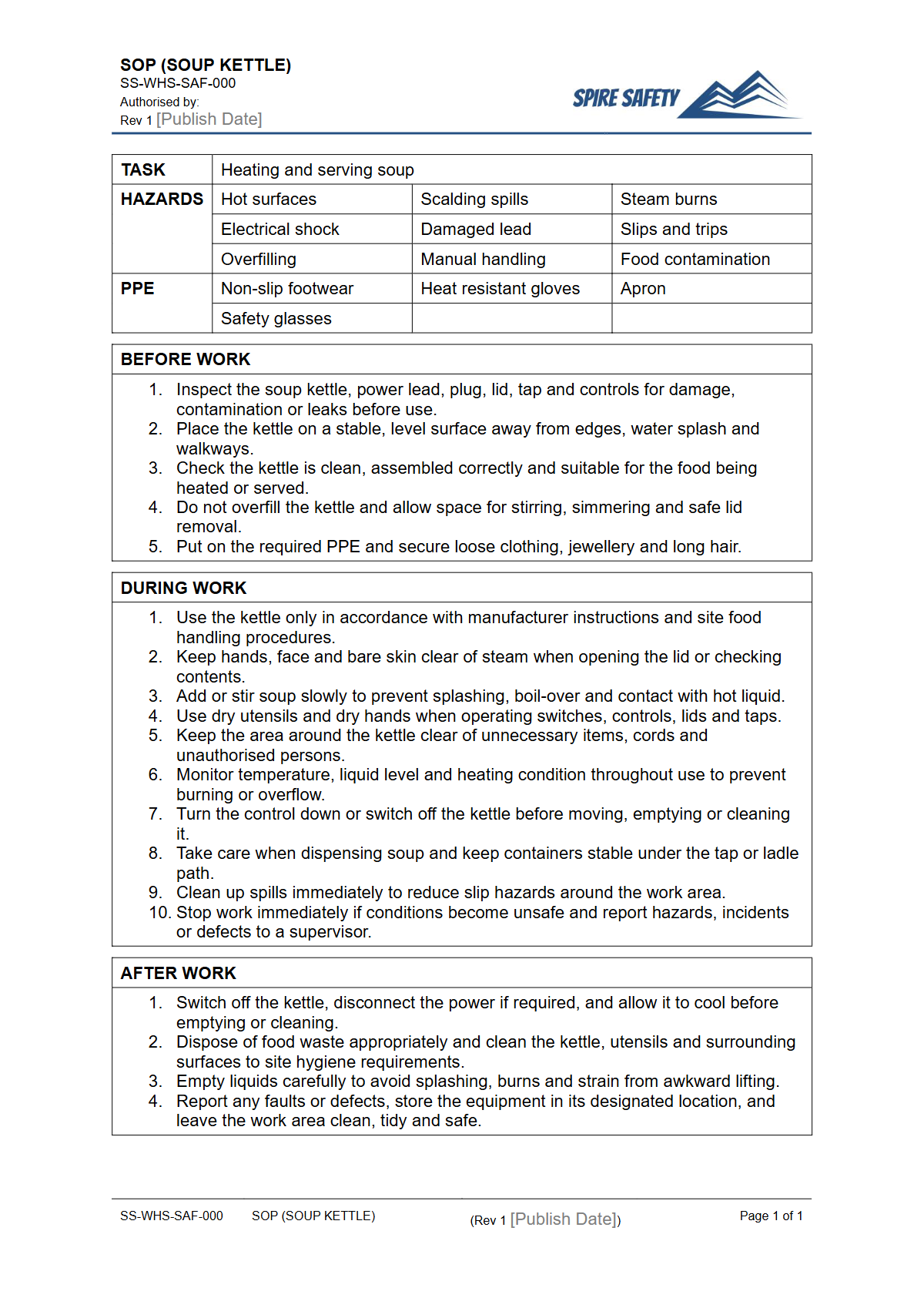
Our soup kettle SOP template is organised into logical sections to guide users through the entire process safely. Key areas covered include:
- Personal Protective Equipment (PPE): Specifies necessary PPE such as heat-resistant gloves, aprons, and non-slip, enclosed footwear.
- Pre-Operational Checks: A checklist of actions to perform before use, including inspecting the power cord for damage, ensuring the thermostat is functioning correctly, and checking that the unit is clean and stable.
- Safe Operating Steps: Detailed, sequential instructions for filling the kettle, setting the temperature, stirring, and dispensing hot liquids safely to prevent splashes and spills.
- Cleaning and Post-Use Procedures: Outlines the correct method for safely emptying, cleaning, and storing the kettle, including handling of any specified cleaning chemicals.
- Emergency Response: Clear instructions on how to react to incidents such as major spills, burns, or electrical faults.
Ensuring these documented steps are consistently followed is a key function of workplace supervision and can be verified through regular WHS compliance auditing.
When to use it
A Safe Operating Procedure for a soup kettle should be used as a primary training document for all new and existing employees who are required to operate the equipment. It serves as the foundation for practical, on-the-job training and competency assessments.
The SOP should be readily accessible in the work area for quick reference. It is also a vital document to review during incident investigations or when conducting a workplace risk assessment on kitchen activities.
If your organisation needs assistance in integrating such procedures, you may consider engaging WHS consulting professionals for expert guidance.
Who should use it
This template is designed for use by any person or business responsible for safety in a commercial kitchen environment. This includes:
- WHS Managers and Advisors: To develop and formalise safety documentation as part of the overall safety management system.
- Kitchen Managers and Supervisors: To train staff, enforce safe work practices, and ensure consistent operational standards.
- Chefs, Cooks, and Kitchen Hands: As a practical guide for operating the equipment safely during their daily tasks.
- Business Owners (PCBUs): To help meet their primary duty of care under Australian WHS legislation to provide and maintain a safe working environment.
By implementing this SOP, you contribute to a stronger safety culture where risks are actively managed. For more templates and safety guides, you can explore our free WHS resources library.
Common mistakes
Common mistakes to avoid
- Overfilling the kettle, leading to dangerous splashes and spills when heating or serving.
- Using incorrect cleaning chemicals or abrasive scourers, which can damage the equipment's internal surface.
- Failing to conduct pre-operational checks on the power cord and thermostat for signs of wear or damage.
- Leaving the lid off during heating, which increases steam output and the risk of burns to staff working nearby.
Legal references
Legal considerations
The following legal requirements may be relevant to this type of work.
- Work Health and Safety Act (Harmonised) — Provides the primary duties for protecting workers and other people from work health and safety risks.
- Work Health and Safety Regulations (Harmonised) — Sets out requirements supporting the management of workplace hazards and risks.
The following codes may be relevant to this type of work.
- Managing WHS Risks Code of Practice — Provides practical guidance on identifying hazards, assessing risks and applying effective controls.
- Work Health and Safety Consultation, Cooperation and Coordination Code of Practice — Provides practical guidance on consulting workers and coordinating with other duty holders.
- Managing the Work Environment and Facilities Code of Practice — Provides practical guidance on safe work environments, workplace facilities and related controls.
Did you know
Burn Severity
Hot liquids are a leading cause of serious burns in hospitality. A soup kettle holding liquid near boiling point (100°C) can cause third-degree burns in less than a second of skin contact.
Electrical Safety
Most commercial soup kettles are plug-in appliances. Regular electrical testing and tagging are crucial, as faults in damp kitchen environments significantly increase the risk of electrocution.
FAQ
Frequently asked questions
01What are the main hazards of using a commercial soup kettle?
02Is a Safe Operating Procedure a legal requirement in Australia?
03How often should a soup kettle SOP be reviewed?
04Who is responsible for implementing the soup kettle SOP?
Share this resource
Free Safe Operating Procedure (Soup Kettle) Template
Browse Categories
How To Use It
- 1Download and open in Word or PDF.
- 2Replace the placeholders with your business details.
- 3Get it reviewed by a WHS specialist before rollout.
Need it customised?
Our WHS consultants can adapt this template to your site, run a gap analysis, or audit what you already have in place.
Book a Free Consultation WHS consulting servicesor call 1300 156 382
Related templates
- Free Safe Operating Procedure (Spa Equipment Cleaning) Template
- Free Safe Operating Procedure (Spa Pool Cleaning) Template
- Free Safe Operating Procedure (Spa Room Cleaning) Template
- Free Safe Operating Procedure (Specimen Transport) Template
- Free Safe Operating Procedure (Spill Berm Setup) Template
- Free Safe Operating Procedure (Spill Kit Use) Template