
Free Safe Operating Procedure (Solvent Handling) Template
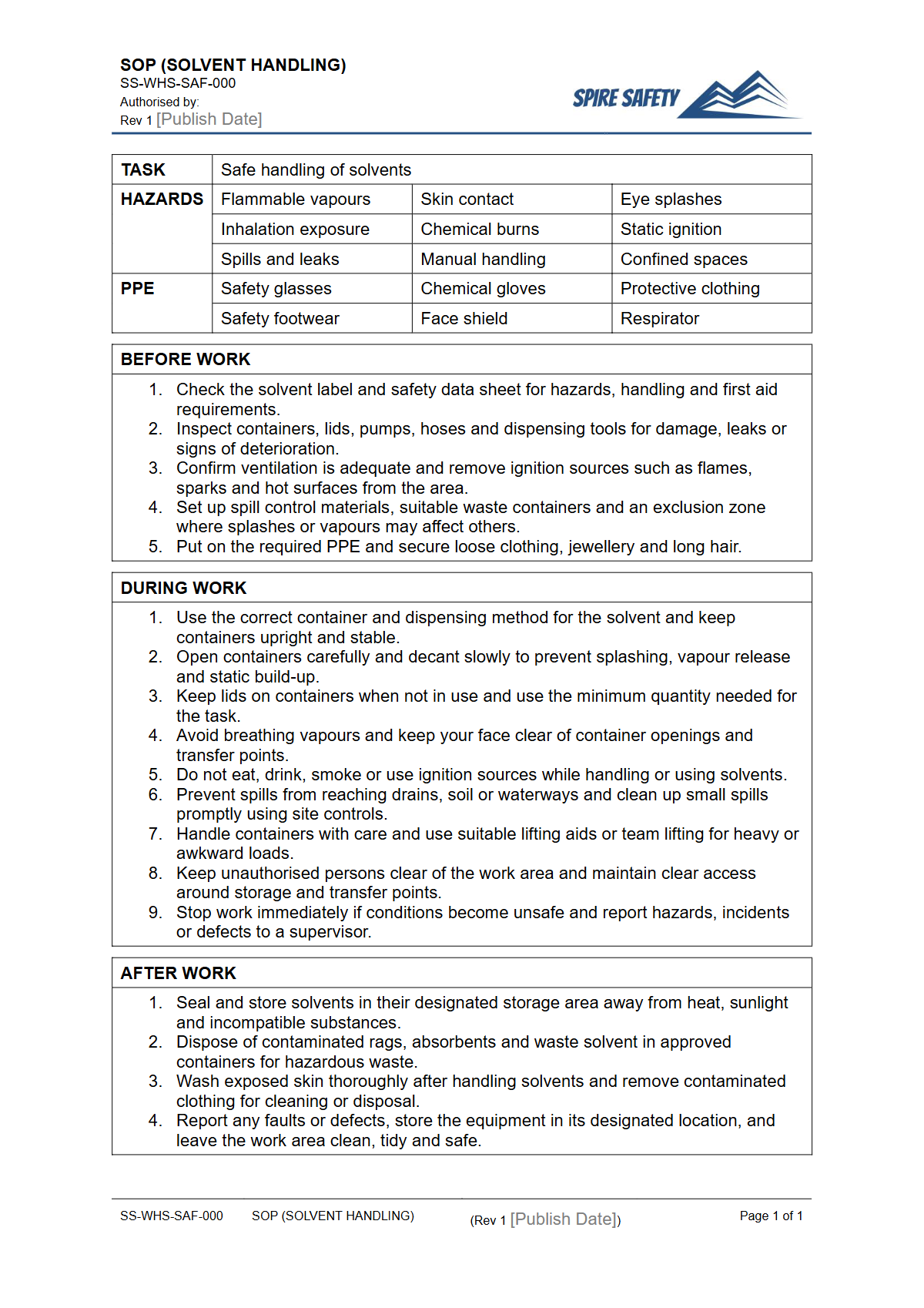
Download our free Safe Operating Procedure template for solvent handling. This customisable DOCX and PDF helps you detail controls for chemical risks.
Free Safe Operating Procedure (Solvent Handling) Template
DOCX • 126 KB + PDF
Updated Oct 2026
No signup required
Purpose of the Free Safe Operating Procedure (Solvent Handling) Template
Handling solvents, from cleaning agents and degreasers to paints and adhesives, presents significant workplace risks. This free Safe Operating Procedure (Solvent Handling) Template provides a structured starting point for documenting the controls necessary to manage these hazards.
Effective management protects workers from chemical exposure, fire, and explosion risks. This SOP is designed to help you formalise safe work methods, specify required personal protective equipment (PPE), and outline emergency actions, aligning your processes with Australian WHS best practices.
Video walkthrough
How to use the Free Safe Operating Procedure (Solvent Handling) Template
Download the template in your preferred format (DOCX or PDF) and begin adapting it to your specific operational context. A well-written SOP is a critical component of a robust safety framework. It should be developed in consultation with workers who perform the task and integrated into your broader WHS management system.
Customisation is essential
IMPORTANT: This document is a template and must be customised to reflect the specific hazards at your workplace. We've provided a comprehensive framework, but you are responsible for adding site-specific details.
This includes identifying the exact solvents used, referencing their Safety Data Sheets (SDS), detailing your storage areas, specifying control measures like ventilation systems, and listing the correct PPE for each task.
When to use a Safe Operating Procedure
An SOP for solvent handling should be a living document, used throughout the work lifecycle. It is essential for:
- Worker Training: Inducting new employees or training workers on new tasks or substances.
- Pre-Task Planning: Reviewing procedures before starting work, especially for non-routine tasks.
- Supervision and Monitoring: Providing a clear standard for supervisors to monitor performance and ensure safe practices are followed.
- Incident Investigation: Serving as a benchmark to assess whether procedures were followed during a near miss or incident.
Key Components of the Solvent Handling SOP
Our template guides you through documenting the critical safety elements required for handling solvents. These include:
- Hazard Identification: Identifying risks such as inhalation of vapours, skin contact, fire, and environmental contamination.
- Control Measures: Detailing controls according to the hierarchy of controls, from ventilation systems to safe storage and handling practices.
- Personal Protective Equipment (PPE): Specifying the exact type of gloves, eyewear, and respiratory protection required based on the solvent's SDS.
- Step-by-Step Procedure: Breaking down the task into sequential steps, from preparation and decanting to use and clean-up. Many solvents are flammable, a risk also present in tasks like hot work, which requires its own documentation such as our free Oxy Acetylene SOP template.
- Emergency Procedures: Outlining immediate actions for spills, fires, and first aid for chemical exposure.
Who should use this Safe Operating Procedure
This SOP is intended for all levels of an organisation where solvents are handled:
- Persons Conducting a Business or Undertaking (PCBUs): To help meet their primary duty of care to ensure a safe working environment.
- Managers and Supervisors: To train workers, enforce safe practices, and ensure controls are maintained. Tasks in a workshop often overlap, so procedures for equipment like an air compressor should also be readily available.
- Workers: As a clear guide to performing their tasks safely and understanding the associated risks and controls.
- Health and Safety Representatives (HSRs): As a key document for consultation during the risk management process.
By using SOPs for various high-risk tasks, such as those involving power tools covered by our circular saw SOP, you build a comprehensive safety library for your team. You can find many other document templates in our free WHS resources library to continue strengthening your safety systems.
Common mistakes
Common mistakes to avoid
- Using a generic template without customising it for specific solvents and tasks.
- Failing to provide adequate mechanical ventilation when handling volatile solvents indoors.
- Storing solvents in unlabelled, poorly sealed, or inappropriate containers.
- Neglecting to provide or enforce the use of chemically-resistant PPE specified in the Safety Data Sheet (SDS).
Legal references
Legal considerations
The following legal requirements may be relevant to this type of work.
- Work Health and Safety Act (Harmonised) — Provides the primary duties for protecting workers and other people from work health and safety risks.
- Work Health and Safety Regulations (Harmonised) — Sets out requirements supporting the management of workplace hazards and risks.
The following codes may be relevant to this type of work.
- Managing WHS Risks Code of Practice — Provides practical guidance on identifying hazards, assessing risks and applying effective controls.
- Work Health and Safety Consultation, Cooperation and Coordination Code of Practice — Provides practical guidance on consulting workers and coordinating with other duty holders.
- Managing the Work Environment and Facilities Code of Practice — Provides practical guidance on safe work environments, workplace facilities and related controls.
Did you know
Hidden Vapour Dangers
The vapour from just one litre of a common flammable solvent can generate enough fumes to create a highly explosive atmosphere in an average-sized room, which can be ignited by a simple static spark.
Long-Term Effects
Chronic, low-level exposure to some organic solvents, even at levels that don't cause immediate symptoms, can lead to serious long-term health issues known as 'painter's syndrome' or chronic solvent-induced encephalopathy (CSE).
FAQ
Frequently asked questions
01What is a Safe Operating Procedure (SOP)?
02Why are solvents considered hazardous?
03Do I need a separate SOP for every solvent I use at my workplace?
04Is using this template enough to be compliant?
Share this resource
Free Safe Operating Procedure (Solvent Handling) Template
Browse Categories
How To Use It
- 1Download and open in Word or PDF.
- 2Replace the placeholders with your business details.
- 3Get it reviewed by a WHS specialist before rollout.
Need it customised?
Our WHS consultants can adapt this template to your site, run a gap analysis, or audit what you already have in place.
Book a Free Consultation WHS consulting servicesor call 1300 156 382
Related templates
- Free Safe Operating Procedure (Solvent Recycling Unit) Template
- Free Safe Operating Procedure (SOP) Template
- Free Safe Operating Procedure (Sound Level Meter) Template
- Free Safe Operating Procedure (Soup Kettle) Template
- Free Safe Operating Procedure (Spa Equipment Cleaning) Template
- Free Safe Operating Procedure (Spa Pool Cleaning) Template