
Free Safe Operating Procedure (Solvent Recycling Unit) Template
Effectively manage the risks of solvent recycling with our free template. This customisable Safe Operating Procedure provides a solid starting point.
Free Safe Operating Procedure (Solvent Recycling Unit) Template
DOCX • 126 KB + PDF
Updated Oct 2026
No signup required
Purpose of the Free Safe Operating Procedure (Solvent Recycling Unit) Template
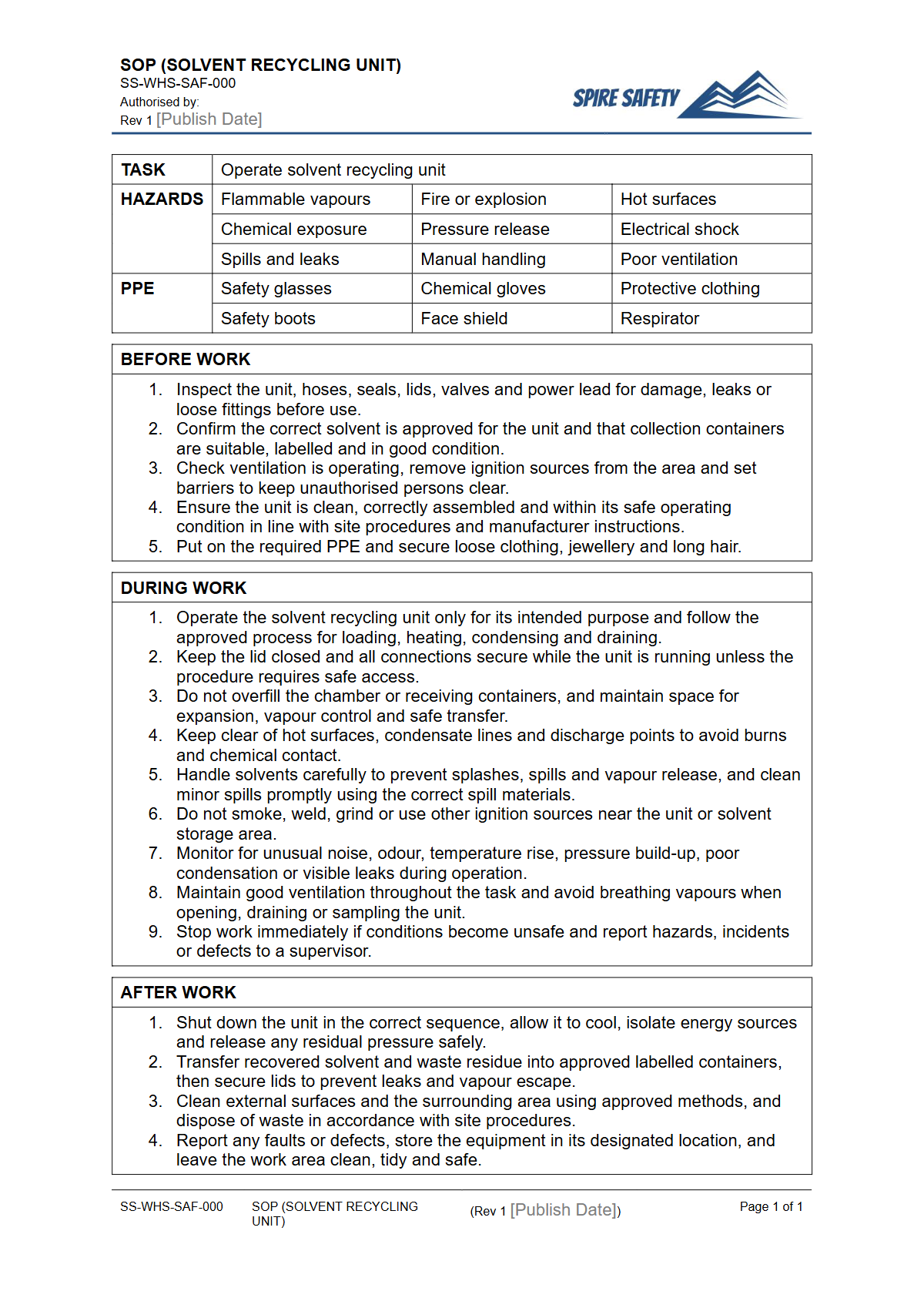
Operating a solvent recycling unit involves significant risks, including fire, explosion, and exposure to hazardous chemicals. This Free Safe Operating Procedure (Solvent Recycling Unit) Template provides a structured framework to document the step-by-step process for safely operating your specific equipment.
A well-developed SOP is a critical administrative control measure that helps your organisation meet its duty of care under Australian WHS laws. It guides workers, ensures consistent and safe work practices, and forms an essential part of your training and induction program.
By using this template, you can clearly define pre-operational checks, safe operating sequences, shutdown procedures, and emergency responses. This formalised approach helps minimise the risk of incidents by ensuring all personnel are aware of the hazards and the control measures in place to protect them.
It also serves as a key document for demonstrating due diligence and forms part of a compliant approach to managing hazardous chemicals in the workplace.
Video walkthrough
How to use the Free Safe Operating Procedure (Solvent Recycling Unit) Template
This document provides a comprehensive starting point, but it must be adapted to your workplace. Download the DOCX file and customise it with the specific details of your solvent recycling unit, including the make and model, the types of solvents used, and your site-specific emergency procedures.
It is crucial that a competent person—someone with the relevant knowledge and experience in chemical safety and plant operation—reviews and approves the final document before it is implemented.
We strongly recommend consulting the manufacturer's operating manual and any relevant Safety Data Sheets (SDS) for the solvents being processed. Incorporate this information directly into the SOP.
The final procedure should be a practical, easy-to-understand guide that reflects the real-world tasks your operators perform. Developing effective safety documents can be complex; if you require assistance, our team offers professional WHS consulting to help you create site-specific documentation.
When to use a Safe Operating Procedure
A Safe Operating Procedure for a solvent recycling unit should be used consistently as a core part of your daily operations. It is not a document that should be filed away and forgotten.
It should be readily accessible to all operators near the equipment. Key times to use the SOP include:
- Training and Induction: For all new operators before they are authorised to use the equipment.
- Refresher Training: As part of regular competency reviews to ensure standards are maintained.
- Pre-operational Checks: As a checklist to ensure the unit and surrounding area are safe before starting a cycle.
- Risk Assessments and Audits: As evidence of the control measures your organisation has implemented.
- Incident Investigations: To review whether established procedures were followed and if they need improvement.
Integrating this SOP into your daily workflow reinforces safe behaviour and demonstrates a commitment to safety. It is a vital component of robust WHS management systems that aim for proactive risk reduction rather than reactive responses.
Who should use this Safe Operating Procedure
This SOP is intended for several key roles within an organisation:
- Operators: The primary users who perform the day-to-day tasks of operating the solvent recycling unit. The SOP is their guide to working safely.
- Supervisors and Managers: Responsible for ensuring that operators are trained on the SOP and follow it correctly. They use it as a tool for supervision and performance management.
- WHS Advisors and Personnel: Use the SOP to conduct risk assessments, workplace inspections, and audits.
- Maintenance Staff: To understand the safe shutdown and isolation procedures required before performing maintenance or repairs.
- Trainers: As the basis for developing training programs and competency assessments for operators.
What to include in your SOP
A thorough SOP for a solvent recycling unit should cover several key areas to be effective. Beyond the basic operating steps, ensure your customised document includes:
- Required Personal Protective Equipment (PPE): Specify the exact types of gloves, eyewear, respiratory protection, and protective clothing required.
- Pre-operational Safety Checks: A detailed checklist for inspecting the unit, ventilation system, bonding and grounding connections, and surrounding area for ignition sources.
- Emergency Procedures: Clear, step-by-step instructions for responding to spills, fires, or vapour releases, including the location of emergency stops, fire extinguishers, and spill kits.
- Waste Handling: Procedures for the safe handling and disposal of the still bottoms (the waste residue left after distillation).
These documents are critical for plant and equipment, functioning similarly to our Oxy Acetylene SOP template by focusing on fire and explosion hazards. For other types of fixed plant, you might also find our Air Compressor SOP template useful as a reference.
Review and Improvement
An SOP is a living document. It should be reviewed at least annually, or whenever there is a change to the equipment, process, or chemicals used.
It must also be reviewed after any incident or near-miss to incorporate any learnings. This process of continual improvement is fundamental to maintaining a safe workplace and is a key focus during regular WHS compliance auditing.
Documenting procedures for all types of plant is essential for a safe system of work. For example, procedures for moving equipment like a Conveyer System SOP require a similar level of detail regarding start-up, operation, and shutdown. For more templates and safety resources, browse our entire free WHS resources library.
Common mistakes
Common mistakes to avoid
- Using a generic SOP without customising it for the specific unit and solvents.
- Failing to adequately address static electricity control through proper bonding and grounding.
- Neglecting to specify emergency procedures for spills, fires, and power failures.
- Positioning the unit in an area with poor ventilation or near potential ignition sources.
Legal references
Legal considerations
The following legal requirements may be relevant to this type of work.
- Work Health and Safety Act (Harmonised) — Provides the primary duties for protecting workers and other people from work health and safety risks.
- Work Health and Safety Regulations (Harmonised) — Sets out requirements supporting the management of workplace hazards and risks.
The following codes may be relevant to this type of work.
- Managing WHS Risks Code of Practice — Provides practical guidance on identifying hazards, assessing risks and applying effective controls.
- Work Health and Safety Consultation, Cooperation and Coordination Code of Practice — Provides practical guidance on consulting workers and coordinating with other duty holders.
- Managing the Work Environment and Facilities Code of Practice — Provides practical guidance on safe work environments, workplace facilities and related controls.
Did you know
VOC Impact
Many solvents are Volatile Organic Compounds (VOCs) which can contribute to the formation of ground-level ozone, a major component of smog. Effective recycling and containment helps reduce these environmental impacts.
Static Ignition
Simply pouring or pumping flammable liquids can generate enough static electricity to ignite flammable vapours. This is why proper bonding and grounding of the recycling unit and associated containers is a critical safety control.
FAQ
Frequently asked questions
01What is a solvent recycling unit?
02Are SOPs legally required for solvent recyclers in Australia?
03What are the main hazards of a solvent recycling unit?
04How often should our solvent recycler SOP be reviewed?
Share this resource
Free Safe Operating Procedure (Solvent Recycling Unit) Template
Browse Categories
How To Use It
- 1Download and open in Word or PDF.
- 2Replace the placeholders with your business details.
- 3Get it reviewed by a WHS specialist before rollout.
Need it customised?
Our WHS consultants can adapt this template to your site, run a gap analysis, or audit what you already have in place.
Book a Free Consultation WHS consulting servicesor call 1300 156 382
Related templates
- Free Safe Operating Procedure (SOP) Template
- Free Safe Operating Procedure (Sound Level Meter) Template
- Free Safe Operating Procedure (Soup Kettle) Template
- Free Safe Operating Procedure (Spa Equipment Cleaning) Template
- Free Safe Operating Procedure (Spa Pool Cleaning) Template
- Free Safe Operating Procedure (Spa Room Cleaning) Template