
Free Safe Operating Procedure (Solar Roof Access) Template
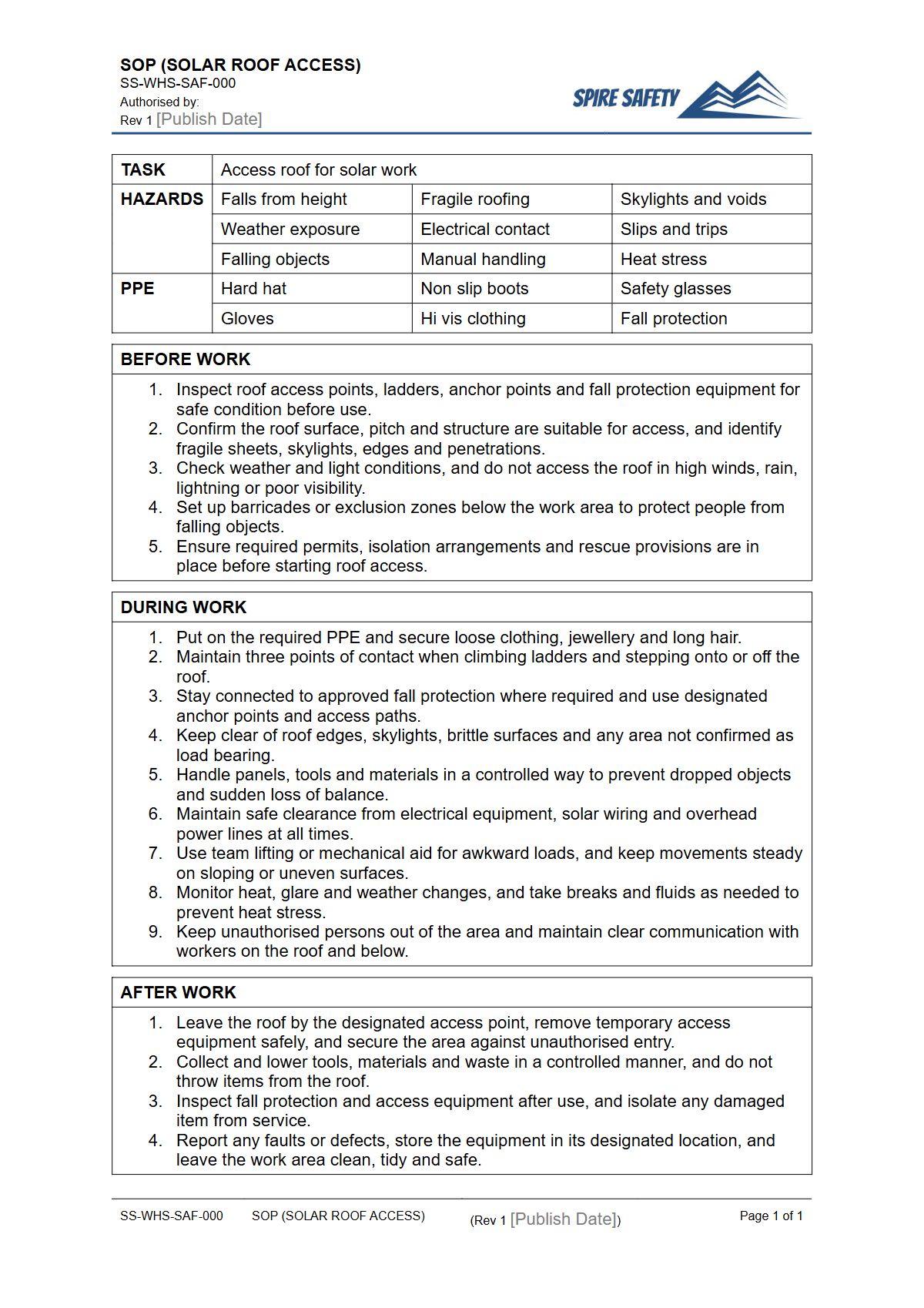
Manage the risks of working at heights on solar installations. Download our free Safe Operating Procedure (Solar Roof Access) template to get started.
Free Safe Operating Procedure (Solar Roof Access) Template
DOCX • 126 KB + PDF
Updated Oct 2026
No signup required
Purpose of the Free Safe Operating Procedure (Solar Roof Access) Template
Working on roofs to install or maintain solar panel systems presents significant health and safety risks, primarily from falls from height, electrical hazards, and manual handling. This free Safe Operating Procedure (Solar Roof Access) template provides a structured starting point for your organisation to document a safe system of work for these tasks.
It is designed to help you outline the required steps, personal protective equipment (PPE), and risk controls needed to ensure workers can access and work on roofs safely. An SOP is a fundamental administrative control that forms a critical part of your overall safety framework.
By clearly defining the approved process, this SOP helps standardise behaviour, assists in worker training and induction, and demonstrates a commitment to managing WHS risks. Properly developed and implemented, it becomes a key document within your broader WHS management systems. This template guides you in considering the entire process, from pre-work checks and site assessment to the safe completion of the task and emergency procedures, aligning with the principles of the model Australian WHS framework.
Video walkthrough
How to use the Free Safe Operating Procedure (Solar Roof Access) Template
This document is a template and must be customised to suit the specific circumstances of your workplace, equipment, and personnel. Download the DOCX file and adapt it by consulting with your workers and other relevant parties.
A PDF version is also available for easy distribution once your customisation is complete. The goal is to create a practical document that reflects the reality of your operations.
When customising the SOP, you must include site-specific details, such as the types of roofs encountered, approved access methods (e.g., ladders, scaffolding, elevating work platforms), required fall protection systems, isolation and de-energisation procedures for solar arrays, and emergency response plans.
For example, your procedure should specify the type of equipment used to get materials to the roof. If you use elevating work platforms like telehandlers, you may need a separate procedure for their operation, which you can develop using a free Telehandler SOP template. We cannot stress this enough: for this document to be useful and contribute to a safe workplace, you must invest the time to tailor it with your team.
A generic, uncustomised procedure is not an effective risk control.
What is a Safe Operating Procedure?
A Safe Operating Procedure (SOP), sometimes called a safe work procedure, is a written document that provides step-by-step instructions on how to safely perform a specific task or operate a piece of machinery. It identifies the hazards associated with the task and details the risk control measures required to eliminate or minimise those hazards.
Unlike a Safe Work Method Statement (SWMS), which is required for high-risk construction work and focuses on the sequence of a specific job, an SOP provides a more general, repeatable set of instructions for a standard task. Both are essential tools for managing workplace safety.
When to use a Solar Roof Access SOP
A Safe Operating Procedure for solar roof access should be used consistently as part of your daily operations. It is not a document to be filed away and forgotten.
Use it during worker induction and training to ensure new team members understand the established safety protocols from day one. It should be readily available at the worksite for workers and supervisors to reference before and during the task.
The SOP also serves as a critical tool for planning and risk assessment before any roof work commences.
The procedure should be formally reviewed on a regular basis (e.g., annually), whenever a process or piece of equipment changes, or after any incident, near miss, or identified hazard. These reviews are an excellent opportunity to engage your team and ensure the SOP remains relevant and effective.
Regular reviews and spot checks can be incorporated into your internal safety audit schedule to verify that the documented procedures are being followed correctly in practice. You may wish to formalise this process through a professional WHS compliance auditing service.
Who should use this Safe Operating Procedure
This SOP is intended for use by any Person Conducting a Business or Undertaking (PCBU) whose workers perform tasks related to solar panel systems on roofs. This includes solar installation companies, electrical contractors, maintenance firms, and facilities management teams. It should be actively used by:
- Workers: To understand and follow the safe steps required for their job.
- Supervisors and Team Leaders: To train workers, monitor compliance, and ensure the correct controls are in place before work begins.
- WHS Managers and Advisors: To develop, implement, and review safety documentation as part of the overall WHS management system.
- Project Managers: To ensure safety compliance is integrated into project planning and execution.
Developing a robust, site-specific SOP requires careful consideration of various hazards and legal obligations. If your organisation lacks the in-house expertise to confidently adapt this template, seeking external WHS consulting can provide the necessary guidance to ensure your procedures are practical and effective. If you are looking for other document templates, you can browse our complete free WHS resources library.
Common mistakes
Common mistakes to avoid
- Failing to adequately assess roof integrity before loading it with workers, panels, and equipment.
- Using inadequate or incorrectly installed fall protection systems, such as non-rated anchor points.
- Neglecting to de-energise and isolate panels before work begins, creating a live electrical environment.
- Ignoring adverse weather conditions like high winds, rain, or extreme heat that can increase risks dramatically.
Legal references
Legal considerations
The following legal requirements may be relevant to this type of work.
- Work Health and Safety Act (Harmonised) — Provides the primary duties for protecting workers and other people from work health and safety risks.
- Work Health and Safety Regulations (Harmonised) — Sets out requirements supporting the management of workplace hazards and risks.
The following codes may be relevant to this type of work.
- Managing WHS Risks Code of Practice — Provides practical guidance on identifying hazards, assessing risks and applying effective controls.
- Work Health and Safety Consultation, Cooperation and Coordination Code of Practice — Provides practical guidance on consulting workers and coordinating with other duty holders.
- Managing the Work Environment and Facilities Code of Practice — Provides practical guidance on safe work environments, workplace facilities and related controls.
Did you know
Falls From Height
Falls from height remain a leading cause of fatalities and serious injuries in the Australian construction industry. A well-implemented roof access procedure is a critical control measure to prevent these incidents.
Solar Panel Weight
A single residential solar panel can weigh between 18-25kg. This poses a significant manual handling risk, especially when lifting multiple panels onto a roof in awkward positions.
FAQ
Frequently asked questions
01What key hazards should a Solar Roof Access SOP cover?
02Is a Safe Work Method Statement (SWMS) also required for solar roof access?
03How often should our Solar Roof Access SOP be reviewed?
04Can I use this template for both commercial and residential solar installations?
Share this resource
Free Safe Operating Procedure (Solar Roof Access) Template
Browse Categories
How To Use It
- 1Download and open in Word or PDF.
- 2Replace the placeholders with your business details.
- 3Get it reviewed by a WHS specialist before rollout.
Need it customised?
Our WHS consultants can adapt this template to your site, run a gap analysis, or audit what you already have in place.
Book a Free Consultation WHS consulting servicesor call 1300 156 382
Related templates
- Free Safe Operating Procedure (Solar Shade Cleaning) Template
- Free Safe Operating Procedure (Solvent Handling) Template
- Free Safe Operating Procedure (Solvent Recycling Unit) Template
- Free Safe Operating Procedure (SOP) Template
- Free Safe Operating Procedure (Sound Level Meter) Template
- Free Safe Operating Procedure (Soup Kettle) Template