
Free Safe Operating Procedure (Soiled Linen Trolley) Template
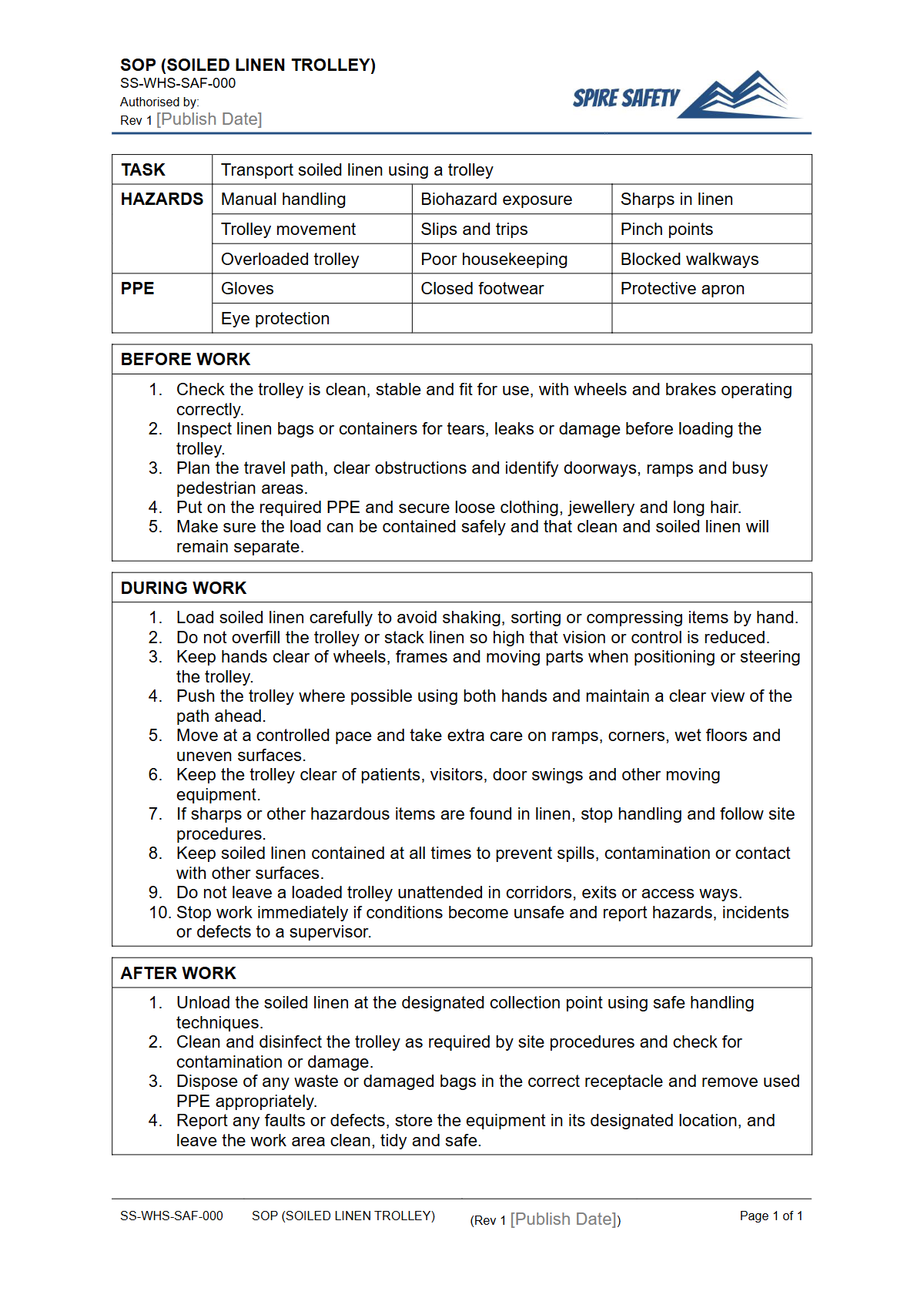
Download our free Safe Operating Procedure for soiled linen trolleys. This template helps you document safe work methods for handling and transport.
Free Safe Operating Procedure (Soiled Linen Trolley) Template
DOCX • 126 KB + PDF
Updated Oct 2026
No signup required
Purpose of the Free Safe Operating Procedure (Soiled Linen Trolley) Template
Handling soiled linen trolleys is a routine task in many healthcare, aged care, and hospitality settings, but it carries significant work health and safety risks. This Free Safe Operating Procedure (Soiled Linen Trolley) Template provides a structured starting point for your organisation to document a clear, step-by-step process for this task, aligned with Australian WHS principles.
The primary goal is to control hazards and minimise the risk of injury to workers.
Key hazards associated with managing soiled linen trolleys include musculoskeletal disorders (MSDs) from pushing and pulling heavy, awkward loads; slips, trips, and falls from spills or poor trolley placement; and exposure to biological hazards from contaminated linen. A documented SOP ensures that all workers follow the same approved, safe method every time, which is crucial for training new staff and reinforcing safe behaviour in existing teams.
Implementing clear procedures is a fundamental part of managing workplace risks, and you can get assistance from our team for expert WHS consulting to support your processes.
By formally outlining the required steps, personal protective equipment (PPE), and emergency actions, this SOP helps your business meet its duty of care. It forms a critical part of your safety management system, demonstrating a commitment to proactively identifying and controlling workplace hazards.
These individual procedures are essential components of comprehensive WHS management systems that protect both your employees and your organisation.
Video walkthrough
How to use the Free Safe Operating Procedure (Soiled Linen Trolley) Template
This document is a template and is not a ready-to-use procedure. It must be customised to reflect the specific equipment, environment, and work practices of your workplace.
To do this, consult with the workers who regularly perform the task, as they have direct knowledge of the challenges and risks involved. Review the template and add or remove steps to match your operational reality.
Important: We have designed this template as a guide. You must adapt it to your specific site. Key areas for customisation include:
- Trolley Specifications: Detail the make and model of trolleys used, including their weight capacity and brake mechanisms.
- Facility Layout: Reference specific routes, noting any ramps, uneven surfaces, blind corners, or doorways that require special care.
- Personal Protective Equipment (PPE): List the exact PPE required, such as specific types of gloves, closed-toe footwear, and aprons.
- Emergency Procedures: Outline actions to be taken in case of a large spill, trolley failure, or personal injury.
- Linen Handling: Specify procedures for bagging linen, securing bags, and maximum fill levels to prevent overloading.
A well-customised SOP is an invaluable tool for operational consistency. This same principle of site-specific adaptation applies to all equipment procedures, such as an SOP for floor scrubber operation, which is another common task in similar environments.
When to use it
A Safe Operating Procedure for soiled linen trolleys should be used as a central reference document throughout the employment lifecycle. It is not a document to be filed away after creation.
Integrate it into your daily operations and formal WHS processes.
Use this SOP during worker induction and training to establish a baseline for safe performance. It should also be a key resource for refresher training sessions to prevent complacency.
Following any incident or near miss involving a linen trolley, the SOP should be reviewed and updated to incorporate any learnings. It can also serve as a useful reference point for pre-start meetings or toolbox talks, allowing supervisors to highlight specific risks before a shift begins.
You can find more templates and checklists in our free WHS resources library to support these activities.
Who should use it
This Safe Operating Procedure is intended for all personnel who are required to handle, push, pull, or empty soiled linen trolleys. This includes a wide range of roles across different industries, such as:
- Hospital porters and orderlies
- Healthcare assistants and nurses
- Aged care workers
- Hotel and resort housekeepers
- Commercial laundry workers
- Cleaning and environmental services staff
Furthermore, supervisors, managers, and WHS officers should use this document to guide their training, supervision, and risk management activities. It provides a clear benchmark against which to measure safe work performance and forms an important piece of evidence during safety inspections. Regular verification that procedures are followed is a key part of the safety assurance process, often checked during WHS compliance auditing.
In settings like large hotels or hospitals, safety management involves integrating procedures for various operational tasks. Just as this SOP addresses linen transport, a separate deep fryer operation SOP would be essential in the kitchen, ensuring a consistent approach to safety across all departments.
Common mistakes
Common mistakes to avoid
- Overfilling trolleys, making them too heavy, unstable, and difficult to control.
- Failing to use correct pushing techniques and twisting the back instead of turning with the feet.
- Neglecting pre-start checks on wheels, brakes, and the trolley's structural integrity.
- Not wearing or incorrectly using appropriate Personal Protective Equipment (PPE) like gloves.
Legal references
Legal considerations
The following legal requirements may be relevant to this type of work.
- Work Health and Safety Act (Harmonised) — Provides the primary duties for protecting workers and other people from work health and safety risks.
- Work Health and Safety Regulations (Harmonised) — Sets out requirements supporting the management of workplace hazards and risks.
The following codes may be relevant to this type of work.
- Managing WHS Risks Code of Practice — Provides practical guidance on identifying hazards, assessing risks and applying effective controls.
- Work Health and Safety Consultation, Cooperation and Coordination Code of Practice — Provides practical guidance on consulting workers and coordinating with other duty holders.
- Managing the Work Environment and Facilities Code of Practice — Provides practical guidance on safe work environments, workplace facilities and related controls.
Did you know
Manual Handling Risk
Musculoskeletal disorders from hazardous manual tasks are a leading cause of serious workers' compensation claims in Australia, particularly in the healthcare and social assistance industry.
Linen Weight
A full linen trolley can weigh over 100kg. Pushing and pulling such heavy loads, especially over uneven surfaces or up ramps, significantly increases the risk of back and shoulder injuries.
FAQ
Frequently asked questions
01What is a Safe Operating Procedure for a soiled linen trolley?
02Is this soiled linen trolley SOP template suitable for hospitals and aged care?
03What hazards should be covered in an SOP for soiled linen trolleys?
04How often should we review our Safe Operating Procedures?
Share this resource
Free Safe Operating Procedure (Soiled Linen Trolley) Template
Browse Categories
How To Use It
- 1Download and open in Word or PDF.
- 2Replace the placeholders with your business details.
- 3Get it reviewed by a WHS specialist before rollout.
Need it customised?
Our WHS consultants can adapt this template to your site, run a gap analysis, or audit what you already have in place.
Book a Free Consultation WHS consulting servicesor call 1300 156 382
Related templates
- Free Safe Operating Procedure (Solar Inverter Service) Template
- Free Safe Operating Procedure (Solar Panel Cleaning) Template
- Free Safe Operating Procedure (Solar Panel Install) Template
- Free Safe Operating Procedure (Solar Panel Removal) Template
- Free Safe Operating Procedure (Solar Roof Access) Template
- Free Safe Operating Procedure (Solar Shade Cleaning) Template