
Free Safe Operating Procedure (Soil Sampling) Template
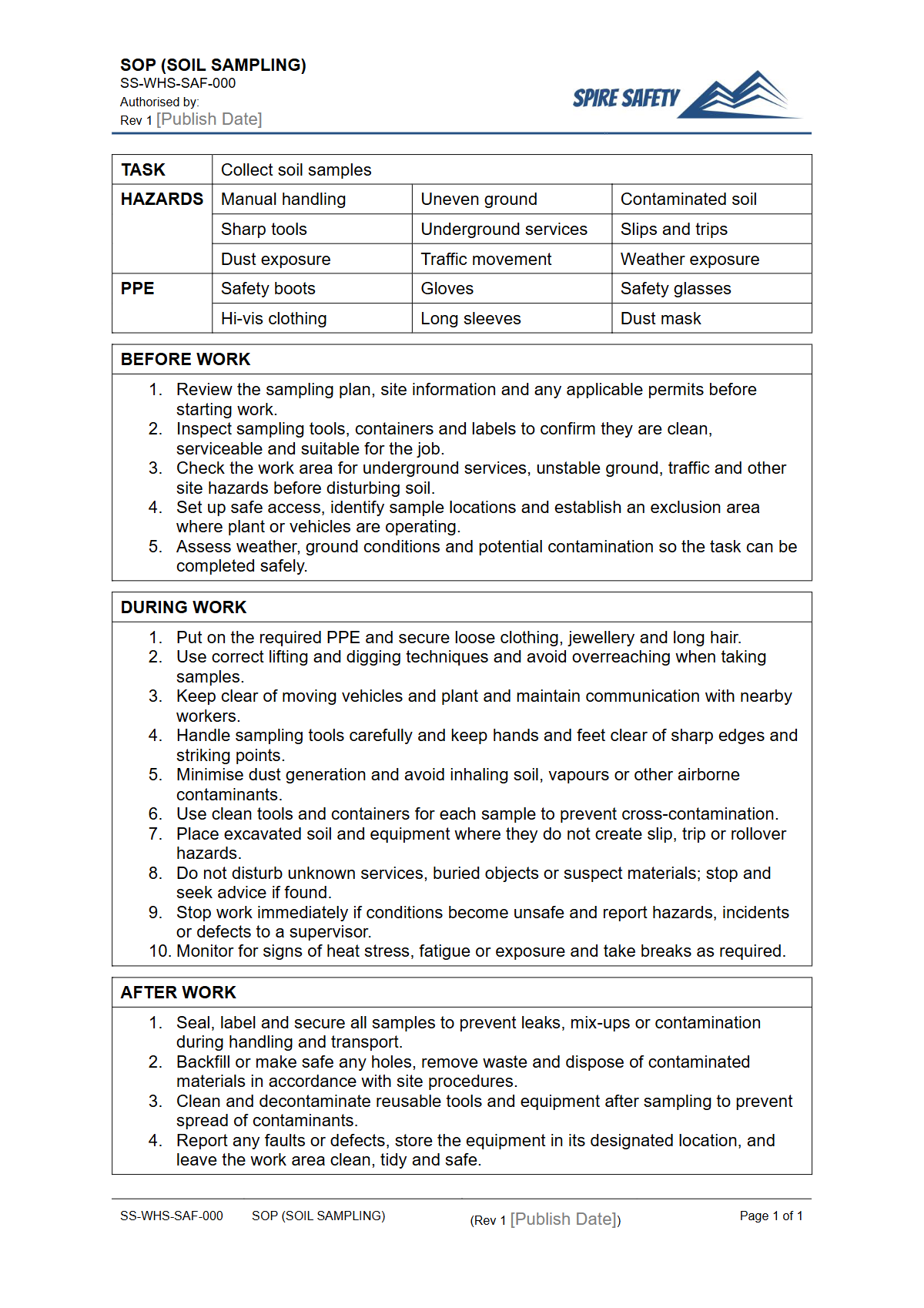
Download our free Safe Operating Procedure for Soil Sampling. This template helps you document step-by-step instructions for safely collecting soil samples.
Free Safe Operating Procedure (Soil Sampling) Template
DOCX • 126 KB + PDF
Updated Oct 2026
No signup required
Purpose of the Free Safe Operating Procedure (Soil Sampling) Template
This Free Safe Operating Procedure (Soil Sampling) Template provides a structured starting point for businesses to document the process for collecting soil samples safely. Soil sampling is a common activity in industries like construction, environmental consulting, agriculture, and geotechnical engineering.
It involves potential hazards such as manual handling injuries, exposure to contaminants, and striking underground services. A documented SOP is a critical tool for managing these risks effectively.
It formalises a safe system of work, helps standardise procedures across teams, and serves as a vital resource for worker training and inductions.
By clearly outlining the required steps, personal protective equipment (PPE), and emergency procedures, this Safe Operating Procedure helps your organisation meet its primary duty of care under Australian WHS legislation. It encourages a proactive approach to safety, ensuring that risks are identified and controlled before work begins.
For activities involving any form of excavation, even minor ones for sampling, it's also worth reviewing procedures for related equipment. You can find guidance in documents like our free Trencher SOP Template.
Video walkthrough
How to use the Free Safe Operating Procedure (Soil Sampling) Template
This document is a template and must be customised to suit the specific requirements of your workplace. To use it effectively, you should consult with workers and other stakeholders involved in the soil sampling process.
Start by downloading the DOCX file and adding your company branding. Then, review each section and adapt the content to reflect your specific equipment (e.g., hand augers, drill rigs), site conditions, types of soil and potential contaminants, and internal procedures.
It is essential to conduct a site-specific risk assessment and incorporate its findings into the final SOP.
Remember: We are not WHS consultants, and this template does not constitute legal advice. You must adapt it to your unique operational context to ensure it is effective.
Integrating this SOP into your broader safety framework is key to its success. A well-documented procedure is a cornerstone of effective WHS management systems, ensuring consistent and safe work practices are followed across your organisation.
When to use a Safe Operating Procedure
A Safe Operating Procedure for soil sampling should be used as a primary reference document for anyone involved in the task. It is not a document to be filed away and forgotten. It should be actively used in several situations:
- During training and induction: New and existing employees should be trained on the contents of the SOP before they are authorised to perform soil sampling.
- For pre-start meetings: The SOP can be reviewed during toolbox talks or pre-start meetings to refresh workers' knowledge of the hazards and controls relevant to the day's tasks.
- During the task: Workers should have access to the SOP while on-site to reference specific steps or emergency contacts.
- For incident investigations: If an incident or near-miss occurs, the SOP should be reviewed to determine if the procedure was followed and if it needs to be updated.
- During audits and reviews: This document will form part of your evidence base during internal or external safety reviews, such as WHS compliance auditing.
Who should use it
This template is designed for use by a range of personnel within an organisation. Primarily, it is for the workers who directly perform the soil sampling tasks, including:
- Environmental Scientists and Technicians
- Geotechnical Engineers
- Agricultural Workers and Agronomists
- Construction and Earthworks Labourers
- Site Supervisors and Forepersons
Additionally, WHS Managers, Safety Officers, and business owners (PCBUs) should use this template to establish, implement, and review safety protocols. It ensures that management has provided a clear, safe system of work.
In larger projects, coordination with operators of heavy machinery is crucial for site safety. For instance, teams may need to work around equipment covered by documents like our free Scraper SOP Template.
Key Considerations for Soil Sampling
Before beginning any soil sampling, a thorough risk assessment is essential. This process should identify potential hazards specific to the location and task. Key considerations include:
- Underground Services: Always complete a Dial Before You Dig (DBYD) enquiry before breaking ground, no matter how shallow the sampling. This is the single most important step to prevent fatal or catastrophic damage to gas, electrical, water, or communications infrastructure.
- Contaminants: The site may have chemical (e.g., heavy metals, hydrocarbons, asbestos) or biological (e.g., bacteria, fungi) contaminants. The risk assessment must identify these and specify the required PPE and decontamination procedures.
- Site Access and Ground Conditions: Assess the stability of the ground, especially on slopes, near excavations, or in wet conditions. Plan for safe access and egress, which may involve using mobile plant detailed in other procedures like our free Telehandler SOP Template.
- Manual Handling: Using hand augers, carrying equipment, and lifting sample bags can lead to musculoskeletal injuries. Ensure workers are trained in correct lifting techniques.
- Emergency Plan: Have a clear, site-specific emergency plan that covers medical emergencies, environmental spills, and contact with unexpected hazardous materials.
Developing a comprehensive SOP requires careful consideration of these factors. If you need assistance tailoring this template or developing complex safety documentation, consider engaging specialist WHS consulting services. For more templates and safety guides, explore our complete free WHS resources library.
Common mistakes
Common mistakes to avoid
- Failing to check for underground services before breaking ground.
- Using generic PPE instead of selecting it based on a specific risk assessment for potential contaminants.
- Poor manual handling techniques when using hand augers or lifting heavy sample bags.
- Not having a site-specific emergency plan for incidents like snake bites or exposure to hazardous substances.
Legal references
Legal considerations
The following legal requirements may be relevant to this type of work.
- Work Health and Safety Act (Harmonised) — Provides the primary duties for protecting workers and other people from work health and safety risks.
- Work Health and Safety Regulations (Harmonised) — Sets out requirements supporting the management of workplace hazards and risks.
The following codes may be relevant to this type of work.
- Managing WHS Risks Code of Practice — Provides practical guidance on identifying hazards, assessing risks and applying effective controls.
- Work Health and Safety Consultation, Cooperation and Coordination Code of Practice — Provides practical guidance on consulting workers and coordinating with other duty holders.
- Managing the Work Environment and Facilities Code of Practice — Provides practical guidance on safe work environments, workplace facilities and related controls.
Did you know
Dial Before You Dig
The 'Dial Before You Dig' service is a free national referral service that helps you identify the location of underground pipes and cables before any excavation work, preventing costly or dangerous damage.
Naturally Occurring Asbestos
Certain regions of Australia have Naturally Occurring Asbestos (NOA) in soil and rock. Disturbing these materials through sampling or excavation can release dangerous fibres, requiring specific asbestos management controls.
FAQ
Frequently asked questions
01What should be included in a Safe Operating Procedure for soil sampling?
02Is a Safe Operating Procedure a legal requirement in Australia?
03How often should a Soil Sampling SOP be reviewed?
04Can this template be used for sampling from contaminated sites?
Share this resource
Free Safe Operating Procedure (Soil Sampling) Template
Browse Categories
How To Use It
- 1Download and open in Word or PDF.
- 2Replace the placeholders with your business details.
- 3Get it reviewed by a WHS specialist before rollout.
Need it customised?
Our WHS consultants can adapt this template to your site, run a gap analysis, or audit what you already have in place.
Book a Free Consultation WHS consulting servicesor call 1300 156 382
Related templates
- Free Safe Operating Procedure (Soiled Linen Trolley) Template
- Free Safe Operating Procedure (Solar Inverter Service) Template
- Free Safe Operating Procedure (Solar Panel Cleaning) Template
- Free Safe Operating Procedure (Solar Panel Install) Template
- Free Safe Operating Procedure (Solar Panel Removal) Template
- Free Safe Operating Procedure (Solar Roof Access) Template