
Free Safe Operating Procedure (Soft Serve Machine) Template
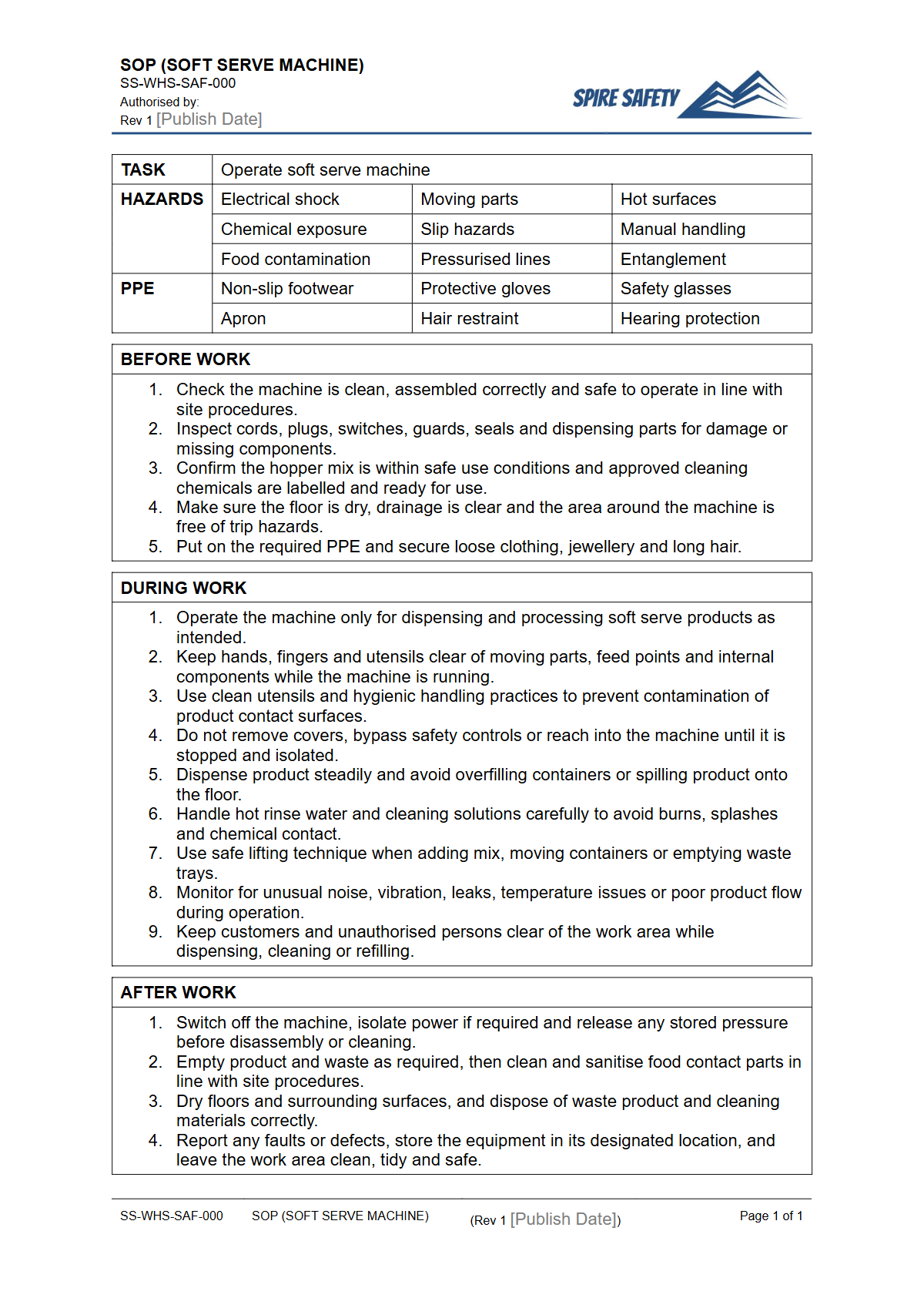
Download our free Safe Operating Procedure (Soft Serve Machine) Template to establish clear, step-by-step instructions for safe operation.
Free Safe Operating Procedure (Soft Serve Machine) Template
DOCX • 126 KB + PDF
Updated Oct 2026
No signup required
Purpose of the Free Safe Operating Procedure (Soft Serve Machine) Template
Operating a soft serve machine involves more than just dispensing a popular treat; it requires managing several workplace health and safety risks. This free Safe Operating Procedure (Soft Serve Machine) Template provides a structured framework for documenting the essential steps to operate, clean, and maintain the equipment safely.
A documented SOP helps ensure all workers follow the same approved process, reducing the risk of injury and ensuring food safety standards are met. By clearly outlining procedures, you create a vital training tool and a reference point for consistent, safe work behaviour.
The primary hazards associated with soft serve machines include electrical hazards from power sources and internal components, mechanical risks from moving parts like augers and mixers, chemical exposure from cleaning and sanitising agents, and biological hazards such as bacteria (e.g., Listeria) if cleaning is inadequate. This SOP template prompts you to address these risks systematically, outlining control measures for each stage of operation.
Video walkthrough
How to use the Free Safe Operating Procedure (Soft Serve Machine) Template
This resource is available for immediate download in both DOCX and PDF formats. The DOCX file is fully editable, allowing you to tailor the content to your specific workplace.
It is crucial to understand that this template is a starting point, not a finished document. For an SOP to be effective, it must be customised to reflect the unique circumstances of your business.
Important: We have no knowledge of your specific machine, cleaning chemicals, or work environment. You must conduct your own risk assessment and adapt this Safe Operating Procedure to your operations. Key details to customise include:
- Machine make and model number
- Specific pre-start checks required by the manufacturer
- Names of the exact cleaning and sanitising chemicals used (and referencing their Safety Data Sheets)
- Step-by-step procedures for assembly, operation, disassembly, and cleaning
- Required Personal Protective Equipment (PPE) such as gloves and safety glasses
- Site-specific emergency procedures and contact details
Robust safety documentation is a cornerstone of a proactive safety culture. These documents form an integral part of a comprehensive framework, which can be managed and improved with a dedicated WHS management system.
When to use this Safe Operating Procedure
A Safe Operating Procedure for a soft serve machine should be a living document used throughout the equipment's lifecycle. It is essential during the induction and training of new employees, ensuring they learn the correct, safe method from the beginning.
It should also be used for regular refresher training to prevent complacency and bad habits from forming among experienced staff. The SOP must be kept in a location where it is readily accessible to all operators, serving as a quick reference guide during daily tasks.
Furthermore, supervisors can use the SOP as a benchmark when conducting work observations to verify that procedures are being followed correctly. The findings from these observations can be critical inputs for a formal WHS compliance audit.
Who should use this Safe Operating Procedure
This SOP is designed for use by Persons Conducting a Business or Undertaking (PCBUs), managers, and supervisors in industries where soft serve machines are common, such as cafes, fast-food restaurants, hotels, and entertainment venues. It provides them with a tool to fulfil their duty of care to provide safe systems of work.
The end-users of the finalised document are the workers who directly operate, clean, and maintain the machine. By providing clear, unambiguous instructions, the SOP empowers them to perform their tasks safely and competently.
Maintaining consistency in safety documentation across all equipment is vital for an effective safety program. Just as a workshop requires a detailed Safe Operating Procedure for an air compressor to ensure operator safety, food service areas need the same level of diligence for their specialised machinery.
This principle of documenting safe work methods applies to all plant and equipment within a business, regardless of its function. For example, larger food production facilities might also need to create a Conveyer System SOP to manage risks associated with automated processes.
By implementing and enforcing a customised SOP for your soft serve machine, you build a stronger safety culture and protect both your employees and customers. For more templates and safety guides, you can browse our complete free WHS resources library.
Common mistakes
Common mistakes to avoid
- Using a generic template without customising it for the specific machine and workplace.
- Failing to adequately train workers on the finalised SOP and confirm their understanding.
- Storing the SOP in an office, rather than making it easily accessible near the equipment.
- Neglecting to include detailed procedures for cleaning, sanitising, and routine maintenance.
Legal references
Legal considerations
The following legal requirements may be relevant to this type of work.
- Work Health and Safety Act (Harmonised) — Provides the primary duties for protecting workers and other people from work health and safety risks.
- Work Health and Safety Regulations (Harmonised) — Sets out requirements supporting the management of workplace hazards and risks.
The following codes may be relevant to this type of work.
- Managing WHS Risks Code of Practice — Provides practical guidance on identifying hazards, assessing risks and applying effective controls.
- Work Health and Safety Consultation, Cooperation and Coordination Code of Practice — Provides practical guidance on consulting workers and coordinating with other duty holders.
- Managing the Work Environment and Facilities Code of Practice — Provides practical guidance on safe work environments, workplace facilities and related controls.
Did you know
Bacterial Risk
Soft serve machines can be breeding grounds for Listeria monocytogenes if not meticulously cleaned and sanitised. Regular, thorough cleaning as per a strict procedure is critical for food safety.
The Accidental Invention
Soft serve ice cream was reportedly invented by accident in the 1930s when an ice cream truck broke down. The owner, Tom Carvel, sold his melting ice cream to passers-by and realised the softer, warmer version was a hit.
FAQ
Frequently asked questions
01What are the main hazards of a soft serve machine?
02Is an SOP legally required for a soft serve machine in Australia?
03How often should our soft serve machine SOP be reviewed?
04Can I use this template for a slushie or frozen yoghurt machine?
Share this resource
Free Safe Operating Procedure (Soft Serve Machine) Template
Browse Categories
How To Use It
- 1Download and open in Word or PDF.
- 2Replace the placeholders with your business details.
- 3Get it reviewed by a WHS specialist before rollout.
Need it customised?
Our WHS consultants can adapt this template to your site, run a gap analysis, or audit what you already have in place.
Book a Free Consultation WHS consulting servicesor call 1300 156 382
Related templates
- Free Safe Operating Procedure (Soil Amendment Mixing) Template
- Free Safe Operating Procedure (Soil Compaction Test) Template
- Free Safe Operating Procedure (Soil Sampling) Template
- Free Safe Operating Procedure (Soiled Linen Trolley) Template
- Free Safe Operating Procedure (Solar Inverter Service) Template
- Free Safe Operating Procedure (Solar Panel Cleaning) Template