
Free Safe Operating Procedure (Soil Amendment Mixing) Template
Effectively manage hazards associated with mixing soil amendments like compost, fertilisers, and other additives. Download our free template to get started.
Free Safe Operating Procedure (Soil Amendment Mixing) Template
DOCX • 126 KB + PDF
Updated Oct 2026
No signup required
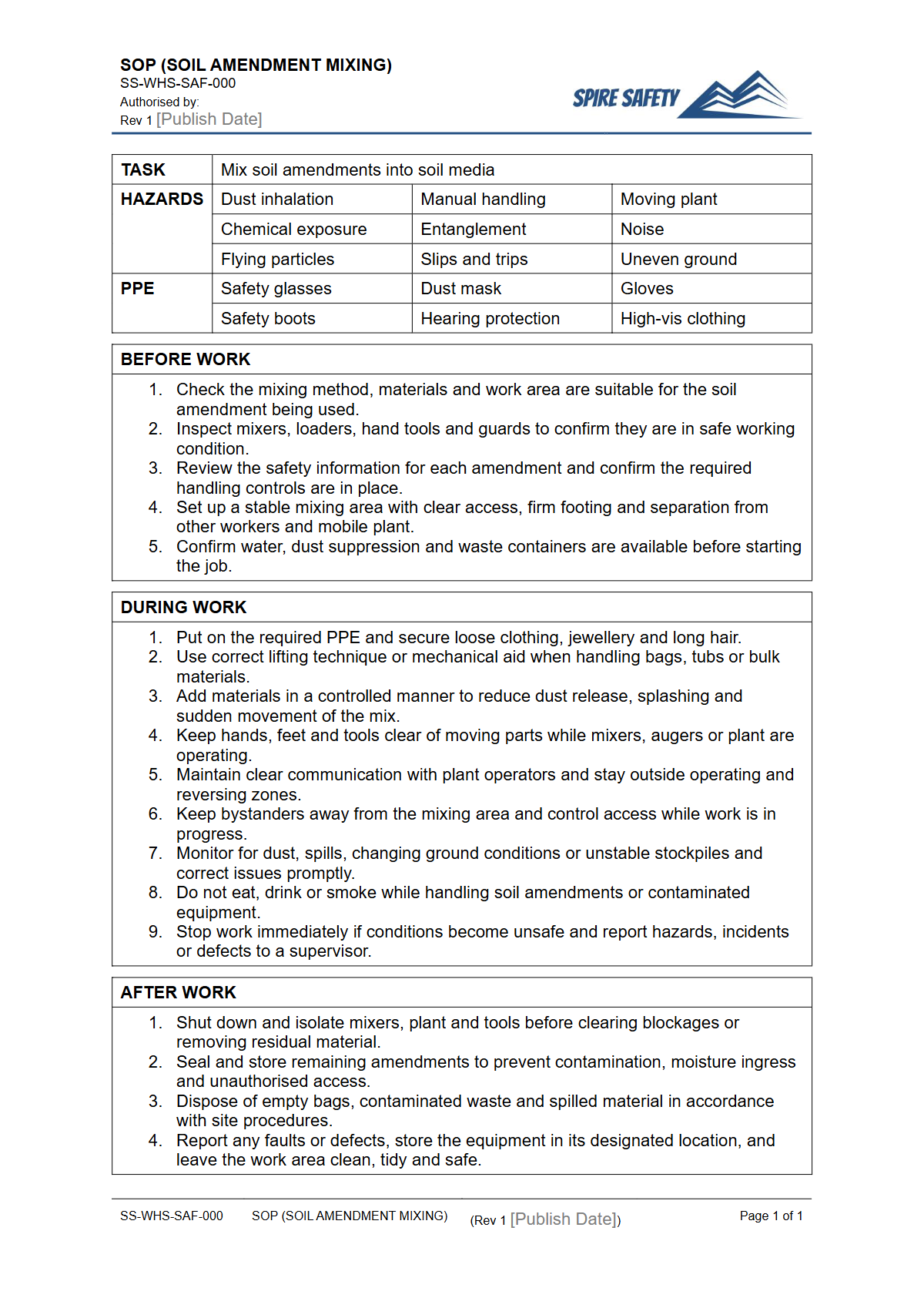
Purpose of the Free Safe Operating Procedure (Soil Amendment Mixing) Template
The primary purpose of this Safe Operating Procedure for Soil Amendment Mixing is to provide a clear set of instructions to ensure the task is performed safely and consistently. Mixing materials can expose workers to significant hazards, including airborne contaminants like crystalline silica from sand, bioaerosols from compost, and dust from fertilisers.
It also involves risks from hazardous chemicals and strenuous manual tasks. By documenting the required personal protective equipment (PPE), pre-operational checks, and step-by-step process, this SOP helps meet WHS obligations to provide a safe system of work. Implementing clear SOPs is a fundamental part of effective WHS management systems.
Video walkthrough
How to use the Free Safe Operating Procedure (Soil Amendment Mixing) Template
This Safe Operating Procedure for Soil Amendment Mixing is available for download as a fully editable DOCX file and a print-ready PDF. To use it, simply download the DOCX version and adapt it to your specific operational context.
You will need to add details about your site, the specific machinery used (e.g., cement mixers, front-end loaders), the types of amendments being mixed, and the controls you have in place. Using machinery like a spreader requires its own set of instructions, which you can document with our FREE Spreader SOP (Safe Operating Procedure) Template.
Important: Customise This Template
This document is a template and must be customised to your workplace. We are not familiar with your specific operations, equipment, or the chemical products you use.
You must adapt this SOP to reflect the unique hazards and control measures relevant to your site to ensure it is effective and supports your safety obligations.
When to use it
An SOP for soil amendment mixing should be used as a primary reference document for the task. It is essential during the induction and training of new workers to ensure they understand the approved, safe method from the outset.
It should also be readily available in the work area for quick reference. Furthermore, this document serves as a critical tool during risk assessments, incident investigations, and regular procedural reviews.
Regular reviews of your SOPs are often a key focus during internal or external WHS compliance auditing activities.
Who should use it
This procedure is intended for all personnel involved in the mixing of soil amendments. This includes:
- Workers: To follow the step-by-step instructions for performing the task safely.
- Supervisors and Team Leaders: To train workers, enforce the procedure, and conduct pre-start checks.
- WHS Managers and Advisors: To develop, review, and integrate the SOP into the broader safety management system.
All users must be deemed competent to perform the task, which may involve specific training on machinery operation, chemical handling, and manual tasks. Similar competency requirements exist for related agricultural tasks, such as those covered in our FREE Planter SOP (Safe Operating Procedure) Template.
Key Hazards in Soil Amendment Mixing
Mixing soil and related materials can introduce several serious health and safety risks. A thorough risk assessment should identify site-specific hazards, which typically include:
Respiratory Hazards
Inhaling dust is a primary concern. This can include respirable crystalline silica (from sand or soil), which can cause silicosis, and organic dusts from compost or mulch, which can cause respiratory sensitisation or infections.
Some fertilisers also release harmful dusts or vapours.
Chemical Hazards
Amendments may contain hazardous chemicals, pesticides, or fertilisers that can cause skin irritation, burns, or systemic health effects if absorbed or ingested. Always refer to the Safety Data Sheet (SDS) for each product.
Mechanical Hazards
Using machinery like rotating drum mixers, augers, or conveyor belts introduces risks of entanglement, crushing, and nip points. If using conveying equipment, a specific FREE Conveyer System SOP (Safe Operating Procedure) Template should also be developed and implemented.
Manual Handling Hazards
Lifting heavy bags of soil, fertiliser, or compost, along with repetitive shovelling and bending, can lead to musculoskeletal injuries. The SOP should specify correct lifting techniques and mechanical aids where possible.
Implementing Control Measures
Based on the identified hazards, your customised SOP should detail the control measures using the hierarchy of controls. This ensures the most effective measures are considered first. Examples include:
- Engineering Controls: Using mixers with enclosed lids, implementing water suppression systems to control dust, or installing local exhaust ventilation.
- Administrative Controls: Providing comprehensive training based on the SOP, rotating jobs to reduce repetitive strain, ensuring adequate supervision, and using clear safety signage. Expert guidance from WHS consulting professionals can help refine these controls for your specific environment.
- Personal Protective Equipment (PPE): Mandating minimum PPE such as P2/N95 respiratory protection, safety glasses or goggles, chemical-resistant gloves, and steel-capped boots. The required PPE will depend on the materials being handled.
By formalising your process with a documented SOP, you create a safer, more consistent work environment. This template is an excellent starting point for building a comprehensive procedure for soil amendment mixing. For more helpful documents and templates, browse our complete free WHS resources library.
Common mistakes
Common mistakes to avoid
- Failing to wet down dry materials to suppress hazardous dust before mixing.
- Using the wrong type of respiratory protection (e.g., a simple dust mask instead of a P2/N95 respirator).
- Neglecting to read the Safety Data Sheet (SDS) for each chemical amendment being used.
- Poor manual handling, such as lifting heavy bags with a bent back instead of using team lifts or mechanical aids.
Legal references
Legal considerations
The following legal requirements may be relevant to this type of work.
- Work Health and Safety Act (Harmonised) — Provides the primary duties for protecting workers and other people from work health and safety risks.
- Work Health and Safety Regulations (Harmonised) — Sets out requirements supporting the management of workplace hazards and risks.
The following codes may be relevant to this type of work.
- Managing WHS Risks Code of Practice — Provides practical guidance on identifying hazards, assessing risks and applying effective controls.
- Work Health and Safety Consultation, Cooperation and Coordination Code of Practice — Provides practical guidance on consulting workers and coordinating with other duty holders.
- Managing the Work Environment and Facilities Code of Practice — Provides practical guidance on safe work environments, workplace facilities and related controls.
Did you know
The Danger in Dust
Some potting mixes and composts can contain Legionella longbeachae bacteria, which can cause a serious lung infection (a form of Legionnaires' disease) if dust is inhaled.
Silica Exposure
The workplace exposure standard for respirable crystalline silica in Australia is very low (0.05 mg/m³ averaged over 8 hours) due to the risk of silicosis, an incurable lung disease.
FAQ
Frequently asked questions
01What PPE is required for mixing soil amendments?
02How often should a Safe Operating Procedure for soil mixing be reviewed?
03Can this template be used for mixing concrete?
04What's the difference between a SWMS and an SOP for this task?
Share this resource
Free Safe Operating Procedure (Soil Amendment Mixing) Template
Browse Categories
How To Use It
- 1Download and open in Word or PDF.
- 2Replace the placeholders with your business details.
- 3Get it reviewed by a WHS specialist before rollout.
Need it customised?
Our WHS consultants can adapt this template to your site, run a gap analysis, or audit what you already have in place.
Book a Free Consultation WHS consulting servicesor call 1300 156 382
Related templates
- Free Safe Operating Procedure (Soil Compaction Test) Template
- Free Safe Operating Procedure (Soil Sampling) Template
- Free Safe Operating Procedure (Soiled Linen Trolley) Template
- Free Safe Operating Procedure (Solar Inverter Service) Template
- Free Safe Operating Procedure (Solar Panel Cleaning) Template
- Free Safe Operating Procedure (Solar Panel Install) Template