
Free Safe Operating Procedure (Soft Drink Dispenser) Template
Ensure safe operation of soft drink dispensers in your workplace with our detailed template. Download your free Safe Operating Procedure to get started.
Free Safe Operating Procedure (Soft Drink Dispenser) Template
DOCX • 126 KB + PDF
Updated Oct 2026
No signup required
Purpose of the Free Safe Operating Procedure (Soft Drink Dispenser) Template
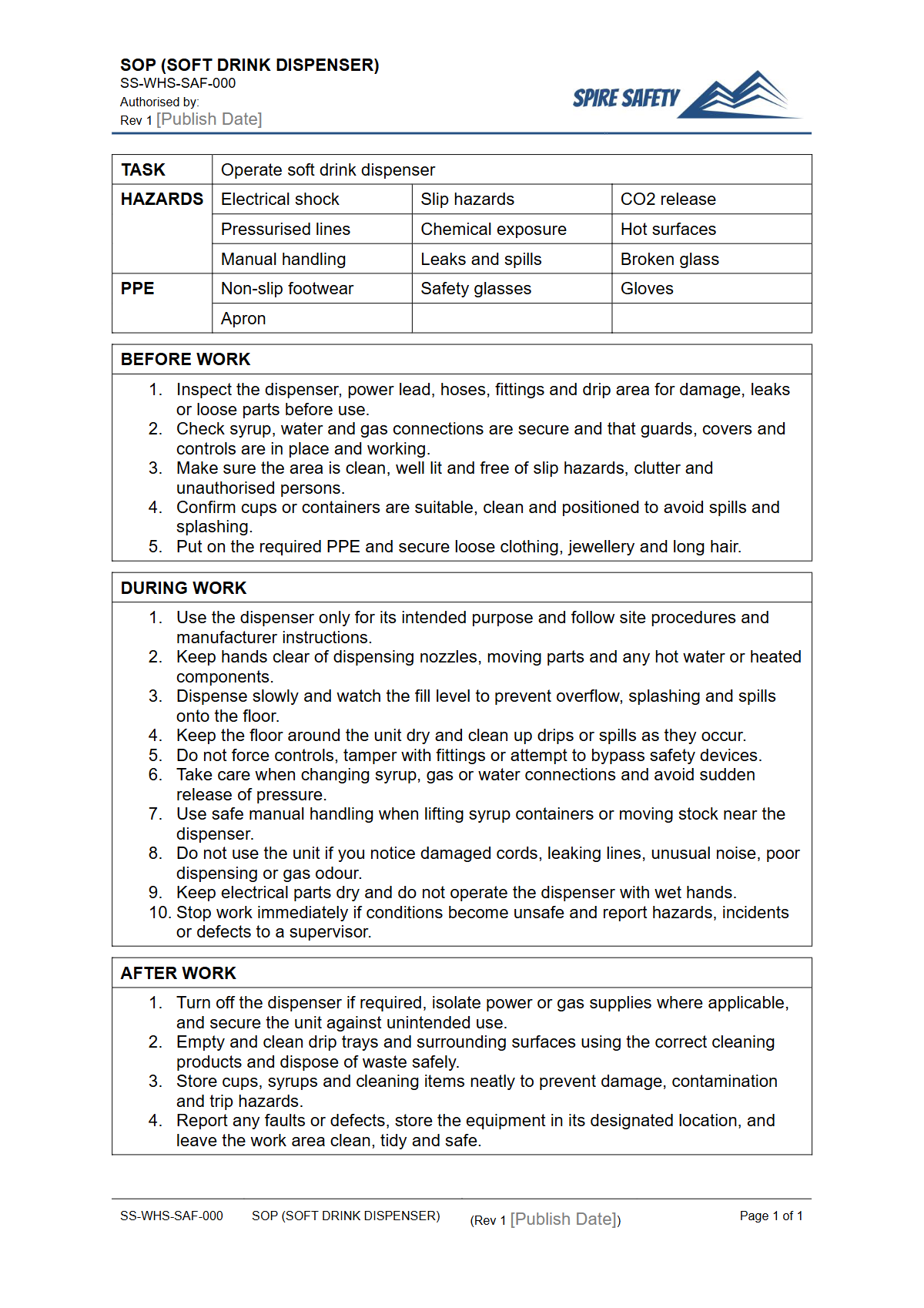
The primary purpose of this Safe Operating Procedure for a soft drink dispenser is to provide a clear, step-by-step guide for operators. It helps standardise tasks like daily setup, operation, cleaning, changing syrup boxes, and replacing CO2 cylinders.
By formalising these steps, you can minimise the risk of injury and property damage. The template prompts you to consider specific hazards, such as electrical shock from wet environments, musculoskeletal injuries from lifting heavy syrup boxes (Bag-in-Box), and exposure to CO2 in enclosed spaces. It forms an essential part of a safe system of work, similar to procedures for other common hospitality equipment like our Safe Operating Procedure for a Deep Fryer.
Video walkthrough
How to use the Free Safe Operating Procedure (Soft Drink Dispenser) Template
Download the template in your preferred format (DOCX for easy editing or PDF) and adapt it to your specific equipment and workplace environment. It is crucial to conduct a site-specific risk assessment to identify all relevant hazards and control measures.
The template includes sections for pre-operational checks, operational steps, post-operational shutdown, cleaning, and emergency procedures.
Important: This is a template, not a finished document. We have drafted it to align with Australian WHS principles, but you must customise it with your specific details, including machine model numbers, workplace rules, chemical information for cleaning agents, and emergency contact numbers.
A generic procedure is not sufficient to ensure safety. Integrating tailored SOPs into your overall safety framework is a key function of effective WHS management systems.
When to use it
A Safe Operating Procedure for a soft drink dispenser should be used in several key situations. It is an essential tool for inducting and training new employees, ensuring they learn the correct, safe method from day one.
It should also be used for refresher training for existing staff to prevent complacency. The SOP serves as a benchmark for competency and can be referenced during daily operations if a worker is unsure of a step.
It is also a critical document to review after any incident or near-miss involving the equipment, helping to identify and rectify gaps in the procedure. Consistent procedures for all equipment, including cleaning apparatus like those covered in our Free Floor Scrubber Operation SOP, create a holistic safety culture.
Who should use it
This SOP template is designed for use by Persons Conducting a Business or Undertaking (PCBUs), managers, and supervisors in industries like hospitality, food service, and entertainment. WHS managers or safety officers can use it to develop and implement standardised procedures across one or multiple sites.
Team leaders and venue managers are responsible for ensuring the finalised SOP is communicated to all relevant workers and that training is conducted and recorded. Workers who operate, clean, or maintain the soft drink dispenser are the end-users of the document and should be consulted during its development to ensure it is practical and reflects how the task is actually performed.
Regular reviews of these documents can be incorporated into your schedule of WHS compliance auditing to ensure they remain current.
By establishing and enforcing a clear SOP, you create a safer environment for everyone. This structured approach not only helps in meeting WHS duties but also improves operational efficiency and consistency. For more templates and safety resources covering a wide range of tasks and equipment, browse our complete free WHS resources library.
Common mistakes
Common mistakes to avoid
- Using the template without customising it for the specific dispenser model and workplace.
- Failing to provide hands-on training, assuming staff will just read the document.
- Neglecting to include safety data sheet (SDS) information for cleaning chemicals.
- Storing heavy 'Bag-in-Box' syrup containers above shoulder height, creating manual handling risks.
Legal references
Legal considerations
The following legal requirements may be relevant to this type of work.
- Work Health and Safety Act (Harmonised) — Provides the primary duties for protecting workers and other people from work health and safety risks.
- Work Health and Safety Regulations (Harmonised) — Sets out requirements supporting the management of workplace hazards and risks.
The following codes may be relevant to this type of work.
- Managing WHS Risks Code of Practice — Provides practical guidance on identifying hazards, assessing risks and applying effective controls.
- Work Health and Safety Consultation, Cooperation and Coordination Code of Practice — Provides practical guidance on consulting workers and coordinating with other duty holders.
- Managing the Work Environment and Facilities Code of Practice — Provides practical guidance on safe work environments, workplace facilities and related controls.
Did you know
Pressurised Systems
The CO2 cylinders used in soft drink dispensers are high-pressure vessels. A leak in a poorly ventilated cool room or cellar can displace oxygen, creating a serious asphyxiation hazard.
Hospitality Hazards
Slips, trips, and falls are the second most common cause of serious workers' compensation claims in the Australian accommodation and food services industry, often caused by liquid spills.
FAQ
Frequently asked questions
01What should be included in a soft drink dispenser SOP?
02Is a Safe Operating Procedure legally required for a soft drink dispenser in Australia?
03How often should I review the Safe Operating Procedure for my soft drink dispenser?
04Can this template be used for other beverage dispensers?
Share this resource
Free Safe Operating Procedure (Soft Drink Dispenser) Template
Browse Categories
How To Use It
- 1Download and open in Word or PDF.
- 2Replace the placeholders with your business details.
- 3Get it reviewed by a WHS specialist before rollout.
Need it customised?
Our WHS consultants can adapt this template to your site, run a gap analysis, or audit what you already have in place.
Book a Free Consultation WHS consulting servicesor call 1300 156 382
Related templates
- Free Safe Operating Procedure (Soft Serve Machine) Template
- Free Safe Operating Procedure (Soil Amendment Mixing) Template
- Free Safe Operating Procedure (Soil Compaction Test) Template
- Free Safe Operating Procedure (Soil Sampling) Template
- Free Safe Operating Procedure (Soiled Linen Trolley) Template
- Free Safe Operating Procedure (Solar Inverter Service) Template