
Free Safe Operating Procedure (Smoke Detector Test) Template
Download our free Safe Operating Procedure (Smoke Detector Test) Template. This structured document helps you outline key safety steps.
Free Safe Operating Procedure (Smoke Detector Test) Template
DOCX • 126 KB + PDF
Updated Oct 2026
No signup required
Purpose of the Free Safe Operating Procedure (Smoke Detector Test) Template
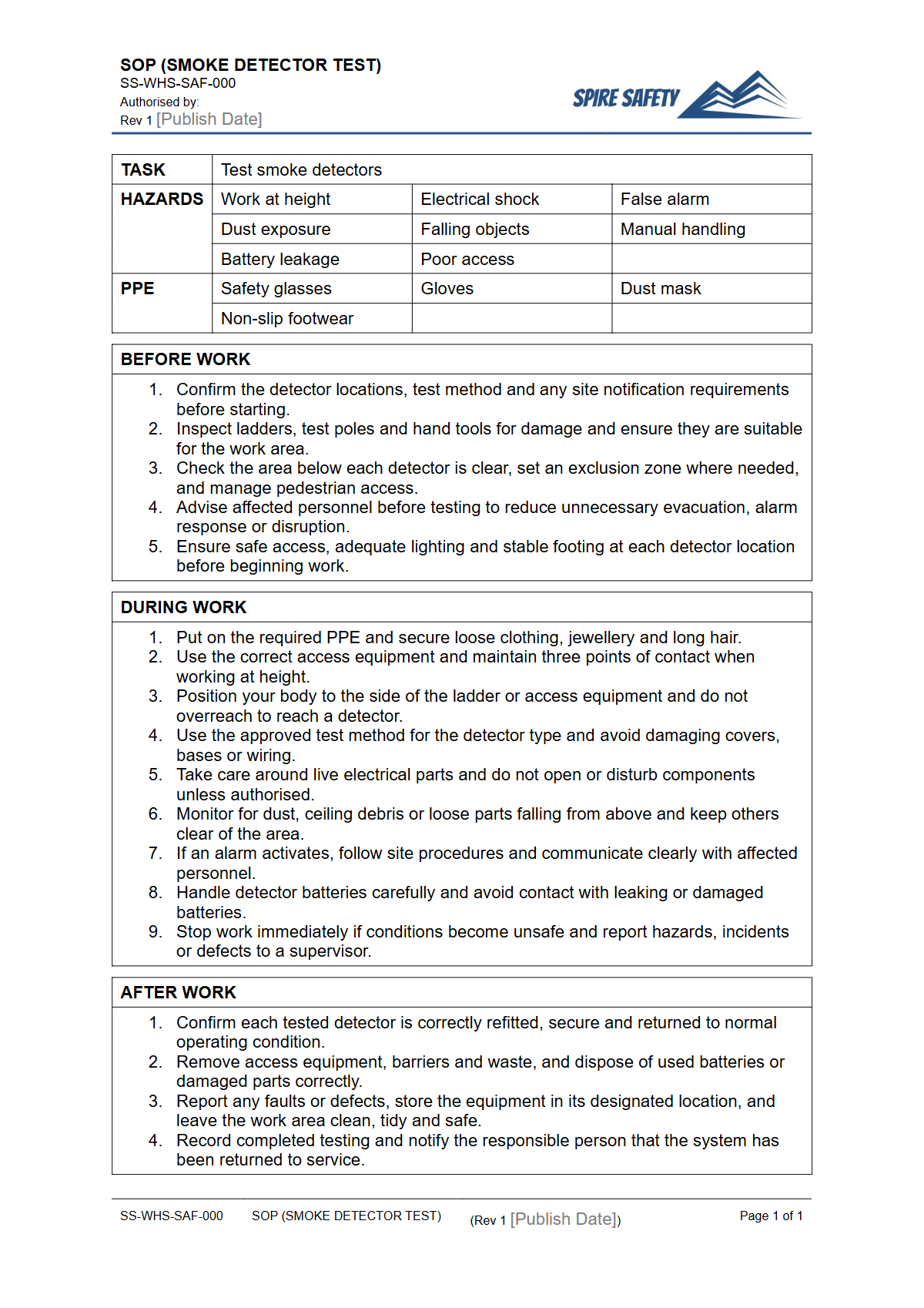
Regularly testing smoke detectors is a critical component of any organisation's fire safety plan and WHS obligations. This free Safe Operating Procedure (Smoke Detector Test) Template provides a structured framework for outlining the required steps to perform these tests safely and consistently.
It guides workers through the process, covering pre-operational checks, the step-by-step testing sequence, and post-task clean-up. A well-defined SOP minimises risks associated with working at heights, handling equipment, and ensures that every test is documented correctly, forming a vital part of your safety records.
Using this template helps formalise a routine but essential task, ensuring it is not overlooked. It prompts the identification of hazards such as electrical risks or manual handling issues when accessing hard-to-reach units.
By standardising the process, you improve reliability and ensure that all detectors across your facility are checked to the same standard. This procedure should be integrated into your broader safety framework, which might also include documents like our free SOP for floor scrubber operation for other facility maintenance tasks.
Video walkthrough
How to use the Free Safe Operating Procedure (Smoke Detector Test) Template
This Safe Operating Procedure for smoke detector testing is available for download as a DOCX file for easy editing and a PDF for straightforward distribution. The template is designed to be a comprehensive starting point, aligned with Australian WHS principles, but it must be adapted to your specific operational context.
It is crucial to review every section and add, remove, or modify content to reflect the exact equipment, environment, and hazards present in your workplace.
You will need to fill in site-specific information, including the types of smoke detectors used, their locations, the personal protective equipment (PPE) required, and your organisation’s emergency contacts. This customisation is a key step in fulfilling your duty of care.
For businesses in the hospitality sector, this process is similar to adapting our deep fryer SOP to a specific kitchen layout and model.
Important Note
This is a template that you must customise to reflect the specific equipment, environment, and risks in your workplace. Spire Safety is not liable for the outcomes of its use.
Your final document should be reviewed by key stakeholders and approved by management before being implemented.
When to use it
A Safe Operating Procedure for smoke detector testing should be used whenever a scheduled test is due. Australian standards generally require monthly push-button tests and annual checks by a competent person.
This SOP should be referenced during every test to ensure no steps are missed. It's also valuable to use this procedure after a building has undergone maintenance, after a power outage, or if there is any reason to suspect a detector may have been damaged or compromised.
Consistent use of the SOP ensures a reliable safety system and a clear audit trail.
Furthermore, this document serves as a crucial training tool for new employees or for refresher training for existing staff. Incorporating this SOP into your induction process ensures that from day one, workers understand the correct and safe method for this task.
The effectiveness of your procedures can be verified through regular WHS compliance audits, which check that documented processes are being followed correctly in practice.
Who should use it
This SOP is intended for any person responsible for maintaining workplace safety and fire prevention systems. This typically includes facility managers, maintenance personnel, WHS officers, and any other workers assigned the task of testing smoke detectors.
All personnel using this procedure should be deemed competent, meaning they have received adequate information, instruction, and training on how to perform the test safely. For more complex systems or tests, this may require specialised training or engaging a qualified fire safety professional.
Supervisors and managers should also be familiar with this SOP to ensure they can oversee the work and confirm it is being completed in accordance with the documented procedure. The ultimate goal is to build a comprehensive WHS management system where every task, from routine checks to complex operations, is governed by a clear and safe process.
Similar task-specific documents, like our free Air Compressor SOP, help build out this system for other common workplace equipment.
By implementing and consistently following a tailored SOP, your organisation demonstrates a proactive approach to fire safety and WHS compliance. You can find more templates and checklists to support your safety goals in our extensive free WHS resources library.
Common mistakes
Common mistakes to avoid
- Forgetting to notify the fire monitoring company before testing, leading to a false alarm and potential call-out fees.
- Using a real smoke source (like a candle or incense) that can damage the detector's sensor or leave a residue.
- Neglecting to clean dust and cobwebs from the detector, which can impede smoke entry or cause false alarms.
- Failing to document the test results, creating gaps in compliance records for audits or incident investigations.
Legal references
Legal considerations
The following legal requirements may be relevant to this type of work.
- Work Health and Safety Act (Harmonised) — Provides the primary duties for protecting workers and other people from work health and safety risks.
- Work Health and Safety Regulations (Harmonised) — Sets out requirements supporting the management of workplace hazards and risks.
The following codes may be relevant to this type of work.
- Managing WHS Risks Code of Practice — Provides practical guidance on identifying hazards, assessing risks and applying effective controls.
- Work Health and Safety Consultation, Cooperation and Coordination Code of Practice — Provides practical guidance on consulting workers and coordinating with other duty holders.
- Managing the Work Environment and Facilities Code of Practice — Provides practical guidance on safe work environments, workplace facilities and related controls.
Did you know
Battery Lifespan
Most smoke detector manufacturers recommend replacing the entire unit every 10 years, regardless of whether it seems to be working. The sensors inside degrade over time, reducing their effectiveness.
The 'Test' Button
Pressing the 'test' button on a smoke detector only confirms that the battery and alarm circuit are working. It does not test the smoke sensor's ability to detect smoke, which is why periodic professional testing is also recommended.
FAQ
Frequently asked questions
01How often should smoke detectors be tested in an Australian workplace?
02What's the difference between an ionisation and a photoelectric smoke detector?
03Is this SOP template enough to meet my legal WHS obligations?
04What PPE is needed for testing a smoke detector?
Share this resource
Free Safe Operating Procedure (Smoke Detector Test) Template
Browse Categories
How To Use It
- 1Download and open in Word or PDF.
- 2Replace the placeholders with your business details.
- 3Get it reviewed by a WHS specialist before rollout.
Need it customised?
Our WHS consultants can adapt this template to your site, run a gap analysis, or audit what you already have in place.
Book a Free Consultation WHS consulting servicesor call 1300 156 382
Related templates
- Free Safe Operating Procedure (Smoke Machine) Template
- Free Safe Operating Procedure (Smoke Stain Removal) Template
- Free Safe Operating Procedure (Snorkel Equipment) Template
- Free Safe Operating Procedure (Soccer Goal Inspection) Template
- Free Safe Operating Procedure (Soda Dispenser Cleaning) Template
- Free Safe Operating Procedure (Soft Drink Dispenser) Template