
Free Safe Operating Procedure (Soccer Goal Inspection) Template
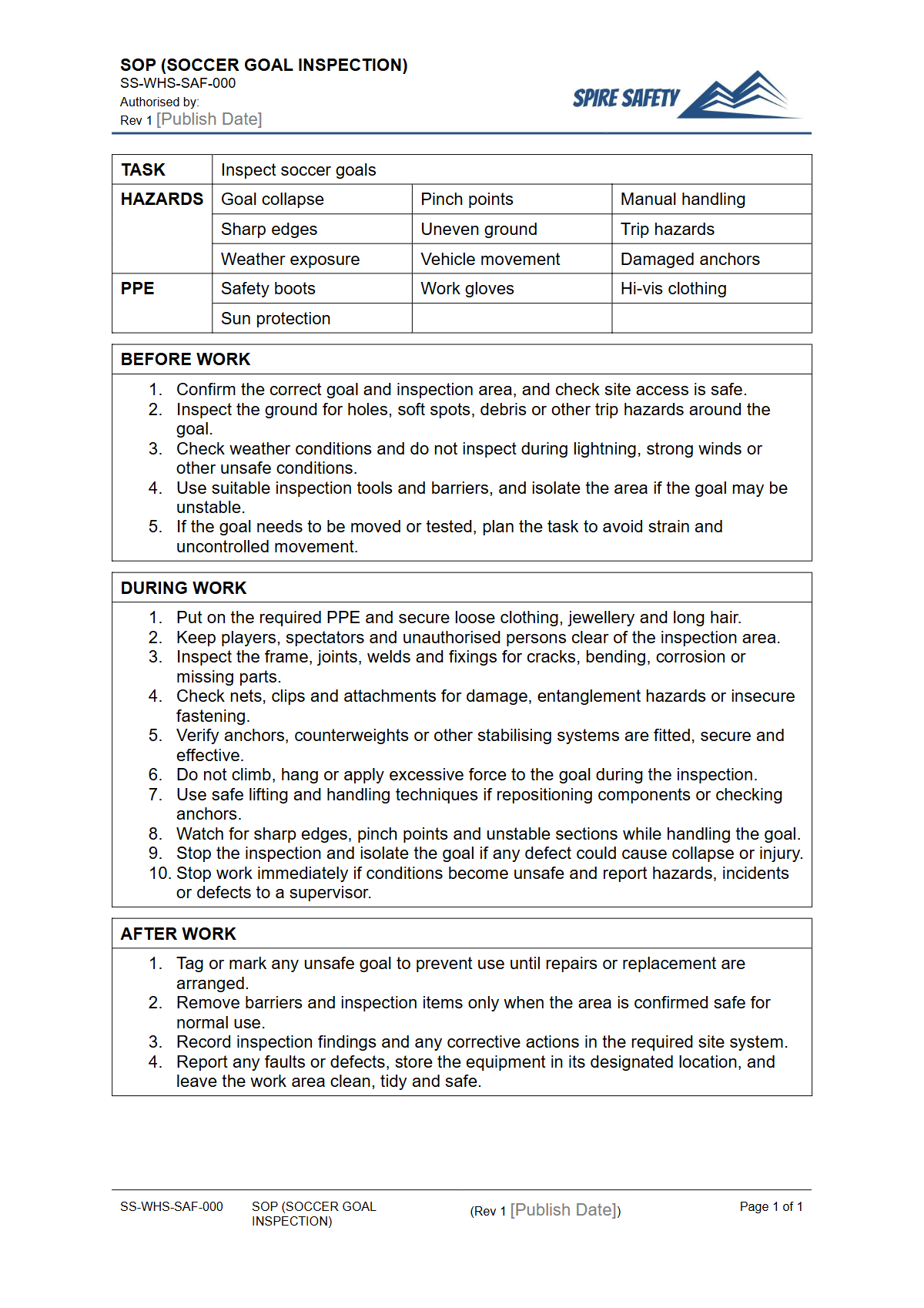
Download our free Safe Operating Procedure for soccer goal inspections. This template helps you document safety checks to prevent accidents and ensure stability.
Free Safe Operating Procedure (Soccer Goal Inspection) Template
DOCX • 126 KB + PDF
Updated Oct 2026
No signup required
Purpose of the Free Safe Operating Procedure (Soccer Goal Inspection) Template
Unsecured or poorly maintained soccer goals pose a significant and often underestimated risk of serious injury or death, particularly to children. This Free Safe Operating Procedure (Soccer Goal Inspection) Template provides a structured framework for organisations like schools, local councils, and sporting clubs to formalise their inspection process.
Documenting regular checks helps a Person Conducting a Business or Undertaking (PCBU) demonstrate due diligence in managing risks associated with sports equipment. Using a formal SOP ensures inspections are consistent, thorough, and recorded, forming a critical component of your overall safety management approach.
By implementing a clear procedure, you can proactively identify hazards such as rust, missing parts, or inadequate anchoring before an incident occurs. This SOP is designed as a practical tool to integrate into your broader WHS management systems, helping to create a safer environment for players, staff, and the public.
Video walkthrough
How to use the Free Safe Operating Procedure (Soccer Goal Inspection) Template
This template is available for download as a DOCX file for easy customisation or as a PDF for immediate use. Your primary goal should be to adapt the document to the specific context of your facility.
This includes listing the exact types of goals you use (e.g., portable aluminium, fixed steel), the surfaces they are used on (grass, synthetic turf), and the specific anchoring methods required for each.
Customisation is essential
It is crucial to remember that this is a template. We have provided a solid starting point aligned with Australian WHS principles, but you must customise it to reflect the specific equipment, ground conditions, and operational context of your club, school, or council.
Fill in the required fields, add site-specific details, and remove any sections that are not relevant to your operations. Regular reviews of this SOP are also recommended as part of your internal safety review cycle, a process that can be verified through formal WHS compliance auditing.
When to use a Soccer Goal Inspection SOP
A Safe Operating Procedure for soccer goal inspection should be used as part of a multi-tiered safety schedule. Its use should be mandated at several key intervals to ensure ongoing safety:
- Before each use: A quick visual check should be performed by a coach or groundskeeper before any training session or match.
- Weekly: A more detailed, documented inspection should occur as part of a regular maintenance schedule.
- Pre-season and post-season: Comprehensive inspections should be conducted at the beginning and end of the soccer season to check for weathering, structural fatigue, or damage from storage.
- After severe weather events: High winds or heavy rain can affect goal stability and ground conditions, necessitating an immediate inspection.
- Following any incident or relocation: If a goal has been struck, moved, or involved in any near-miss, a full inspection must be performed.
This process of routine, documented checks is fundamental to many facility management tasks. A similar methodical approach is detailed in our Safe Operating Procedure for Floor Scrubber Operation, which also relies on pre-use checks for safety.
Who should use this SOP
This SOP is intended for any person responsible for the setup, maintenance, and safety of sporting grounds. The specific roles may vary between organisations, but typically include:
- Groundskeepers and maintenance staff
- Facility or Venue Managers
- School Principals and designated WHS officers
- Sporting club Presidents, committee members, and nominated volunteers
- Coaches and team managers responsible for pre-game checks
Ultimately, the PCBU holds the primary duty of care to ensure the SOP is implemented, and that all personnel involved are competent and trained in the procedure. If your organisation lacks the internal expertise to correctly assess structural risks or develop robust safety procedures, engaging external WHS consulting services can provide the necessary guidance and support.
This template is one of many tools designed to assist organisations in managing their safety obligations. You can explore a wide range of similar documents for other tasks and equipment in our free WHS resources library.
Common mistakes
Common mistakes to avoid
- Failing to use anchors or sufficient counterweights on portable goals.
- Relying on informal, undocumented 'visual checks' instead of a formal inspection checklist.
- Allowing children or adults to swing, climb, or hang from the crossbar or frame.
- Continuing to use goals with visible signs of rust, damage, or missing fasteners.
Legal references
Legal considerations
The following legal requirements may be relevant to this type of work.
- Work Health and Safety Act (Harmonised) — Provides the primary duties for protecting workers and other people from work health and safety risks.
- Work Health and Safety Regulations (Harmonised) — Sets out requirements supporting the management of workplace hazards and risks.
The following codes may be relevant to this type of work.
- Managing WHS Risks Code of Practice — Provides practical guidance on identifying hazards, assessing risks and applying effective controls.
- Work Health and Safety Consultation, Cooperation and Coordination Code of Practice — Provides practical guidance on consulting workers and coordinating with other duty holders.
- Managing the Work Environment and Facilities Code of Practice — Provides practical guidance on safe work environments, workplace facilities and related controls.
Did you know
Tip-Over Risk
According to various international studies and coronial findings, almost all fatalities involving soccer goals are caused by non-anchored or improperly secured goals tipping over.
Australian Standard
The Australian Standard AS 4866.1-2007 outlines specific design, construction, and performance requirements for soccer goals to prevent incidents like head and neck entrapment or structural failure.
FAQ
Frequently asked questions
01What should be included in a soccer goal inspection?
02How often should soccer goals be inspected?
03Are portable soccer goals more dangerous?
04Who is responsible for inspecting soccer goals in Australia?
Share this resource
Free Safe Operating Procedure (Soccer Goal Inspection) Template
Browse Categories
How To Use It
- 1Download and open in Word or PDF.
- 2Replace the placeholders with your business details.
- 3Get it reviewed by a WHS specialist before rollout.
Need it customised?
Our WHS consultants can adapt this template to your site, run a gap analysis, or audit what you already have in place.
Book a Free Consultation WHS consulting servicesor call 1300 156 382
Related templates
- Free Safe Operating Procedure (Soda Dispenser Cleaning) Template
- Free Safe Operating Procedure (Soft Drink Dispenser) Template
- Free Safe Operating Procedure (Soft Serve Machine) Template
- Free Safe Operating Procedure (Soil Amendment Mixing) Template
- Free Safe Operating Procedure (Soil Compaction Test) Template
- Free Safe Operating Procedure (Soil Sampling) Template